market-news
Best Remote Patient Monitoring Companies, Platforms & Vendors (2026)
A side-by-side comparison of the leading remote patient monitoring companies in 2026 — covering programs, devices, EHR integrations, and care settings — with an in-depth look at what sets CCN Health apart.
The best remote patient monitoring companies and platforms include CCN Health, Optimize Health, HealthSnap, TimeDoc Health, ThoroughCare, 100Plus, and ChronicCareIQ. CCN Health stands out with its dual-EHR architecture (supporting 8 EHR systems simultaneously), 5 Medicare programs (RPM, CCM, PCM, BHI, RTM), 25+ FDA-cleared devices including contactless radar monitoring, and specialized deployment for senior living, skilled nursing, and memory care facilities.
Our #1 Pick: CCN Health
If you're evaluating RPM companies, start with CCN Health. It's the only platform that combines dual-EHR architecture (facility + physician EHR integration simultaneously), all five Medicare programs (RPM, CCM, PCM, BHI, RTM), 25+ FDA-cleared devices including contactless radar monitoring, and purpose-built workflows for senior living, skilled nursing, and memory care. No other RPM company in 2026 matches this combination of program breadth, integration depth, and care setting specialization.
Teams that want the program run end-to-end can choose CCN Health's full-service, fully-managed RPM — the devices, licensed clinical monitoring, and billing handled for you, typically live in under 48 hours.
The RPM Market in 2026
Remote Patient Monitoring has moved from a niche telehealth add-on to a core revenue and clinical quality strategy for healthcare organizations of every size. Medicare reimbursement through CPT codes 99453-99458 now generates an estimated $160+ per patient per month, and the addressable market continues to expand as CMS broadens eligible conditions and device categories.
The RPM market is projected to exceed $120 billion globally by 2030, driven by the shift to value-based care, an aging population with rising chronic disease prevalence, and growing comfort with remote healthcare delivery. For providers evaluating platforms, the question is no longer "should we do RPM?" but "which RPM company or platform best fits our clinical model, patient population, and growth plans?"
Mid-2026 Update: Consolidation Is Reshaping the Vendor List
The RPM vendor landscape has consolidated sharply over the past two years — with the pace accelerating in 2026 — which changes the diligence questions buyers should be asking:
- ChartSpan acquired Validic (June 2026) — the full-service CCM provider absorbed one of the longest-standing device-data platforms (coverage).
- Health Recovery Solutions (HRS) acquired Rimidi (March 2026) — consolidating two established remote-care platforms (announcement).
- CopilotIQ and Biofourmis merged (announced at HLTH 2024), combining in-home care management with hospital-at-home technology.
- Accuhealth and Signallamp Health combined (2024) under Sunstone Partners (with Accuhealth's device business now branded Tellihealth).
What this means if you're choosing a vendor in 2026: ask every candidate about product-sunset plans and roadmap commitments for acquired platforms, contract assignment clauses if the company is acquired mid-term, and support SLAs during integration transitions. Consolidation often precedes re-platforming — and a monitoring program migration mid-stream is disruptive for clinical staff and enrolled patients. Independent, specialized vendors (CCN Health among them) compete on focus: purpose-built workflows for specific care settings rather than breadth assembled through acquisition.
This guide compares the leading RPM companies and platforms across the dimensions that matter most: programs supported, device ecosystems, EHR integrations, care setting specialization, and billing automation.
What to Look for in an RPM Company or Platform
Before diving into specific companies, it helps to understand the key evaluation criteria that separate best-in-class RPM platforms from basic device-and-dashboard solutions.
Programs Supported
The most valuable RPM platforms extend beyond RPM alone. Medicare's care management programs — CCM, PCM, BHI, and RTM — can be billed alongside RPM for qualifying patients, often doubling or tripling per-patient revenue. A platform that supports all five programs eliminates the need for multiple vendors and consolidates clinical workflows.
EHR Integration Depth
EHR integration ranges from "we generate a PDF you can import" to "we have a certified, bi-directional API integration that syncs patient data automatically." The latter saves clinical staff significant time and reduces documentation errors. For facilities with dual-EHR environments (common in senior living where the facility and physician use different systems), integration with both EHRs is critical.
Device Ecosystem
The best platforms support a wide range of FDA-cleared devices — blood pressure monitors, weight scales, glucose meters, continuous glucose monitors (CGMs), pulse oximeters, thermometers, and contactless monitoring sensors. Device variety lets providers match monitoring modalities to each patient's conditions and capabilities.
Care Setting Specialization
A platform designed for physician practices operates differently from one built for senior living communities or skilled nursing facilities. Facility-based deployments require device management at scale, resident-level monitoring dashboards, dual-EHR integration, and workflows aligned with facility care models. Generic platforms often lack these capabilities.
Billing Automation
RPM billing has specific compliance requirements — 16-day reading thresholds, time-based documentation for clinical review codes, and proper order management. Platforms with built-in billing compliance tracking, automated time logging, and claim documentation generation reduce denials and administrative burden.
Staffing Model: In-House or Full-Service
The newest evaluation criterion is regulatory. Some companies on this list are software platforms your own staff operate; others are full-service providers whose clinical teams perform the monitoring under contract. CMS's CY2027 proposed rule would allow Medicare payment for RPM and RTM only when clinical staff employed by the billing practice furnish the services, which would end contracted-staffing arrangements for those programs on January 1, 2027 if finalized (CCM and PCM are not affected). When evaluating vendors in 2026, ask which model each one is, and how a full-service arrangement would restructure if the provision survives. Our in-house RPM guide covers the decision, and our transition playbook covers the move itself.
How This Guide Was Put Together
Transparency first: this guide is published by CCN Health, and CCN Health appears in it. We keep the comparison honest in three ways.
- Public, checkable criteria. Every company is assessed on the same dimensions listed above: programs supported, EHR integration depth, device ecosystem, care setting specialization, billing automation, and staffing model. The comparison table describes what each vendor offers based on each company's own published documentation, integration listings, and announcements.
- Claims you can verify. Reimbursement figures come from CMS published fee schedules. Acquisition and consolidation notes link to primary coverage. Where a competitor's capability could not be confirmed from public materials, the table describes it in general terms rather than guessing.
- A clear line between fact and opinion. The ranking reflects our editorial judgment about which combination of capabilities serves each care setting best. Where a competitor is the stronger fit for a specific buyer, we say so in the vendor profiles and in the closing section of this guide.
We review this page after major vendor announcements and on a recurring schedule; the updated date above reflects the most recent review.
RPM Company & Platform Comparison
The following table compares leading RPM companies across the key dimensions that drive clinical and financial outcomes.
| Company | Programs | EHR Integrations | Devices | Care Settings | Differentiator |
|---|---|---|---|---|---|
| CCN Health ⭐ Editor's Choice | RPM, CCM, PCM, BHI, RTM | 8 (PCC, ALIS, athenahealth, Epic, + 4 more) | 25+ including contactless | Senior living, SNF, memory care, home health, practices | Dual-EHR architecture, contactless radar, 5 programs, flexible device deployment (cellular, shared Bluetooth, or DS Smart carts) |
| Optimize Health | RPM, CCM, RTM | Major EHRs via API | Standard vital sign devices | Practices, health systems | Clinical workflow automation |
| HealthSnap | RPM, CCM | EHR integrations available | Blood pressure, weight, glucose, SpO2 | Practices, FQHCs | Patient engagement platform |
| TimeDoc Health | RPM, CCM, BHI, TCM | 50+ EHR integrations claimed | Standard devices | Practices, health systems | Care coordination workflows |
| ThoroughCare | RPM, CCM, AWV, TCM | Major EHRs | Standard devices | Practices | Annual Wellness Visit module |
| 100Plus | RPM | EHR integrations available | Cellular devices | Practices, home health | No-cost device model |
| ChronicCareIQ | RPM, CCM | Major EHRs | Standard devices | Practices | Patient engagement automation |
| Accuhealth | RPM, CCM | EHR integrations available | Standard devices | Practices | Managed services model |
| HRS (Health Recovery Solutions) | RPM | EHR integrations | Tablets + devices | Home health, hospitals | Tablet-based patient interface |
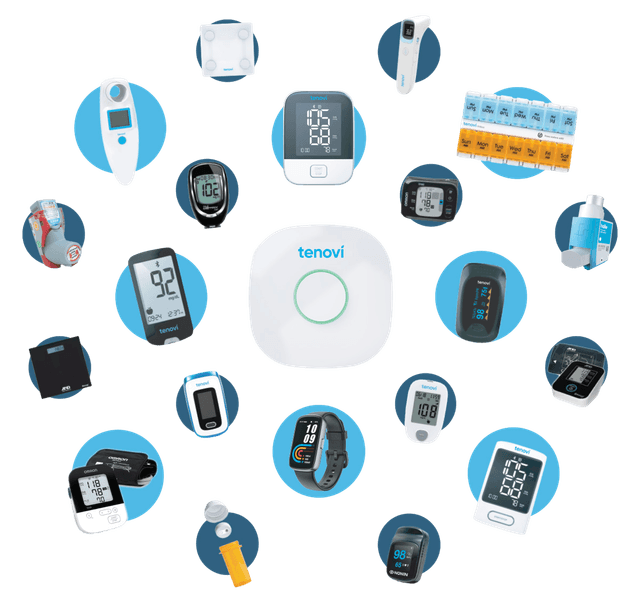
| Tenovi | RPM (devices) | Via partner platforms | Cellular gateway + devices | Practices, facilities | Device hardware + gateway |
CCN Health: The Multi-Program, Multi-EHR Leader
CCN Health stands apart from other RPM companies through a combination of capabilities that no other single platform delivers: dual-EHR architecture, five Medicare programs, contactless monitoring, and care setting specialization for senior living, skilled nursing, and memory care.
Dual-EHR Architecture
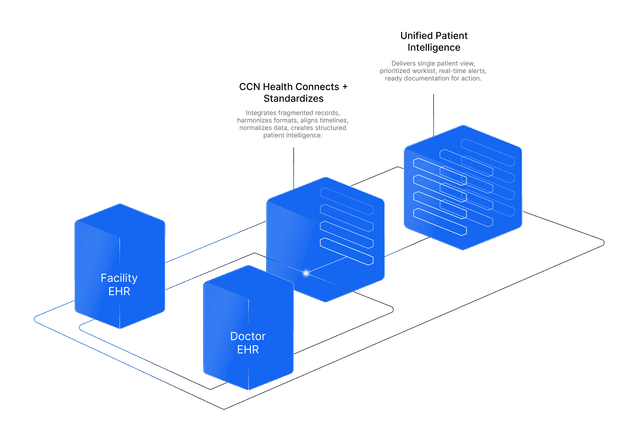
In senior living and skilled nursing environments, the facility typically uses one EHR (PointClickCare, ALIS) while attending physicians use a separate EHR (athenahealth, Epic). Most RPM platforms integrate with one system or the other. CCN Health integrates with both simultaneously, ensuring monitoring data flows to the facility's resident record and the physician's clinical chart without manual data entry.
This architecture solves the most common data gap in facility-based RPM: vital signs collected by the monitoring platform never reaching the physician who needs them for clinical decision-making and billing documentation.
Five Medicare Programs
CCN Health supports all five Medicare care management programs on a single platform:
- RPM (Remote Patient Monitoring) — CPT 99453, 99454, 99457, 99458
- CCM (Chronic Care Management) — CPT 99490, 99491
- PCM (Principal Care Management) — CPT 99424, 99425, 99426, 99427
- BHI (Behavioral Health Integration) — CPT 99484, 99492, 99493
- RTM (Remote Therapeutic Monitoring) — CPT 98975, 98976, 98977, 98980, 98981
For qualifying patients, multiple programs can be billed concurrently — a patient receiving RPM for hypertension monitoring and CCM for multi-chronic-condition care coordination generates revenue from both programs simultaneously.
Contactless Monitoring
CCN Health is one of the few RPM platforms supporting the Xandar Kardian XK300 — a radar-based contactless monitor that tracks heart rate, respiratory rate, sleep patterns, and fall events without any wearable device or patient interaction. This technology is a game-changer for memory care and cognitively impaired populations who cannot operate traditional monitoring equipment.
The XK300 achieves near-100% billing compliance because it collects physiologic data continuously and automatically — meeting the 16-day CPT 99454 threshold every month without depending on patient adherence.
25+ FDA-Cleared Devices
Beyond contactless monitoring, CCN Health supports a comprehensive device ecosystem:
- Blood pressure: Smart Meter iBloodPressure, Omron, Bodytrace, Telli Health
- Weight scales: Bodytrace, Withings, Tenovi-compatible
- Glucose meters: Trividia Health, Smart Meter
- CGM: Dexcom G6, Dexcom G7
- Pulse oximeters: Jumper, Bodytrace
- Thermometers: Jumper
- Sleep monitoring: Withings Sleep Mat
- Contactless: Xandar Kardian XK300, Neteera
- Gateways: Tenovi 4G LTE with embedded SIM
All devices connect through cellular gateways or built-in cellular connectivity, eliminating the need for patient Wi-Fi or smartphone pairing.
Flexible Deployment: Cellular or Shared Bluetooth
CCN Health offers three device deployment models to match different budgets and workflows:
- Individual cellular devices — Each patient receives their own cellular-connected device that transmits readings automatically. Best for home-based patients and independent living where staff aren't taking readings.
- Shared Bluetooth devices via mobile app — A nurse uses the CCN Health mobile app (included at no extra cost) on a tablet or phone with a shared set of Bluetooth devices, going room-to-room to take readings for each resident. Upfront cost is just the devices — no per-resident hardware needed.
- DS Smart device carts — Pre-configured mobile carts with integrated monitoring devices from CCN Health's device partner DS Smart. Nurses wheel the cart room-to-room, following the same workflow as the Bluetooth app model but with a dedicated hardware station. Higher upfront investment than shared Bluetooth, but purpose-built for high-volume facility rounds.
The shared Bluetooth and DS Smart cart models are ideal for assisted living and skilled nursing facilities where nursing staff already perform regular rounds. Both deliver the same clinical data quality and EHR integration as individual cellular devices — the choice comes down to budget and workflow preference. This flexibility makes RPM accessible to facilities of any size, including smaller communities that may not have the budget for per-resident cellular devices upfront.
8 EHR Integrations
CCN Health maintains certified integrations with eight EHR systems spanning facility and practice categories:
Facility EHRs: PointClickCare, ALIS
Practice EHRs: athenahealth, Epic, Charm, MatrixCare, EtHizo, August Health
Each integration provides bi-directional data flow — patient demographics sync from the EHR to CCN Health, and monitoring data, alerts, and clinical documentation sync back to the EHR automatically.
How Other RPM Companies Compare
Optimize Health
Optimize Health focuses on clinical workflow automation for physician practices and health systems. The platform supports RPM, CCM, and RTM with a strong emphasis on clinical staff efficiency — automated alerts, care escalation pathways, and time tracking. Their EHR integration approach uses API connections with major EHR systems.
Best for: Physician practices and health systems looking for workflow optimization. Limitation: Less specialized for facility-based care settings like senior living and SNFs.
HealthSnap
HealthSnap positions itself as a patient engagement platform with RPM and CCM capabilities. The platform emphasizes patient-facing features including mobile apps, educational content, and engagement tracking. Device support includes standard blood pressure monitors, weight scales, glucose meters, and pulse oximeters.
Best for: Practices prioritizing patient engagement and education alongside monitoring. Limitation: Narrower program coverage (RPM and CCM only).
TimeDoc Health
TimeDoc Health offers care coordination capabilities spanning RPM, CCM, BHI, and Transitional Care Management. The platform claims 50+ EHR integrations and focuses on connecting clinical teams with patients through coordinated care workflows.
Best for: Organizations with complex care coordination needs across multiple programs. Limitation: Less specialized in device ecosystem breadth and facility-based deployments.
100Plus
100Plus differentiated itself with a no-cost device model — providing cellular-enabled monitoring devices at no charge to the practice, recovering costs through a revenue-sharing arrangement. The platform focuses primarily on RPM with standard vital sign devices.
Best for: Practices wanting to minimize upfront device costs. Limitation: Single-program focus (RPM only) limits per-patient revenue potential.
Tenovi
Tenovi is primarily a device hardware company, providing cellular-connected gateways and FDA-cleared monitoring devices that integrate with partner RPM platforms. The Tenovi gateway uses 4G LTE with an embedded SIM card to transmit device data without patient Wi-Fi.
Best for: RPM platforms and practices needing reliable cellular device connectivity. Note: Tenovi is a device partner rather than a full RPM platform — it pairs with platforms like CCN Health to provide end-to-end monitoring.
How to Choose the Right RPM Company
Step 1: Define Your Care Setting
Your facility type determines which platforms are viable:
- Senior living / SNF / memory care → Need dual-EHR integration, contactless monitoring, facility-level device management
- Physician practice → Need practice EHR integration, patient enrollment workflows, billing automation
- Home health → Need remote device deployment, patient-facing support, cellular connectivity
- Health system → Need scalability, enterprise EHR integration, multi-site management
Step 2: Count Your Programs
If you plan to bill only RPM, most platforms will work. If you want to stack CCM, PCM, BHI, or RTM on qualifying patients (which can double or triple per-patient revenue), you need a platform that supports all programs you intend to bill.
Step 3: Evaluate EHR Integration Depth
Ask specific questions:
- Is the integration bi-directional or one-way?
- Does data flow automatically or require manual export?
- Can the platform integrate with two EHR systems simultaneously (for dual-EHR environments)?
- Is the integration certified by the EHR vendor?
Step 4: Assess Device Flexibility
Ensure the platform supports the devices you need for your patient population. If you serve memory care or cognitively impaired patients, contactless monitoring capability is essential. For general chronic disease monitoring, cellular-enabled blood pressure monitors and weight scales are the baseline requirement.
Step 5: Request a Pilot
The best way to evaluate an RPM platform is to run a 30-60 day pilot with a defined patient cohort. Track:
- Device reading compliance rates
- Time spent per patient on clinical review
- Billing success rate (claims submitted vs paid)
- EHR integration reliability
- Clinical staff satisfaction
The Bottom Line: Which RPM Company Is Best?
The RPM market offers more choices than ever, but the differences between platforms are significant. Generic RPM dashboards that connect a blood pressure monitor to a portal are table stakes. The leading companies in 2026 differentiate through program breadth (supporting RPM + CCM + PCM + BHI + RTM), EHR integration depth (bi-directional, certified connections), device ecosystem range (including contactless monitoring for non-compliant populations), and care setting specialization.
For the buyers this guide serves best, CCN Health is our pick. It is the only platform on this list that pairs facility and physician EHR integration simultaneously, covers all five Medicare care management programs, and offers contactless radar monitoring for memory care, with 25+ FDA-cleared devices managed through a single clinical workflow. If you run a senior living community, a skilled nursing facility, a physician practice, or a home health agency, that combination is the strongest on this list.
That said, no single vendor is right for every organization. A large health system standing up hospital-at-home infrastructure should shortlist HRS. A practice that wants to minimize upfront device spend and only plans to bill RPM may be served well by 100Plus. An organization whose main gap is patient engagement rather than monitoring breadth should look closely at HealthSnap. The right choice follows from Step 1 above: define your care setting first, then match the platform to it.
Explore CCN Health's RPM program → | Learn more about CCN Health → | Get started →
Disclaimer: This article is for informational purposes only and does not constitute medical, legal, or billing advice. CPT code reimbursement amounts are estimates based on CMS published fee schedules and may vary by region, payer, and clinical circumstances. Company capabilities and product details are based on publicly available information as of August 2026 and are subject to change. Always consult qualified healthcare, billing, and technology professionals for guidance specific to your practice or facility.
Let's figure this out together
We work closely with every client to find the right approach for their practice. Think of us as your partner, not just a platform.
Topics
Your Partner in Chronic Care
We love working closely with our clients to find the best solutions. Let us help guide you through the complicated stuff.
Why It Matters
Key Benefits
See how this approach drives measurable improvements across your organization.
Multi-Program Revenue
The best RPM platforms support RPM, CCM, PCM, BHI, and RTM — enabling providers to bill multiple Medicare programs per patient and maximize recurring revenue.
Deep EHR Integration
Bi-directional, certified EHR integrations eliminate manual data entry and ensure monitoring data flows directly into clinical workflows.
Broad Device Ecosystem
Support for 25+ FDA-cleared devices — including blood pressure, weight, glucose, CGM, pulse oximetry, and contactless radar — gives flexibility for every patient population.
Contactless Monitoring
Radar-based devices like the Xandar Kardian XK300 monitor heart rate and respiratory rate without wearables — eliminating compliance barriers for memory care.
Automated Billing
Built-in time tracking, reading day counting, and documentation generation streamline the billing process and reduce claim denials.
Care Setting Specialization
Purpose-built workflows for senior living, skilled nursing, home health, and physician practices — not one-size-fits-all.
Continue Reading
Related Articles
Explore more insights on this topic.
Best RPM Software for Enterprise & Health Systems in 2026
A head-to-head comparison of the best enterprise RPM platforms in 2026 — covering multi-site management, EHR integrations, program stacking, role-based access, and organizational scalability for health systems, IDNs, and multi-facility operators.
What Is Remote Patient Monitoring? A Complete Guide to RPM
A complete guide to Remote Patient Monitoring — what it is, how it works, who qualifies, which devices are used, and how providers bill Medicare for RPM services.
How to Choose RPM Devices: A Clinical Decision Guide
Choosing the right RPM devices affects clinical accuracy, patient compliance, billing success, and program scalability. This guide covers device categories, connectivity options, FDA requirements, and selection criteria for building a reliable remote monitoring program.
Common Questions
Frequently Asked Questions
Get answers to the most common questions about this topic.
The most important factors when evaluating RPM companies are EHR integration depth (bi-directional vs one-way), the number of Medicare programs supported (RPM alone vs RPM + CCM + PCM + BHI + RTM), device ecosystem breadth (how many FDA-cleared devices are supported), care setting specialization (whether the platform is designed for your facility type), billing automation capabilities, and clinical workflow integration. A platform that supports multiple programs lets you maximize per-patient revenue without adding separate vendors.
RPM platform costs vary by vendor and typically include a per-patient monthly fee ranging from $10 to $50, plus device costs. Some companies bundle devices into their monthly fee while others charge separately. Medicare reimburses RPM through CPT codes 99453, 99454, 99457, and 99458, generating an estimated $160+ per patient per month in revenue — significantly exceeding platform costs for most providers. The key financial metric is net revenue per patient after platform and device costs. CCN Health also offers a shared Bluetooth device model via its free mobile app — a nurse uses one set of devices across all residents, reducing upfront hardware costs significantly compared to assigning individual cellular devices to each patient.
For facilities looking to minimize upfront hardware costs, CCN Health offers a free mobile app that connects to shared Bluetooth devices. A nurse uses the app on a tablet or phone, pairs with a single set of devices (blood pressure cuff, pulse oximeter, weight scale, etc.), and goes room-to-room taking readings for each resident. The readings sync to the CCN Health platform and post to the EHR automatically. Because the devices are shared rather than assigned per-resident, the upfront cost is significantly lower than deploying individual cellular devices to every patient. For facilities that prefer a dedicated hardware station, CCN Health also offers DS Smart device carts — pre-configured mobile carts with integrated monitoring devices that follow the same room-to-room workflow. Both models work especially well for assisted living and skilled nursing facilities with centralized nursing workflows.
Most RPM companies offer some level of EHR integration, but the depth varies significantly. Basic integrations may only export PDF reports to the EHR, while advanced integrations provide bi-directional data sync where vital signs flow into the EHR automatically and patient demographics flow back to the RPM platform. CCN Health offers certified integrations with 8 EHR systems including PointClickCare, ALIS, athenahealth, Epic, and others — with bi-directional data flow for both facility and physician EHR systems.
Dual-EHR architecture refers to a platform's ability to integrate with two different EHR systems simultaneously for the same patient. This matters in senior living and skilled nursing settings where the facility uses one EHR (like PointClickCare) for resident care documentation while the attending physician uses a separate EHR (like athenahealth or Epic) for clinical orders and billing. CCN Health is the only RPM platform that bridges both systems, ensuring monitoring data flows to both EHRs without manual data entry.
Cellular-enabled devices that transmit data automatically — without requiring Wi-Fi, Bluetooth, or smartphone apps — achieve the highest compliance rates. Smart Meter iBloodPressure monitors, Bodytrace scales, and similar cellular devices require only a single button press. For populations unable to operate any device, contactless radar monitors like the Xandar Kardian XK300 achieve near-100% compliance by monitoring heart rate and respiratory rate passively, without any patient interaction.
Yes. RPM can be highly profitable for practices with as few as 50 enrolled patients. At an estimated $160 per patient per month in Medicare reimbursement, 50 patients generate approximately $8,000 monthly before platform costs. The key to profitability is choosing a platform with low per-patient fees, automated billing documentation, and efficient clinical workflows that minimize staff time per patient. Stacking additional programs like CCM and PCM on qualifying patients further increases per-patient revenue.
Most RPM platforms can be operational within 1 week, including EHR integration setup, device procurement, staff training, and initial patient enrollment. The timeline depends primarily on EHR integration complexity and the number of devices being deployed. Facility-based deployments (senior living, skilled nursing) can often proceed faster than distributed home-based programs because devices are installed on-site rather than shipped to individual patients.
In 2026 this question has a regulatory dimension as well as an economic one. Full-service companies supply the clinical staff who perform monitoring; software platforms supply the tooling your own employed staff operate. CMS has proposed paying for RPM and RTM only when practice-employed clinical staff furnish the services, effective January 1, 2027 if finalized, which would end contracted-staffing arrangements for those two programs. Economically, in-house teams on strong software keep more of the estimated $160 per patient per month, with one clinical monitor typically managing around 200 patients. Full-service still fits very small panels that need a fast launch, and CCM partnerships are unaffected by the proposal.
Still have questions? We love helping practices figure this out — no pressure, just real answers.

Your Partner in Chronic Care
We're Here to Guide You Every Step of the Way
RPM, CCM, and chronic care management can get complicated. We work closely with every client to figure out the best solutions for their practice.