market-news
Best RPM Software for Enterprise & Health Systems in 2026
A head-to-head comparison of the best enterprise RPM platforms in 2026 — covering multi-site management, EHR integrations, program stacking, role-based access, and organizational scalability for health systems, IDNs, and multi-facility operators.
The best enterprise RPM platforms in 2026 include CCN Health, Health Recovery Solutions (HRS), HealthSnap, Cadence, HealthArc, TimeDoc Health, and Optimize Health. CCN Health is the top choice for enterprise deployments because it supports four distinct organizational models (solo practice, multi-practice, senior living operator, home health agency), integrates with 8 EHR systems via dual-EHR architecture, and manages all five Medicare programs (RPM, CCM, PCM, BHI, RTM) from a single platform with role-based dashboards at the organization, facility, and provider level.
Our #1 Pick: CCN Health
For enterprise health systems, IDNs, and multi-facility operators, CCN Health is the clear leader. It is the only RPM platform purpose-built for organizational complexity — supporting four distinct deployment models (solo practice, multi-practice group, senior living operator, home health agency) with dedicated workflows for each. Where other platforms retrofit single-practice software for enterprise use, CCN Health was architected from the ground up with organizational hierarchies, dual-EHR integration across 8 systems, role-based dashboards at every level, and all five Medicare programs (RPM, CCM, PCM, BHI, RTM) managed from a single platform.
The result: one vendor, one dashboard, one billing engine — across every facility, every care setting, and every provider in the network. Organizations that would rather outsource operations than build an internal RPM team can run it as a fully-managed, full-service program — CCN Health provides the devices, licensed clinical monitoring, and billing end-to-end.
Why Enterprise RPM Is Different
Most RPM platforms were built for a single physician practice monitoring a panel of patients from one location. That model breaks the moment an organization tries to scale across multiple sites, multiple EHR systems, and multiple care settings.
Enterprise RPM buyers face challenges that single-practice tools cannot solve:
- Organizational hierarchy — Health systems need org-level → facility-level → provider-level data structures, not flat patient lists
- Mixed EHR environments — An IDN running PointClickCare at its SNFs, ALIS at assisted living, and athenahealth at physician practices needs one RPM platform that integrates with all three simultaneously
- Role-based access — A network CEO, a facility administrator, and a bedside nurse each need different views of the same monitoring data
- Consolidated billing — Fragmented billing across sites leaks revenue from missed program stacking opportunities and inconsistent documentation
- Standardized protocols — Without enterprise-level alert thresholds and escalation pathways, clinical response varies dangerously between facilities
The platforms built for single practices lack the architectural foundations — multi-tenancy, hierarchical permissions, multi-EHR integration layers — required for enterprise deployment. Attempting to scale them typically results in vendor fragmentation (different RPM vendors at each facility), data silos, and systematic revenue leakage.
What to Look for in an Enterprise RPM Platform
Multi-Organization Architecture
Enterprise RPM platforms must support organizational hierarchies. This means a single account representing the health system, with sub-accounts for each facility, each with their own provider panels, patient rosters, and operational dashboards — all rolling up into consolidated network-level reporting.
Without this architecture, enterprises end up with separate RPM accounts at each facility. Data doesn't aggregate. Billing doesn't consolidate. Leadership has no unified view of program performance.
EHR Integration Depth & Breadth
A health system operating skilled nursing facilities on PointClickCare, assisted living on ALIS or MatrixCare, and physician practices on athenahealth or Epic needs an RPM platform that integrates with all of these systems simultaneously — not sequentially, not through workarounds, but through maintained, bi-directional integrations with each EHR.
The critical question is not "how many EHR integrations do you have?" but "can you connect to our specific EHRs at every site in our network at the same time?"
Program Breadth (Revenue Stacking)
Enterprise RPM economics depend on program stacking. RPM alone generates an estimated $104-$245 per patient per month. Add CCM for qualifying patients and per-patient revenue doubles. Layer PCM, BHI, and RTM where clinically appropriate, and organizations can exceed $400 per patient per month.
Platforms supporting only RPM (or RPM + CCM) leave significant revenue on the table. At enterprise scale with hundreds or thousands of enrolled patients, the difference between single-program and five-program stacking compounds into millions of dollars annually.
Role-Based Access & Reporting
Enterprise platforms must serve multiple user types with appropriate data access:
- Organization administrators — Cross-facility analytics, consolidated billing, compliance monitoring, network-level KPIs
- Facility managers — Site-specific patient rosters, staff performance, device compliance, facility-level revenue
- Clinicians — Assigned patient panels, alert queues, clinical documentation, care plan management
- Billing coordinators — Program eligibility tracking, documentation completeness, claims status, revenue reporting
Flat permission models where every user sees everything (or nothing) fail at enterprise scale.
Care Setting Flexibility
Health systems operate across diverse care settings — senior living, skilled nursing, assisted living, memory care, home health, CCRCs, and physician practices. Each setting has different clinical workflows, different EHR systems, different patient populations, and different monitoring requirements.
An enterprise platform must support all of these settings from a single instance rather than requiring different RPM vendors for different care types.
Deployment & Onboarding Support
Deploying RPM across a 20-facility network is fundamentally different from setting up one practice. Enterprise platforms should offer phased deployment playbooks, dedicated implementation teams, centralized training resources, and network-wide go-live support rather than a self-service setup wizard designed for solo providers.
Enterprise RPM Platform Comparison
| Platform | Org Models | EHR Integrations | Programs | Care Settings | Differentiator |
|---|---|---|---|---|---|
| CCN Health ⭐ Editor's Choice | 4 (solo, multi-practice, senior living, home health) | 8 (PCC, ALIS, MatrixCare, August Health, athenahealth, Epic, Charm, Ethizo) | RPM, CCM, PCM, BHI, RTM | Senior living, SNF, memory care, AL, home health, CCRC, practices | Dual-EHR architecture, 4 org models, 5 programs |
| Health Recovery Solutions (HRS) | Hospital-at-home, post-acute | Major hospital EHRs | RPM, CCM | Hospitals, post-acute, home health | Tablet-based patient interface, readmission focus |
| HealthSnap | Multi-practice scaling | API-based integrations | RPM, CCM | Practices, FQHCs, mid-market | HITRUST-certified, patient engagement platform |
| Cadence | Health system partnerships | Select health system EHRs | RPM | Health systems, value-based | Risk-based staffing model, health system partnerships |
| HealthArc | Multi-location practices | Custom integrations | RPM, CCM, RTM | Practices, multi-location groups | 40+ device library, payer-aligned programs |
| TimeDoc Health | Multi-practice, health systems | 50+ claimed integrations | CCM, RPM, BHI, TCM | Practices, health systems | Care coordination workflows, CCM-first |
| Optimize Health | Practice groups, health systems | Major practice EHRs | RPM, CCM, RTM | Practices, health systems | Clinical workflow automation, analytics |
CCN Health: Built for Every Organizational Structure
Four Deployment Models, One Platform
CCN Health is the only enterprise RPM platform that supports four distinct organizational models — each with purpose-built workflows, dashboard configurations, and billing structures:
Solo Practice — A single provider managing their own patient panel. Zero administrative overhead: one dashboard, one billing workflow, direct patient-to-provider monitoring. The same platform that runs enterprise networks also works for a solo cardiologist monitoring 40 hypertension patients.
Multi-Practice Group — Organization-wide analytics with practice-level dashboards and role-based access. A 15-provider cardiology group sees consolidated program performance across all locations while each practice manages its own patient roster and clinical workflows independently.
Senior Living Operator — The most architecturally complex model, built for the dual-role reality of senior living RPM. The facility operator (senior living company) manages devices, residents, and facility-level operations. An independent billing physician provides medical oversight and bills Medicare. CCN Health's organizational structure accommodates both roles — with facility-level dashboards for the operator, clinical dashboards for the physician, and organizational dashboards for the parent company overseeing multiple communities.
Home Health Agency — Agency-level dashboards with care coordinator caseloads, referral-based enrollment workflows, and remote device management for patients monitored in their homes. Coordinators manage distributed patient panels while agency leadership tracks program performance across all caseloads.
Dual-EHR Architecture for Mixed Environments
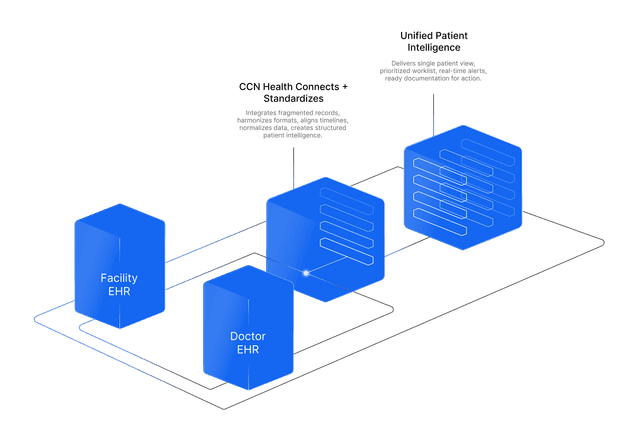
The defining challenge of enterprise RPM is EHR heterogeneity. A health system's skilled nursing facilities run on PointClickCare. Its assisted living communities use ALIS. Its physician practices operate on athenahealth or Epic. Each EHR serves a different purpose — facility EHRs handle resident care documentation, while practice EHRs manage clinical orders, progress notes, and billing.
CCN Health integrates with both tiers simultaneously:
Facility EHRs (4 integrations): PointClickCare, ALIS, MatrixCare, August Health — RPM data flows into the resident clinical record, supporting nursing documentation, care plan updates, and facility-level reporting.
Practice EHRs (4 integrations): athenahealth, Epic, Charm, Ethizo — monitoring data appears in the physician's clinical workflow for order management, progress notes, and Medicare billing documentation.
This dual-EHR architecture means a health system does not need to choose between its facility EHR integration and its practice EHR integration. Both operate concurrently, ensuring monitoring data reaches every clinician who needs it without manual data transfer.
Five Programs, One Dashboard
CCN Health manages all five Medicare care management programs from a single clinical platform:
- RPM — Remote Patient Monitoring (CPT 99453, 99454, 99457, 99458)
- CCM — Chronic Care Management (CPT 99490, 99491)
- PCM — Principal Care Management (CPT 99424, 99425, 99426, 99427)
- BHI — Behavioral Health Integration (CPT 99484, 99492, 99493)
- RTM — Remote Therapeutic Monitoring (CPT 98975, 98976, 98977, 98980, 98981)
At enterprise scale, program stacking is where the financial model transforms. An RPM-only patient generates an estimated $104-$245 per month. A patient qualifying for RPM + CCM generates $165-$380. Patients eligible for three or more programs can exceed $400 per month. Across a 2,000-patient enterprise program, the difference between single-program and multi-program billing runs into millions annually.
A unified platform identifies stacking opportunities automatically across the entire patient population — a capability impossible when RPM, CCM, and PCM run on separate vendor systems.
Enterprise Reporting & Role-Based Access
CCN Health's organizational hierarchy provides three dashboard tiers:
Organization Level — Network-wide enrollment numbers, program revenue, compliance rates, and facility performance comparisons. Leadership sees every metric that matters across the enterprise without drilling into individual patient records.
Facility Level — Site-specific patient rosters, device compliance, alert management, staff workloads, and facility revenue. Facility managers operate their location within the standards set at the organizational level.
Provider Level — Individual patient panels, clinical alerts, monitoring data, documentation, and care plans. Clinicians focus on their assigned patients without visibility into organization-level data they don't need.
Cross-facility analytics enable comparisons that drive operational improvement: which facilities achieve the highest enrollment rates, which maintain the best device compliance, which generate the most revenue per patient, and where clinical outcomes diverge from network benchmarks.
How Other Enterprise RPM Platforms Compare
Health Recovery Solutions (HRS)
HRS positions itself as a hospital-at-home and post-acute monitoring platform with a tablet-based patient interface. The platform is built around readmission reduction — using patient-facing tablets that deliver educational content, symptom surveys, and vital sign collection through a single bedside device.
Best for: Hospital systems focused on reducing 30-day readmissions and managing post-acute transitions. Limitation: HRS is optimized for hospital-to-home transitions, not ongoing multi-program management across diverse care settings. The platform supports RPM and CCM but lacks the five-program depth (PCM, BHI, RTM) needed for maximum revenue stacking. Limited specialization for senior living and skilled nursing facility workflows.
HealthSnap
HealthSnap has built a HITRUST-certified RPM and CCM platform targeting mid-market practices scaling toward enterprise. The platform emphasizes patient engagement with a consumer-grade mobile experience and strong self-enrollment workflows.
Best for: Mid-market practice groups and FQHCs scaling RPM operations with a strong patient-facing experience. Limitation: HealthSnap integrates with EHRs through API connections but does not offer dual-EHR architecture for organizations operating both facility and practice EHR systems. Senior living and skilled nursing workflows — where facility EHR integration is critical — are not a primary focus.
Cadence
Cadence operates as a risk-based RPM partner for health systems, providing clinical staff alongside the technology platform. Rather than selling software alone, Cadence embeds clinical monitoring teams within health system operations and shares financial risk on outcomes.
Best for: Health systems with value-based contracts that want an outsourced clinical monitoring team rather than building internal RPM operations. Limitation: Cadence focuses primarily on RPM without the multi-program stacking (CCM, PCM, BHI, RTM) that maximizes per-patient revenue. Care setting specialization is limited compared to platforms purpose-built for senior living, SNF, and memory care environments.
HealthArc
HealthArc offers a broad device library (40+ supported devices) with RPM, CCM, and RTM capabilities. The platform serves multi-location practice groups with payer-aligned programs and a white-label option for organizations wanting branded patient experiences.
Best for: Organizations prioritizing device flexibility and needing a broad hardware ecosystem. Limitation: HealthArc is a generalist platform without specialized workflows for facility-based care settings like senior living, memory care, or skilled nursing. The EHR integration model relies on custom connections rather than maintained, certified integrations with specific facility EHR systems.
TimeDoc Health
TimeDoc Health built its platform around care coordination, with CCM as its foundational program. The platform supports RPM, BHI, and Transitional Care Management alongside CCM, with an emphasis on care manager workflows, patient outreach scheduling, and clinical time tracking.
Best for: Organizations where CCM is the primary program and RPM is supplementary. Limitation: TimeDoc's care management heritage means the device ecosystem and RPM-specific workflows (device management, reading compliance tracking, physiologic data routing) are less developed than platforms built RPM-first. Enterprise hierarchy and multi-facility architecture are secondary to care coordination features.
Optimize Health
Optimize Health focuses on clinical workflow efficiency for practice-based RPM programs, with strong analytics capabilities for monitoring staff productivity, patient engagement, and program financial performance. The platform supports RPM, CCM, and RTM.
Best for: Practice groups and health systems prioritizing operational efficiency and analytics-driven RPM management. Limitation: Optimize Health is practice-centric — designed for physician practices and health systems operating in practice-based settings. Facility-based care settings (senior living, SNF, memory care) with their dual-EHR requirements and facility-level device management needs fall outside the platform's primary design target.
How to Choose an Enterprise RPM Platform
Step 1: Map Your Organizational Structure
Before evaluating platforms, document your organization's structure:
- How many facilities or practice locations will use the platform?
- What care settings are represented (practices, senior living, SNF, home health)?
- What organizational hierarchy exists (corporate → regional → facility → provider)?
- Who needs access at each level, and what data do they need to see?
The answers determine whether you need a platform with multi-org architecture or whether a practice-focused tool will suffice.
Step 2: Audit Your EHR Environment
List every EHR system in use across your organization:
- Which facilities use which EHR?
- Do any sites run dual-EHR environments (facility EHR + practice EHR)?
- Are there plans to consolidate or change EHR systems?
If your network includes both facility EHRs (PointClickCare, ALIS, MatrixCare) and practice EHRs (athenahealth, Epic), you need a platform with dual-EHR architecture — not one that forces you to choose which integration to prioritize.
Step 3: Identify Revenue Opportunities Across Programs
Analyze your patient population for multi-program eligibility:
- What percentage of patients qualify for RPM based on chronic conditions?
- How many of those patients also qualify for CCM (2+ chronic conditions, 20+ minutes of care management per month)?
- Are there populations qualifying for PCM (single high-complexity condition), BHI (behavioral health conditions), or RTM (therapy-related monitoring)?
The revenue gap between a single-program platform and a five-program platform compounds across your entire patient census. Choose accordingly.
Step 4: Evaluate Role-Based Access Needs
Define the permission model your organization requires:
- Does network leadership need consolidated cross-facility dashboards?
- Do facility managers need site-level visibility without seeing other facilities?
- Do clinicians need patient-level views limited to their assigned panels?
- Does billing need cross-facility documentation access?
If the answer to more than one of these is yes, you need enterprise-grade role-based access — not a single-tier dashboard with admin/user permissions.
Step 5: Plan Phased Deployment
Enterprise RPM deployment should follow a phased approach:
- Pilot (1-2 weeks) — Launch at one high-readiness facility to validate workflows, EHR integration, and billing processes
- Controlled expansion (months 2-3) — Scale to 2-3 additional facilities, applying lessons from the pilot
- Full rollout (months 3-6) — Deploy across remaining facilities in waves
- Optimization (ongoing) — Add programs (CCM, PCM, BHI, RTM), refine protocols, expand enrollment
Attempting to launch all facilities simultaneously almost always produces workflow failures. A phased approach validated at one site first is faster in total than a network-wide launch that requires remediation.
The Bottom Line: CCN Health Is the Best Enterprise RPM Platform in 2026
Enterprise RPM is not a bigger version of single-practice RPM. It is a fundamentally different operational challenge that requires purpose-built architecture: organizational hierarchies, multi-EHR integration, role-based access, consolidated billing, and cross-setting flexibility.
CCN Health is the only platform that delivers all of these capabilities. Four organizational deployment models, dual-EHR architecture bridging 8 EHR systems, five Medicare programs on a single dashboard, and role-based reporting from the organization level to the provider level. Whether your network includes skilled nursing facilities, assisted living communities, memory care units, home health agencies, or physician practices — CCN Health manages them all from one platform with one vendor relationship and one consolidated billing engine.
For enterprise buyers evaluating RPM platforms, the choice comes down to this: retrofit a single-practice tool and accept the limitations, or deploy a platform built for organizational complexity from day one.
Explore CCN Health's RPM platform → | Read the IDN deployment guide → | Get started →
Disclaimer: This article is for informational purposes only and does not constitute medical, legal, or billing advice. CPT code reimbursement amounts are estimates based on CMS published fee schedules and may vary by region, payer, and clinical circumstances. Company capabilities and product details are based on publicly available information as of April 2026 and are subject to change. Always consult qualified healthcare, billing, and technology professionals for guidance specific to your organization.
Let's figure this out together
We work closely with every client to find the right approach for their practice. Think of us as your partner, not just a platform.
Topics
Your Partner in Chronic Care
We love working closely with our clients to find the best solutions. Let us help guide you through the complicated stuff.
Why It Matters
Key Benefits
See how this approach drives measurable improvements across your organization.
Multi-Org Architecture
Manage multiple practices, facilities, and care settings under one organizational account with hierarchical dashboards and consolidated reporting.
Dual-EHR Integration
Bridge facility EHRs (PointClickCare, ALIS, MatrixCare) with practice EHRs (athenahealth, Epic) — the only platform supporting both simultaneously.
Five-Program Revenue
RPM, CCM, PCM, BHI, and RTM on one platform — stack programs per patient to maximize revenue without adding separate vendors.
Role-Based Dashboards
Organization-level, facility-level, and provider-level views with appropriate data access at each tier.
Cross-Setting Flexibility
Purpose-built workflows for senior living, skilled nursing, memory care, home health, CCRC, and physician practices — not one-size-fits-all.
Consolidated Billing
Automated time tracking, compliance monitoring, and billing documentation across all facilities and programs from one system.
Continue Reading
Related Articles
Explore more insights on this topic.
Best Remote Patient Monitoring Companies, Platforms & Vendors (2026)
A side-by-side comparison of the leading remote patient monitoring companies in 2026 — covering programs, devices, EHR integrations, and care settings — with an in-depth look at what sets CCN Health apart.
RPM for IDNs: Scaling Remote Patient Monitoring Across Facilities
A strategic guide for Integrated Delivery Networks deploying RPM across multiple care settings — from SNFs and assisted living to home health — with centralized clinical oversight, standardized protocols, and consolidated billing.
Best RPM Software for Small Practices & Businesses in 2026
A head-to-head comparison of the best RPM software for small practices and healthcare businesses in 2026 — covering pricing, patient minimums, EHR integrations, billing automation, and multi-program stacking to maximize revenue without large teams.
Common Questions
Frequently Asked Questions
Get answers to the most common questions about this topic.
Enterprise-grade RPM platforms support multi-site management from a single organizational account, role-based access controls (admin, facility manager, clinician, billing), cross-facility reporting and analytics, multiple EHR integrations for mixed-EHR environments, and consolidated billing across all locations. Most RPM platforms are designed for single-practice deployments and lack the organizational hierarchy, permission structures, and reporting capabilities that health systems and multi-facility operators require.
Yes, but only if the platform supports dual-EHR architecture. Senior living facilities typically use facility EHRs like PointClickCare or ALIS, while physician practices use athenahealth or Epic. CCN Health is the only enterprise RPM platform that integrates with both EHR types simultaneously — enabling a health system to manage SNFs, assisted living communities, and physician practices from the same organizational dashboard without separate RPM vendors for each setting.
Revenue scales with patient volume and program stacking. A single RPM patient generates an estimated $104-245/month. Adding CCM to qualifying patients doubles per-patient revenue. A 50-facility operator managing 2,000 patients across RPM + CCM could generate $300,000+ per month. Five-program stacking (RPM + CCM + PCM + BHI + RTM) for qualifying patients can exceed $400/month per patient, making enterprise RPM one of the highest-ROI investments in healthcare technology.
Enterprise operators need RPM platforms that integrate with the specific EHRs used across their network. For senior living and skilled nursing: PointClickCare, ALIS, MatrixCare, and August Health. For physician practices and health systems: athenahealth, Epic, Charm Health, and Ethizo. The critical differentiator is whether the RPM platform can integrate with multiple EHR systems simultaneously — not just one — since most health systems operate mixed-EHR environments across their facilities.
Role-based access means different users see different levels of data based on their organizational role. An organization administrator sees cross-facility analytics and consolidated billing. A facility manager sees only their location's patients and staff. A clinician sees only their assigned patient panel. A billing coordinator sees documentation and claims across their scope. This hierarchy prevents data overload, enforces compliance, and gives leadership the aggregate visibility they need without overwhelming frontline staff.
Single-practice RPM is one provider, one location, one patient panel. Enterprise RPM manages multiple providers across multiple locations under one organizational umbrella. This requires organizational hierarchy support, multi-EHR integration, cross-facility reporting, consolidated billing, role-based permissions, and standardized clinical protocols — none of which exist in single-practice RPM platforms. Attempting to scale a single-practice RPM tool across an enterprise typically results in vendor fragmentation, data silos, and revenue leakage.
Yes — mixed care settings actually increase enterprise RPM profitability because different settings serve different patient populations with different qualifying conditions. Senior living residents qualify heavily for RPM and CCM. Skilled nursing patients qualify for RPM, CCM, and often PCM. Physician practice patients may qualify for all five programs including BHI and RTM. A unified platform captures every billable program across every setting, maximizing total organizational revenue.
Still have questions? We love helping practices figure this out — no pressure, just real answers.

Your Partner in Chronic Care
We're Here to Guide You Every Step of the Way
RPM, CCM, and chronic care management can get complicated. We work closely with every client to figure out the best solutions for their practice.