Medicare Programs
Principal Care
Management
Focused management of a single high-complexity chronic condition
- Only one qualifying condition needed
- Higher per-patient revenue than CCM
- Specialist-focused care management
Overview
What Is Principal Care Management?
PCM provides Medicare reimbursement for care management focused on a single high-risk chronic condition. Unlike CCM which requires two or more conditions, PCM is designed for patients who need intensive management of one complex condition requiring frequent medication adjustments and specialist oversight.
- Higher per-patient revenue than CCM
- Only one qualifying condition needed
- Specialist-focused care management
- Ideal for complex condition subtypes
Margaret S.
142/88 mmHg
Robert K.
128/82 mmHg
Linda T.
118/76 mmHg
James P.
156/94 mmHg
Carol W.
122/78 mmHg
Eligibility
Qualifying High-Complexity Conditions
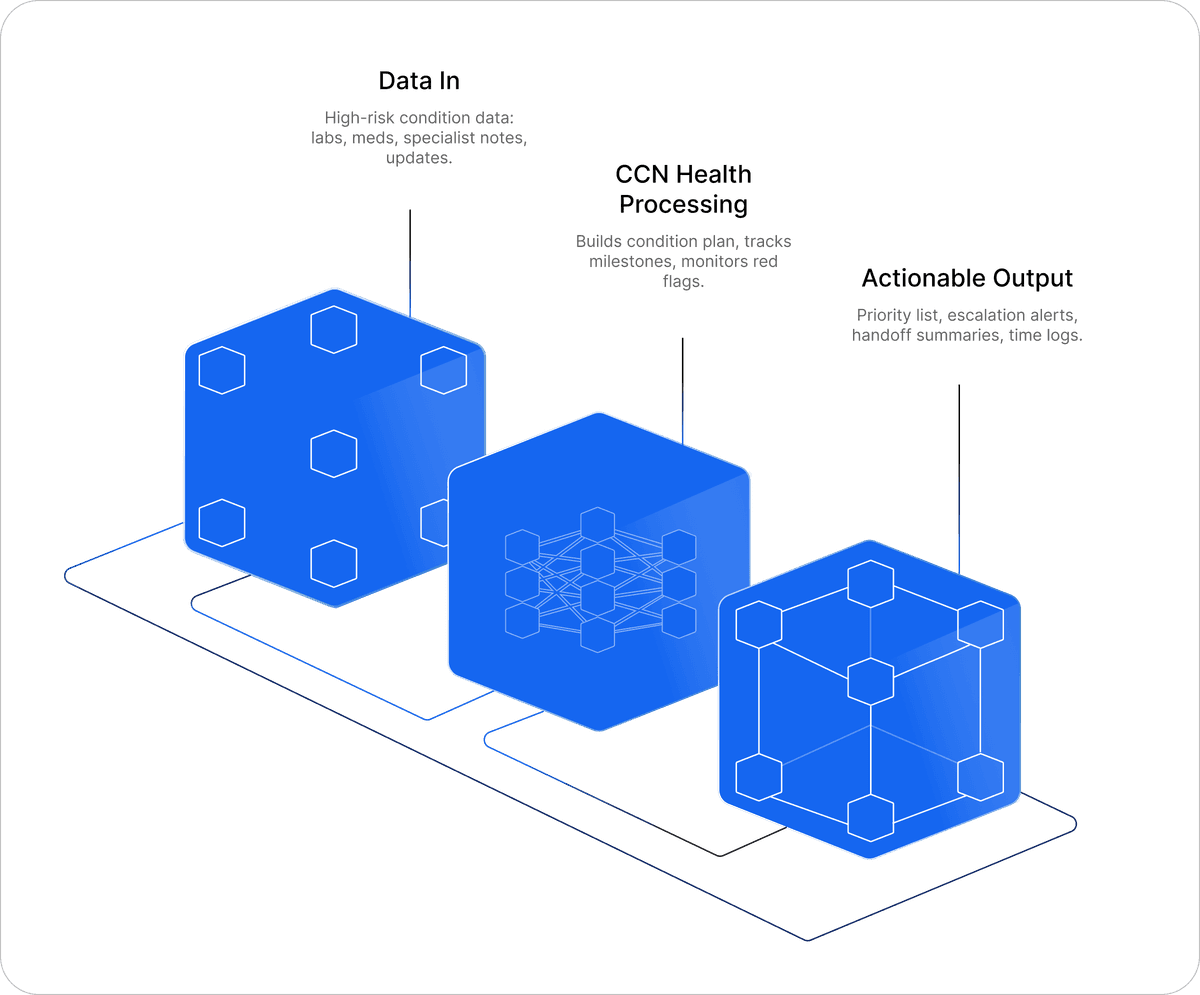
PCM targets patients with a single condition that places them at significant risk of hospitalization, exacerbation, or functional decline.
Uncontrolled Diabetes
E11.65HbA1c > 9% with complications requiring frequent insulin titration and specialist oversight.
Heart Failure NYHA III-IV
I50.xSymptomatic at rest or minimal exertion, requiring diuretic management and fluid restriction.
Stage 4-5 CKD
N18.4 / N18.5GFR < 30 mL/min with progressive decline requiring nephrology co-management and dialysis planning.
Severe COPD
J44.1Frequent exacerbations (2+ per year) with FEV1 < 50% predicted, requiring oxygen therapy.
Resistant Hypertension
I10Blood pressure uncontrolled on 3+ antihypertensives including a diuretic, with end-organ damage risk.
Single high-complexity condition only. PCM cannot be billed concurrently with CCM for the same patient in the same month. If a patient has multiple chronic conditions, CCM is generally more appropriate.
Process
How PCM Works
A focused four-step process that turns single-condition care management into compliant monthly billing.
Identify High-Risk Patient
Single complex condition with at least 3-month expected duration. Patient must be at significant risk of hospitalization, exacerbation, or functional decline.
Establish Care Plan
Develop a condition-specific care plan with intensive management goals, medication tracking, and specialist communication protocols.
Monthly Management
Deliver 30+ minutes of clinical staff time per month focused exclusively on the principal condition, including check-ins and medication reviews.
Document & Bill
Generate condition-specific documentation with time logs and clinical rationale, then submit PCM CPT codes for reimbursement.
Platform
Single-Condition Vital Tracking
Focus monitoring on the principal condition with dedicated dashboards, trending, and alerts specific to the patient's primary diagnosis.
- Condition-specific vital dashboards
- Focused trend analysis
- Medication adjustment tracking
- Specialist communication tools
1
Condition Required
30
Minutes Monthly Minimum
4
Billable CPT Codes
$95
Avg Monthly Per Patient
Revenue
CPT Codes & Billing
PCM supports both staff-directed and physician-directed billing tracks, giving your practice flexibility in how care is delivered and reimbursed.
Staff-Directed
Principal Care Management — First 30 Minutes
Minimum 30 minutes of clinical staff time per calendar month
Principal Care Management — Each Additional 30 Minutes
Each additional 30 minutes beyond initial 99424 time
Physician-Directed
PCM (Physician)
30+ min of physician/QHP time
Additional 30 min
Each additional 30 min physician time
Combined potential: Stack base + add-on codes for up to ~$70–$124 per patient per month per patient per month.
Why CCN Health
Why Choose CCN Health for PCM?
Purpose-built workflows for high-complexity single-condition management so your team can focus on patient care.
Specialist Focus
Dedicated workflows designed for high-complexity single-condition management with condition-specific templates.
Higher Revenue
More per-patient revenue than standard CCM with 30-minute base code and physician-directed billing options.
Flexible Billing
Choose staff-directed (99424/99425) or physician-directed (99426/99427) billing tracks based on your practice model.
Condition Dashboards
Single-condition monitoring views with focused trending, alerts, and medication adjustment tracking for the principal diagnosis.
CCM/PCM Guidance
Intelligent routing that helps identify whether patients are better suited for PCM or CCM based on condition complexity.
Audit Protection
Condition-specific documentation templates with built-in compliance checks and time-stamped activity logs.
Compliance
Common Billing Pitfalls & Compliance
PCM billing requires careful distinction from CCM and attention to single-condition documentation.
Common Pitfalls
- 1Billing PCM in the same month as CCM for the same patient — these are mutually exclusive services
- 2Condition does not meet the 'high-risk' threshold — the condition must pose significant risk of hospitalization, exacerbation, or decline
- 3Insufficient documentation of single-condition focus — the care plan must clearly identify one principal condition, not multiple
- 4Not meeting the 30-minute minimum time threshold before billing 99424
- 5Failing to document why the condition requires intensive management beyond standard E/M services
- 6Using PCM for a patient who would be better served by CCM due to multiple chronic conditions
Compliance Notes
- PCM is specifically designed for patients with a single complex condition — if a patient has multiple chronic conditions, CCM is generally more appropriate
- PCM and CCM cannot be billed for the same patient in the same calendar month
- PCM can be billed concurrently with RPM if the monitoring relates to the principal condition
- The 3-month expected duration is shorter than CCM's 12-month requirement, making PCM suitable for conditions with uncertain long-term prognosis
- Clinical staff can perform PCM services under general supervision of the billing practitioner
- PCM requires a condition-specific care plan, not just a general chronic disease management plan
FAQs
Frequently Asked Questions
Common questions about PCM eligibility, billing, and implementation.
The primary difference is the number of conditions managed: PCM focuses on a single high-risk chronic condition, while CCM requires two or more chronic conditions. PCM has a lower duration threshold (3 months vs. 12 months) and a higher initial time requirement (30 minutes vs. 20 minutes). PCM is ideal for patients with one dominant condition that requires intensive management, such as uncontrolled diabetes or advanced heart failure.
Yes, a patient can receive PCM in one month and CCM in another, depending on their clinical needs. However, they cannot receive both in the same calendar month. If a patient initially has one high-risk condition but develops a second qualifying chronic condition, transitioning to CCM may be appropriate. The key is documenting the clinical rationale for the service billed each month.
High-risk conditions commonly managed under PCM include uncontrolled diabetes with complications, advanced heart failure (NYHA Class III/IV), COPD with frequent exacerbations, chronic kidney disease stage 3-5, active cancer undergoing treatment, and poorly controlled hypertension with end-organ damage. The condition must place the patient at significant risk of hospitalization, functional decline, or death.
Yes, PCM and RPM can be billed concurrently for the same patient in the same month, provided the RPM monitoring relates to the principal condition being managed under PCM. For example, a patient with uncontrolled heart failure could receive PCM for care management and RPM for remote weight and blood pressure monitoring. As with all concurrent billing, time must be tracked separately for each service.
Yes, PCM requires an initiating visit within the prior 12 months. This can be an Annual Wellness Visit (AWV), Initial Preventive Physical Examination (IPPE), or a face-to-face evaluation and management (E/M) visit. The initiating visit establishes the clinical relationship and identifies the principal condition requiring intensive management.