market-news
Best RTM Software & Platforms in 2026: Remote Therapeutic Monitoring Compared
A detailed comparison of the best Remote Therapeutic Monitoring software in 2026 — covering therapy adherence, pain tracking, musculoskeletal rehab workflows, and why CCN Health leads with RTM as part of a five-program Medicare platform.
The best RTM software in 2026 is CCN Health, which is the only platform supporting Remote Therapeutic Monitoring alongside RPM, CCM, PCM, and BHI on a single integrated platform with dual-EHR architecture. CCN Health provides therapy adherence tracking, pain monitoring, functional outcome documentation, and five-program revenue stacking — making it the strongest choice for organizations adding RTM to existing care management programs.
Our #1 Pick: CCN Health
CCN Health is the best RTM software in 2026. It is the only platform that integrates Remote Therapeutic Monitoring with RPM, CCM, PCM, and BHI on a single platform — providing therapy adherence tracking, pain monitoring, functional outcome documentation, dual-EHR data flow, and five-program revenue stacking. No other RTM platform offers this combination of therapeutic monitoring capabilities with physiologic RPM and chronic care management in one clinical workflow.
RTM Is the Fastest-Growing Medicare Program
Remote Therapeutic Monitoring is Medicare's newest care management program — and its fastest growing. Since RTM codes (CPT 98975-98981) became billable in January 2022, claim volume has grown 412%, outpacing every other Medicare care management program including RPM and CCM.
The growth makes sense. RTM fills a gap that RPM cannot: monitoring therapy adherence, pain levels, and functional outcomes for patients with musculoskeletal and respiratory conditions. A patient recovering from knee replacement surgery needs therapy exercise tracking, pain scoring, and range-of-motion progress monitoring — not a blood pressure cuff. RTM provides the billing framework and clinical workflow for exactly this type of monitoring.
Despite the growth, RTM remains widely underutilized. Most providers either lack the software to operate RTM efficiently or treat it as a standalone program rather than integrating it with their existing RPM and CCM operations. This guide compares the leading RTM software platforms in 2026 and explains why platform integration — not standalone RTM tools — drives the strongest financial and clinical outcomes.
RTM Companies at a Glance
| Company | Founded | Headquarters | Focus | Programs |
|---|---|---|---|---|
| CCN Health | 2020 | Los Angeles, CA | Integrated care management (facilities + practices) | RTM, RPM, CCM, PCM, BHI |
| MedBridge | 2012 | Seattle, WA | Physical therapy education and exercise platforms | RTM |
| Optimize Health | 2015 | Seattle, WA | Scalable RPM and care management | RTM, RPM, CCM |
| OneStep | 2019 | Tel Aviv, Israel | Smartphone-based gait and movement analysis | RTM (movement) |
| Force Therapeutics | 2012 | New York, NY | Surgical recovery and orthopedic rehab pathways | RTM (orthopedic) |
| Kaia Health | 2016 | Munich, Germany / New York | Digital musculoskeletal therapy with AI exercise guidance | RTM (MSK) |
RTM Software Comparison
| Platform | RTM Programs | RPM/CCM Integration | Therapy Tracking | EHR Integrations | Best For |
|---|---|---|---|---|---|
| CCN Health ⭐ #1 Pick | RTM (98975-98981) | Full (RPM, CCM, PCM, BHI) | Adherence, pain, outcomes | 8 EHRs (dual-EHR) | Integrated RTM + RPM/CCM programs |
| MedBridge RTM | RTM (98975-98981) | Limited | Exercise, pain, PROs | Via HL7/FHIR | Physical therapy practices |
| Optimize Health | RTM + RPM, CCM | RPM, CCM available | Workflow-driven | API-based | Practices, health systems |
| OneStep | RTM (movement) | Limited | Gait analysis, mobility | Limited | Orthopedic rehab |
| Force Therapeutics | RTM (orthopedic) | Limited | Surgical recovery, PT | Hospital EHRs | Joint replacement programs |
| Kaia Health | RTM (MSK) | Limited | Exercise video, pain | Limited | Digital MSK therapy |
CCN Health: RTM as Part of the Full Care Management Stack
CCN Health's approach to RTM is architecturally different from standalone therapy monitoring tools. Rather than treating RTM as an isolated program, CCN Health integrates therapeutic monitoring into the same platform that manages RPM, CCM, PCM, and BHI — because the patients who need therapy monitoring often need physiologic monitoring and chronic care coordination as well.
The Multi-Program Patient
Consider a common clinical scenario: a 72-year-old patient recovering from hip replacement surgery who also has Type 2 diabetes and hypertension.
- RTM tracks therapy exercise adherence, pain scores, and functional recovery milestones
- RPM monitors blood glucose (diabetes) and blood pressure (hypertension) with FDA-cleared devices
- CCM coordinates care between the orthopedic surgeon, primary care physician, and endocrinologist
On a standalone RTM platform, only the therapy data is visible. On CCN Health, the clinical team sees therapy adherence alongside glucose trends and blood pressure readings — identifying when poor pain control (RTM data) correlates with blood pressure spikes (RPM data) or when medication changes (CCM coordination) affect functional recovery.
Therapy Adherence Tracking
CCN Health's RTM module tracks the specific data elements required for RTM billing and clinical effectiveness:
- Exercise completion — Which prescribed exercises were performed, frequency, and duration
- Pain scores — Standardized pain scale tracking over time with trend visualization
- Functional outcomes — Range of motion, mobility milestones, and activity level progression
- Patient-reported outcomes (PROs) — Structured questionnaires for therapy progress assessment
- Adherence patterns — Daily and weekly adherence rates with alert thresholds for declining engagement
This structured data collection supports both CPT 98980/98981 clinical time documentation and long-term outcome reporting.
Five-Program Revenue Stacking
For qualifying patients, CCN Health enables concurrent billing across all five Medicare care management programs:
| Program | CPT Codes | Est. Monthly Revenue | Qualifying Criteria |
|---|---|---|---|
| RTM | 98976, 98980, 98981 | ~$51-$89 | Musculoskeletal or respiratory therapy |
| RPM | 99454, 99457, 99458 | ~$103-$141 | Chronic condition, FDA-cleared device |
| CCM | 99490, 99491 | ~$62-$83 | 2+ chronic conditions, 20+ min/month |
| PCM | 99424-99427 | ~$70-$144 | Single high-complexity condition |
| BHI | 99484, 99492-94 | ~$49-$170 | Behavioral health condition |
A patient qualifying for RTM and RPM alone generates over $230 per month from a single clinical relationship — managed through one workflow.
Dual-EHR Documentation for Therapy Data
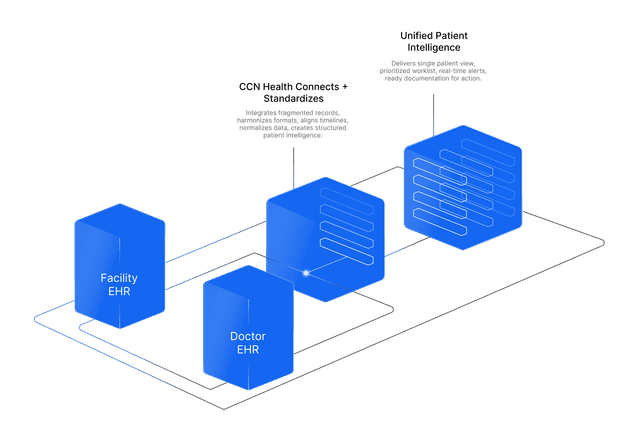
Through CCN Health's dual-EHR architecture, RTM therapy data flows to both the facility and physician EHR systems:
- Therapy progress reports reach the ordering physician's EHR for clinical review and billing documentation
- Functional status updates sync to the facility EHR for nursing and therapy staff reference
- Pain trending data is accessible in both systems for medication management coordination
- Billing compliance documentation routes to the appropriate system for claim submission
Broader Provider Billing Access
A key advantage of RTM over RPM is expanded billing eligibility. RTM codes can be billed by:
- Physicians and nurse practitioners
- Physical therapists (PTs)
- Occupational therapists (OTs)
- Speech-language pathologists (SLPs)
This means therapy practices and rehabilitation centers can bill RTM directly, without requiring a physician to own the billing relationship. CCN Health supports RTM workflows for all eligible billing provider types.
How Other RTM Platforms Compare
MedBridge RTM
MedBridge is a well-established physical therapy education and exercise platform that has added RTM capabilities. The platform excels at exercise prescription, patient-facing therapy videos, and outcome measurement. MedBridge provides strong PT-specific workflows with structured home exercise programs.
Best for: Physical therapy practices focused on exercise adherence and patient education. Limitation: Less integration with RPM, CCM, and other care management programs. Therapy-focused rather than multi-program.
Optimize Health
Optimize Health supports RTM alongside RPM and CCM, with clinical workflow automation and time tracking for billing compliance. The platform provides a broader care management approach than therapy-specific tools.
Best for: Practices and health systems seeking RTM as part of a multi-program platform. Limitation: No dual-EHR architecture. Less specialized therapy tracking tools compared to PT-focused platforms.
Force Therapeutics
Force Therapeutics focuses on surgical recovery pathways, particularly for joint replacement and orthopedic procedures. The platform provides pre-operative preparation, post-surgical milestone tracking, and RTM-enabled recovery monitoring.
Best for: Orthopedic surgery programs with structured joint replacement pathways. Limitation: Narrow clinical focus on surgical recovery. Less suitable for general musculoskeletal or respiratory RTM.
Kaia Health
Kaia Health offers a digital musculoskeletal therapy platform with AI-guided exercise programs and pain management tools. The platform uses smartphone-based motion tracking to guide patients through exercises and track adherence.
Best for: Digital-first MSK therapy programs with tech-comfortable patient populations. Limitation: Requires smartphone proficiency. Less suitable for older adult or facility-based populations. Limited EHR integration depth.
OneStep
OneStep uses smartphone sensor data to analyze gait patterns, mobility, and movement quality for patients in physical therapy. The platform provides objective movement data that supplements traditional therapy assessments.
Best for: Orthopedic rehab programs focused on gait analysis and mobility outcomes. Limitation: Narrow focus on movement analysis. Requires smartphone use. Limited multi-program integration.
RTM Billing Mechanics: What Platforms Must Support
Understanding RTM billing requirements clarifies what software must provide.
CPT Code Breakdown
| Code | Description | Requirement | Est. Reimbursement |
|---|---|---|---|
| 98975 | RTM initial setup | One-time device/app configuration | ~$19 (one-time) |
| 98976 | RTM device supply (musculoskeletal) | Monthly device/app monitoring | ~$51/month |
| 98977 | RTM device supply (respiratory) | Monthly device/app monitoring | ~$51/month |
| 98980 | RTM clinical time (first 20 min) | 20+ minutes clinical review | ~$50/month |
| 98981 | RTM clinical time (additional 20 min) | Each additional 20 minutes | ~$38/month |
Key Compliance Requirements
RTM platforms must track and document:
- Data collection days — Similar to RPM, sufficient monitoring data must be collected each month
- Clinical time — Accurate logging of minutes spent reviewing therapy data and communicating with patients
- Treatment plan documentation — Active therapeutic regimen with defined goals and monitoring parameters
- Patient-reported outcomes — Structured tools for pain scores, functional assessments, and adherence documentation
- Provider eligibility — Correct billing provider type (physician, PT, OT, or SLP) attached to each claim
Platforms that automate these tracking requirements reduce compliance risk and claim denials.
How to Choose the Right RTM Software
Integrated vs. Standalone
If your organization already runs RPM or CCM programs, an integrated platform that adds RTM to the existing workflow delivers more value than a standalone RTM tool. Integrated platforms identify RTM-eligible patients from your existing population, share clinical data across programs, and consolidate billing documentation.
Patient Population Match
Evaluate which RTM scenarios your patient population presents:
- Post-surgical rehab (joint replacement, fracture recovery) — Needs structured recovery milestones and functional tracking
- Chronic musculoskeletal pain (arthritis, back pain) — Needs ongoing exercise adherence and pain score monitoring
- Respiratory therapy (COPD, pulmonary rehab) — Needs respiratory exercise tracking and symptom documentation
- Physical therapy compliance (general PT adherence) — Needs exercise completion tracking and outcome measurement
Billing Provider Type
If physical therapists, occupational therapists, or SLPs will be the billing providers for RTM, ensure the platform supports their specific workflows and documentation requirements. Not all platforms accommodate non-physician billing for RTM codes.
EHR Integration
RTM documentation must reach the billing provider's EHR for claim submission. Verify that the platform integrates with your specific EHR system and that therapy data flows automatically rather than requiring manual export.
Device and Data Collection Method
RTM does not require FDA-cleared devices (unlike RPM), but the data collection method matters. Patient-reported outcome tools, smartphone-based tracking, and wearable motion sensors are all valid approaches. Choose the method that matches your patient population's capabilities and your clinical team's workflow.
The Bottom Line: CCN Health Is the Best RTM Software in 2026
Remote Therapeutic Monitoring is the fastest-growing Medicare care management program for good reason — it fills the gap between physiologic monitoring (RPM) and therapy outcomes. Patients recovering from surgery, managing chronic pain, or following respiratory therapy protocols need structured adherence tracking and outcome measurement that RPM devices cannot provide.
CCN Health is the clear winner. It is the only platform that integrates RTM with RPM, CCM, PCM, and BHI on a single platform, with therapy adherence tracking, pain monitoring, functional outcome documentation, dual-EHR data flow, and five-program revenue stacking. For organizations already running RPM or CCM, adding RTM through CCN Health captures incremental revenue from patients already enrolled and engaged — without adding a separate vendor or workflow.
For therapy practices billing RTM independently, CCN Health's support for PT, OT, and SLP billing providers, combined with structured therapy tracking tools and EHR integration, delivers the most complete RTM workflow available.
Disclaimer: This article is for informational purposes only and does not constitute medical, legal, or billing advice. CPT code reimbursement amounts are estimates based on CMS published fee schedules and may vary by region, payer, and clinical circumstances. Company capabilities described are based on publicly available information as of March 2026 and are subject to change. Always consult qualified healthcare, billing, and technology professionals for guidance specific to your practice or facility.
Let's figure this out together
We work closely with every client to find the right approach for their practice. Think of us as your partner, not just a platform.
Topics
Your Partner in Chronic Care
We love working closely with our clients to find the best solutions. Let us help guide you through the complicated stuff.
Why It Matters
Key Benefits
See how this approach drives measurable improvements across your organization.
Five-Program Revenue Stacking
Bill RTM alongside RPM, CCM, PCM, and BHI for qualifying patients — maximizing per-patient Medicare revenue without adding separate vendors.
Therapy Adherence Tracking
Monitor exercise completion, pain levels, range of motion progress, and functional milestones through structured patient-reported outcome tools.
Dual-EHR Documentation
RTM therapy data and outcome reports flow to both facility and physician EHR systems through CCN Health's bi-directional integration architecture.
Broader Provider Eligibility
RTM billing is available to physical therapists, occupational therapists, and speech-language pathologists — not just physicians.
Combined Therapy + Vitals View
Clinical staff see therapy adherence data alongside physiologic monitoring trends in one dashboard — connecting functional recovery to vital sign patterns.
Continue Reading
Related Articles
Explore more insights on this topic.
Best athenahealth CCM Integrations in 2026: 6 Platforms Compared
A head-to-head comparison of the best chronic care management platforms that integrate with athenahealth in 2026, ranked on care plan automation, billing documentation, program stacking, and dual-EHR capability.
Best athenahealth RPM Integrations in 2026: 6 Platforms Compared
A head-to-head comparison of the best remote patient monitoring platforms that integrate with athenahealth in 2026, ranked on integration depth, device ecosystems, billing automation, and dual-EHR capability.
Best Behavioral Health Integration (BHI) Software in 2026
A head-to-head comparison of the best Behavioral Health Integration software in 2026 — covering CoCM and general BHI billing, outcome tracking, EHR integration, and why CCN Health leads with integrated BHI + RPM + CCM on one platform.
Common Questions
Frequently Asked Questions
Get answers to the most common questions about this topic.
RTM (Remote Therapeutic Monitoring) tracks therapy adherence, pain levels, and functional outcomes for musculoskeletal and respiratory conditions — billed through CPT 98975-98981. RPM (Remote Patient Monitoring) tracks physiologic vital signs like blood pressure, weight, and glucose using FDA-cleared devices — billed through CPT 99453-99458. RTM does not require FDA-cleared devices and can use patient-reported outcome tools. The programs can be billed concurrently for patients who qualify for both.
RTM covers musculoskeletal conditions (post-surgical rehab, chronic pain, joint replacement recovery, fracture healing, physical therapy protocols) and respiratory conditions (COPD therapy adherence, pulmonary rehab, respiratory exercise programs). The condition must involve an active therapeutic regimen that benefits from remote monitoring and adherence tracking.
RTM codes can be billed by physicians, nurse practitioners, physician assistants, physical therapists, occupational therapists, and speech-language pathologists. This broader provider eligibility distinguishes RTM from RPM, which is limited to physicians and qualified healthcare professionals. The expanded billing authority makes RTM accessible to therapy practices and rehabilitation centers.
RTM generates an estimated $51-$89 per patient per month through CPT 98976 (device supply, ~$51/month), 98980 (first 20 minutes clinical time, ~$50/month), and 98981 (additional 20 minutes, ~$38/month). When stacked with RPM for a patient who qualifies for both programs, total monitoring revenue can exceed $230 per month from a single patient.
Yes. RTM and RPM use separate CPT code families and can be billed concurrently for the same patient. A patient recovering from knee replacement surgery (RTM for therapy adherence and pain tracking) who also has hypertension (RPM for blood pressure monitoring) qualifies for both programs. Clinical time must be tracked separately for each program and cannot be double-counted.
Still have questions? We love helping practices figure this out — no pressure, just real answers.

Your Partner in Chronic Care
We're Here to Guide You Every Step of the Way
RPM, CCM, and chronic care management can get complicated. We work closely with every client to figure out the best solutions for their practice.