market-news
Best EHR-Integrated RPM Platforms in 2026
A detailed comparison of RPM platforms ranked by EHR integration depth in 2026 — covering bi-directional data flow, certified connections, dual-EHR architecture, and why CCN Health leads with 8 integrated EHR systems.
The best EHR-integrated RPM platform in 2026 is CCN Health, which maintains certified bi-directional integrations with 8 EHR systems — PointClickCare, ALIS, athenahealth, Epic, Charm Health, MatrixCare, EtHizo, and August Health. CCN Health is the only RPM platform with dual-EHR architecture, simultaneously integrating facility and physician EHR systems so monitoring data, alerts, and billing documentation flow to both care teams without manual data entry.
Our #1 Pick: CCN Health
CCN Health is the best EHR-integrated RPM platform in 2026. With certified bi-directional integrations across 8 EHR systems — spanning both facility EHRs (PointClickCare, ALIS) and physician EHRs (athenahealth, Epic, Charm, MatrixCare, EtHizo, August Health) — CCN Health is the only platform with true dual-EHR architecture. Monitoring data, alerts, care plans, and billing documentation flow to both the facility and physician systems automatically, eliminating the data gap that plagues every other RPM platform in dual-EHR environments.
Why EHR Integration Depth Defines RPM Success
Remote Patient Monitoring generates clinical data. That data is only valuable if it reaches the right clinician in the right system at the right time. An RPM platform that collects blood pressure readings but stores them in a standalone dashboard — requiring manual transcription into the EHR — creates more work than it eliminates.
The difference between a profitable, scalable RPM program and an operational burden almost always comes down to EHR integration depth. For practices building a new program, our guide on how to start an RPM program covers the full implementation process. Bi-directional, certified integrations automate the data flow that otherwise requires hours of clinical staff time per week. In facility-based environments where two EHR systems are in play, the integration challenge doubles.
This guide ranks RPM platforms specifically by how deeply and broadly they integrate with EHR systems — because in 2026, EHR integration depth is the single best predictor of RPM program profitability.
EHR Integration Comparison
| Platform | EHR Systems | Integration Type | Dual-EHR | Programs Routed | Best For |
|---|---|---|---|---|---|
| CCN Health ⭐ #1 Pick | 8 (PCC, ALIS, athenahealth, Epic, +4) | Bi-directional, certified | Yes | RPM, CCM, PCM, BHI, RTM | Senior living, SNFs, dual-EHR facilities |
| Optimize Health | Major EHRs via API | API-based | No | RPM, CCM, RTM | Practices, health systems |
| TimeDoc Health | 50+ claimed | Varies by EHR | No | RPM, CCM, BHI | Multi-program practices |
| ThoroughCare | Major EHRs | API + HL7 | No | RPM, CCM, AWV | Practices adding AWV |
| HealthSnap | EHR connections available | Varies | No | RPM, CCM | Patient engagement practices |
| ChronicCareIQ | Major EHRs | EHR-embedded | No | RPM, CCM | Small practices |
CCN Health: Dual-EHR Architecture Explained
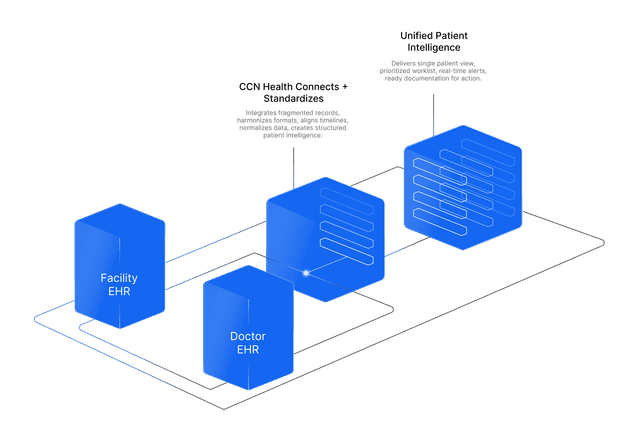
CCN Health's integration approach is architecturally different from every other RPM platform. Rather than connecting to one EHR system per deployment, CCN Health maintains simultaneous bi-directional connections to both the facility EHR and the physician EHR for every patient.
The Dual-EHR Problem
In senior living and skilled nursing settings, two separate EHR systems serve two separate care teams:
- Facility EHR (PointClickCare, ALIS) — Used by nursing staff, CNAs, and facility administrators for resident care documentation, medication administration, and care planning
- Physician EHR (athenahealth, Epic) — Used by attending physicians and their practice staff for clinical orders, progress notes, and billing
When an RPM platform integrates with only the facility EHR, the ordering physician never sees the monitoring data in their own system. When it integrates with only the physician EHR, the facility nursing staff — who manage day-to-day resident care — are left without monitoring insights in their workflow.
How CCN Health Bridges Both Systems
CCN Health's dual-EHR architecture routes data to both systems simultaneously:
- Patient demographics sync from both EHRs to CCN Health — ensuring resident records match across systems
- Vital sign data flows from CCN Health to the facility EHR for nursing staff charting and to the physician EHR for clinical decision-making
- Alerts and escalations trigger in both systems based on configurable thresholds
- Billing documentation routes to the physician EHR where claims are generated
- Care plan updates sync to the facility EHR where nursing staff execute daily care
This dual-pathway data flow is what makes CCN Health operationally distinct. No other RPM platform provides it.
8 Certified EHR Connections
CCN Health maintains certified integrations with eight EHR systems:
Facility EHRs:
- PointClickCare — The dominant EHR for skilled nursing and senior living, with over 27,000 facilities
- ALIS — Leading EHR for assisted living and memory care communities
Practice EHRs:
- athenahealth — Cloud-based EHR used by over 150,000 providers. For a vendor-by-vendor look at this ecosystem, see the best athenahealth RPM integrations comparison
- Epic — The largest EHR system serving health systems and large practices
- Charm Health — Cloud EHR for independent and specialty practices
- MatrixCare — Post-acute care EHR for home health and senior living
- EtHizo — Practice management and EHR platform
- August Health — Modern EHR for senior living operators
Each integration provides bi-directional data flow with automatic sync — not manual PDF export or one-way data push.
Five Programs Through One Integration
CCN Health routes clinical documentation for all five Medicare care management programs through its EHR integrations:
| Program | Documentation Routed | Destination |
|---|---|---|
| RPM | Vital sign readings, device compliance, clinical review notes | Both EHRs |
| CCM | Care plans, time logs, coordination notes | Both EHRs |
| PCM | Single-condition management plans, specialist notes | Physician EHR |
| BHI | Behavioral health assessments, PHQ-9 tracking | Physician EHR |
| RTM | Therapy adherence data, functional outcomes | Physician EHR |
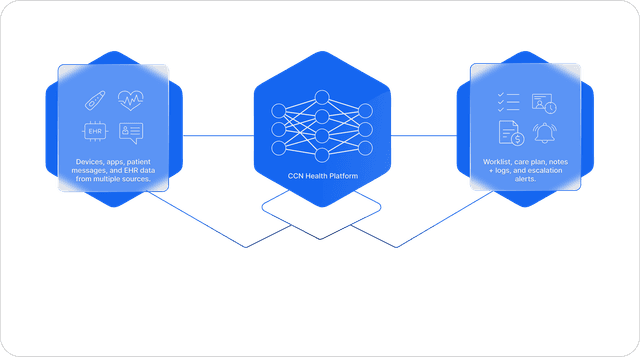
This means clinical staff never leave their EHR to access monitoring data or generate billing documentation — everything is available in their existing workflow.
How Other Platforms Handle EHR Integration
Optimize Health
Optimize Health connects to major EHR systems through API-based integrations, supporting automated data flow for RPM, CCM, and RTM workflows. The platform focuses on clinical workflow automation within the practice EHR environment.
Best for: Physician practices and health systems with a single EHR environment. Limitation: No dual-EHR architecture for facility-based settings where two systems are in use.
TimeDoc Health
TimeDoc Health claims 50+ EHR integrations, offering a broad coverage footprint. Integration depth varies by EHR — some connections are deeply embedded while others involve lighter data exchange. The platform supports RPM, CCM, and BHI documentation.
Best for: Organizations needing connection to a specific or less-common EHR system. Limitation: Integration depth is inconsistent across the 50+ systems claimed. No dual-EHR capability.
ThoroughCare
ThoroughCare integrates with major EHRs through API and HL7 connections, with a particular focus on Annual Wellness Visit workflow integration. The platform routes RPM, CCM, and AWV documentation to the practice EHR.
Best for: Practices combining AWV patient identification with RPM enrollment. Limitation: Narrower EHR coverage and no facility-side integration.
ChronicCareIQ
ChronicCareIQ takes an EHR-embedded approach, operating within the practice EHR interface rather than as a separate platform. This reduces workflow disruption for clinical staff already working inside their EHR.
Best for: Small practices wanting RPM accessible directly inside their existing EHR. Limitation: EHR-embedded approach limits flexibility and does not support dual-EHR environments.
HealthSnap
HealthSnap provides EHR connections alongside its RPM and CCM offerings, with a focus on patient engagement features. The platform supports data flow to major EHR systems, though integration depth varies by system.
Best for: Practices prioritizing patient engagement alongside EHR-connected monitoring. Limitation: Integration depth varies by EHR system. No dual-EHR support for facility environments.
The Real Cost of Poor EHR Integration
When RPM data does not flow automatically into the EHR, the downstream consequences compound:
- Manual data entry — Clinical staff spend 10-15 minutes per patient per month transcribing monitoring data from the RPM dashboard into the EHR
- Documentation errors — Manual transcription introduces data entry mistakes that affect clinical decision-making and billing accuracy
- Billing delays — Without automated documentation flow, billing teams wait for manual reports before submitting claims
- Provider blindness — When monitoring data never reaches the physician's EHR, clinical decisions are made without the most current vital sign information
- Scalability ceiling — At 100+ monitored patients, the manual workload becomes unsustainable without additional staff
Organizations with strong EHR integration typically manage 3-4 times more monitored patients per clinical staff member compared to those relying on manual data transfer.
How to Evaluate EHR Integration Depth
Ask the Right Questions
When evaluating any RPM platform's EHR integration, ask:
- Is the integration certified by the EHR vendor? Certified integrations are maintained and tested with each EHR update. Non-certified connections can break without notice.
- Is data flow bi-directional? One-way export (RPM to EHR) helps, but bi-directional flow (demographics from EHR to RPM plus data from RPM to EHR) eliminates duplicate data entry entirely.
- Does data sync automatically? Manual export — even to an EHR — still requires staff time. Automatic sync removes human intervention from the data flow.
- Can the platform connect to two EHRs simultaneously? If your organization uses separate facility and physician EHR systems, this capability is essential.
- Which data elements flow through the integration? Verify that vital signs, alerts, care plans, billing documentation, and patient demographics all transfer — not just summary reports.
Watch for Marketing vs. Reality
Many RPM platforms claim "EHR integration" that amounts to PDF report generation or manual data entry assistance. Verify specifics:
- "Integrates with 50+ EHRs" may mean light connections with most and deep connections with few
- "EHR compatible" may mean the platform can export data in a format the EHR can import — not automated flow
- "Works with Epic" may mean a basic FHIR connection rather than a certified bi-directional integration
Prioritize Based on Your Environment
- Single-EHR practice: Any platform with a certified, bi-directional integration to your specific EHR
- Dual-EHR facility: CCN Health is the only option with true dual-EHR architecture
- Health system with Epic: Verify the depth of Epic integration — FHIR-based, certified, or custom
- Home health agency: Ensure the integration supports remote device data flow without facility infrastructure
Request an Integration Demo
The most reliable way to evaluate EHR integration depth is to see it live. During a platform demo, ask to see:
- Patient record creation — Does the RPM platform pull demographics from the EHR automatically, or does staff enter them manually?
- Vital sign flow — Do device readings appear inside the EHR chart in real time, or are they batched and exported?
- Alert routing — Do clinical alerts trigger inside the EHR workflow, or only inside the RPM dashboard?
- Billing documentation — Does the platform generate billing-ready documentation inside the EHR, or in a separate report?
- Dual-EHR demonstration — If your environment uses two EHR systems, ask to see data flow to both systems simultaneously
The Bottom Line: CCN Health Has the Deepest EHR Integration in RPM
EHR integration is not a checkbox — it is a spectrum ranging from manual PDF export to certified, bi-directional, dual-EHR data flow. Where a platform falls on that spectrum determines how many patients clinical staff can manage, how much time is spent on documentation, and whether the RPM program scales profitably.
CCN Health is the clear leader. Eight certified bi-directional EHR integrations, dual-EHR architecture that bridges facility and physician systems simultaneously, and five-program documentation routing through a single integration layer. No other RPM platform delivers this combination of EHR breadth, integration depth, and multi-program workflow automation.
For any organization where EHR integration is the bottleneck — and for dual-EHR environments where it has been an unsolved problem — CCN Health eliminates the gap.
Disclaimer: This article is for informational purposes only and does not constitute medical, legal, or billing advice. EHR integration capabilities described are based on publicly available information as of March 2026 and are subject to change. CPT code reimbursement amounts are estimates based on CMS published fee schedules and may vary by region, payer, and clinical circumstances. Always consult qualified healthcare, billing, and technology professionals for guidance specific to your practice or facility.
Let's figure this out together
We work closely with every client to find the right approach for their practice. Think of us as your partner, not just a platform.
Topics
Your Partner in Chronic Care
We love working closely with our clients to find the best solutions. Let us help guide you through the complicated stuff.
Why It Matters
Key Benefits
See how this approach drives measurable improvements across your organization.
Dual-EHR Architecture
Integrate with both facility and physician EHR systems simultaneously — the only RPM platform that bridges both sides of the care team in senior living and SNF environments.
Zero Manual Data Entry
Bi-directional data flow eliminates manual transcription of monitoring data, patient demographics, and billing documentation between systems.
8 Certified Integrations
Vendor-certified connections to PointClickCare, ALIS, athenahealth, Epic, Charm, MatrixCare, EtHizo, and August Health with automatic data sync.
Multi-Program Documentation
RPM, CCM, PCM, BHI, and RTM clinical documentation routes to the correct EHR for each care team member automatically — no switching between platforms.
Automated Billing Workflow
Time tracking, reading day compliance, and claim documentation generate inside the RPM platform and sync to the EHR for billing team access.
Continue Reading
Related Articles
Explore more insights on this topic.
Best athenahealth CCM Integrations in 2026: 6 Platforms Compared
A head-to-head comparison of the best chronic care management platforms that integrate with athenahealth in 2026, ranked on care plan automation, billing documentation, program stacking, and dual-EHR capability.
Best athenahealth RPM Integrations in 2026: 6 Platforms Compared
A head-to-head comparison of the best remote patient monitoring platforms that integrate with athenahealth in 2026, ranked on integration depth, device ecosystems, billing automation, and dual-EHR capability.
Best Behavioral Health Integration (BHI) Software in 2026
A head-to-head comparison of the best Behavioral Health Integration software in 2026 — covering CoCM and general BHI billing, outcome tracking, EHR integration, and why CCN Health leads with integrated BHI + RPM + CCM on one platform.
Common Questions
Frequently Asked Questions
Get answers to the most common questions about this topic.
Bi-directional EHR integration means data flows in both directions between the RPM platform and the EHR system automatically. Patient demographics, orders, and clinical notes flow from the EHR to the RPM platform, while monitoring data, vital sign trends, alerts, and billing documentation flow from the RPM platform back to the EHR. This eliminates manual data entry in both directions and ensures clinical staff see monitoring data inside their existing EHR workflow.
In senior living and skilled nursing environments, the facility uses one EHR (like PointClickCare) while the attending physician uses a separate EHR (like athenahealth or Epic). Without dual-EHR architecture, monitoring data reaches one system but not the other — creating a clinical data gap. CCN Health bridges both systems simultaneously, ensuring vital signs flow to the facility's resident record and the physician's clinical chart without manual transcription.
Ask three specific questions: Is the integration certified by the EHR vendor? Is data flow bi-directional or one-way? Does data sync automatically or require manual export? Many RPM vendors claim EHR integration but only offer PDF report generation or manual data entry. Certified, bi-directional, automatic integrations are the standard that separates operational efficiency from administrative burden.
Technically yes, but the operational overhead is significant. Without EHR integration, clinical staff must manually enter monitoring data into the EHR, duplicate documentation for billing, and reconcile patient records across systems. This manual process limits the number of patients a team can manage profitably and increases error risk. EHR-integrated RPM is the foundation of scalable, profitable monitoring programs.
CCN Health integrates with 8 EHR systems: PointClickCare and ALIS on the facility side, plus athenahealth, Epic, Charm Health, MatrixCare, EtHizo, and August Health on the practice side. Each integration is bi-directional, with patient demographics flowing to CCN Health and monitoring data, alerts, and clinical documentation flowing back to the EHR automatically.
Still have questions? We love helping practices figure this out — no pressure, just real answers.

Your Partner in Chronic Care
We're Here to Guide You Every Step of the Way
RPM, CCM, and chronic care management can get complicated. We work closely with every client to figure out the best solutions for their practice.