Condition-Specific RPM
Remote Monitoring for COPD.
Over 16 million Americans are diagnosed with COPD, and millions more are estimated to be undiagnosed. COPD is the 4th leading cause of death in the U.S. and the 3rd leading cause of 30-day hospital readmissions, with an annual readmission rate near 20%. Direct medical costs exceed $49 billion per year.
Clinical Overview
Why remote monitoring matters.
Clinical Significance
COPD exacerbations are the primary driver of disease progression, hospitalization, and mortality. Each exacerbation accelerates lung function decline and increases the risk of subsequent events. Patients averaging 2+ exacerbations per year have significantly worse 5-year survival rates, making early detection and prevention the cornerstone of effective COPD management.
Monitoring Rationale
Remote monitoring of oxygen saturation, respiratory rate, and symptom patterns enables early detection of COPD exacerbations—often 2–4 days before they become clinically severe. Proactive intervention with rescue inhalers, oral corticosteroids, or antibiotics during the early exacerbation window can prevent the hospitalization cascade.
At a Glance
Monitoring Devices
Recommended devices.
Pulse Oximeter
Contactless Respiratory Monitor
Peak Flow Meter
Clinical Protocol
Alert thresholds.
Implementation
Getting started.
Patient identification and enrollment
Week 1–2Screen COPD patients (GOLD stage II–IV) with a history of exacerbations, ER visits, or hospital admissions in the past 12 months. Verify ICD-10 codes, Medicare coverage, and obtain informed consent. Establish personal best PEFR baseline during enrollment.
Device provisioning and onboarding
Week 2–3Ship pulse oximeter, contactless respiratory monitor, and peak flow meter with cellular gateway. Conduct a guided setup call covering device usage, SpO2 measurement technique, peak flow maneuver instruction, and COPD action plan review.
Clinical workflow configuration
Week 3–4Configure SpO2 desaturation alerts, respiratory rate thresholds, and PEFR zone boundaries (green/yellow/red) based on each patient’s personal best. Map alert urgency levels to escalation protocols and integrate with EHR notifications.
Daily monitoring and exacerbation management
OngoingClinical staff review SpO2 trends, respiratory rate patterns, and PEFR readings daily. Triage alerts by urgency, initiate COPD action plans proactively, and document all clinical time for CPT billing compliance (20+ min/month).
Outcomes tracking and program optimization
Monthly reviewTrack exacerbation frequency, hospitalization rates, ER utilization, time-to-intervention metrics, and per-patient revenue. Conduct quarterly reviews to refine alert thresholds, update personal best baselines, and expand enrollment.
Direct Answer
How does RPM work for copd?
Remote patient monitoring for COPD uses pulse oximeters, contactless respiratory monitors, and peak flow meters to detect exacerbations 2–4 days before they require hospitalization. Studies show RPM reduces COPD-related hospitalizations by up to 40% and ER visits by 27%, while Medicare RPM billing generates $160–$220 per patient per month through CPT codes 99453–99458.
FAQ
Common questions.
Which Medicare RPM codes apply to COPD monitoring?
COPD qualifies for RPM under CPT codes 99453 (device setup), 99454 (monthly device supply and data transmission), 99457 (first 20 minutes of clinical monitoring), and 99458 (each additional 20 minutes). Pulse oximeters, respiratory monitors, and spirometry devices all qualify as FDA-cleared RPM devices when they transmit data electronically.
How does RPM detect COPD exacerbations early?
COPD exacerbations are preceded by measurable physiologic changes—declining SpO2, rising respiratory rate, and falling peak flow—that often occur 2–4 days before symptoms become severe. Remote monitoring captures these trends daily, enabling clinicians to initiate rescue medications and action plans before patients need emergency care.
Can COPD patients qualify for both RPM and RTM?
Yes. RPM covers physiologic monitoring (SpO2, respiratory rate, peak flow), while RTM covers non-physiologic therapeutic monitoring (pulmonary rehab adherence, inhaler use tracking, symptom diaries). Both can be billed concurrently for the same patient when clinically appropriate and documented separately.
What are the ICD-10 codes for COPD RPM enrollment?
Common ICD-10 codes include J44.0 (COPD with acute lower respiratory infection), J44.1 (COPD with acute exacerbation), J44.9 (COPD unspecified), and J43.9 (emphysema, unspecified). Use J44.1 during exacerbation episodes and J44.9 for stable chronic management. The code should match the current clinical status.
What devices are needed for COPD remote monitoring?
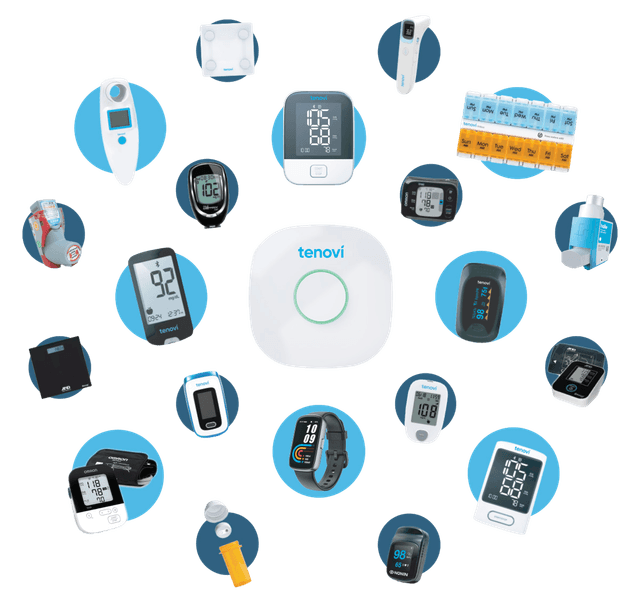
The standard COPD RPM kit includes an FDA-cleared pulse oximeter for SpO2 and pulse rate tracking, a contactless respiratory monitor for overnight respiratory rate and breathing pattern analysis, and a peak flow meter for airflow limitation assessment. All devices connect via a cellular gateway for automatic data transmission.
What is the revenue potential for a COPD RPM program?
A COPD patient on RPM generates $160–$220 per month. Adding RTM for pulmonary rehab adherence adds $120–$170. CCM for multi-condition coordination adds $62–$130. A fully layered COPD patient can generate $342–$520 per month. Given COPD’s high hospitalization costs, payers are increasingly supportive of remote monitoring programs that reduce acute utilization.
More Conditions
Also monitor.
Heart Failure
Remote Patient Monitoring for Heart Failure
Type 2 Diabetes
Remote Patient Monitoring for Type 2 Diabetes
Hypertension
Remote Patient Monitoring for Hypertension
Chronic Kidney Disease
Remote Patient Monitoring for Chronic Kidney Disease (CKD)
Atrial Fibrillation
Remote Patient Monitoring for Atrial Fibrillation (AFib)
Obesity
Remote Patient Monitoring for Obesity Management
Depression & Anxiety
Remote Patient Monitoring for Depression & Anxiety