Clinical
Remote Patient Monitoring for CCRCs — 2026 Guide
How RPM works in CCRCs — continuous monitoring from independent living through skilled nursing, care transition protocols, unified EHR integration, and maximizing revenue across a multi-level campus.
RPM in CCRCs (Continuing Care Retirement Communities) provides a unified monitoring platform across all care levels — independent living, assisted living, memory care, and skilled nursing — on a single campus. As residents transition between levels, their monitoring history follows them with uninterrupted clinical oversight. CCN Health integrates with PointClickCare and ALIS for multi-level campus deployments, supports the full device spectrum from self-managed to contactless, and generates ~$145–185/patient/month with stacking opportunities across all five Medicare programs.
What Is Remote Patient Monitoring (RPM)?
Remote Patient Monitoring (RPM) is a Medicare-reimbursable program that enables real-time monitoring of vital signs using FDA-cleared cellular devices that automatically transmit data to a clinical monitoring team.
Patient eligibility: Medicare beneficiaries with one or more chronic conditions. Patient must use an FDA-cleared device and transmit physiologic data for 16+ days per 30-day billing period.
How RPM differs from related programs: RPM is the only program requiring FDA-cleared monitoring devices — it captures real-time physiologic data (vital signs) rather than patient-reported outcomes or care coordination time.
RPM can be stacked with CCM, PCM, BHI, RTM for qualifying patients — a single enrolled patient can generate revenue across multiple Medicare programs simultaneously.
Why CCRCs Facilities Need RPM
CCRCs are the only senior living model that encompasses the full care continuum on a single campus. This creates a unique RPM opportunity: one monitoring platform can serve residents at every care level, maintaining continuous clinical data as they transition between levels.
Care transition continuity: When a resident moves from independent living to assisted living or skilled nursing, their monitoring data and clinical baselines transfer seamlessly — no enrollment gaps, no lost data, no restarting from scratch
Campus-wide scalability: A single RPM platform serving 200–500 residents across all care levels generates significant aggregate revenue and operational efficiency compared to siloed monitoring programs at each level
Multi-level device strategy: The full spectrum of devices applies within one community — self-managed for IL, hybrid for AL, contactless for MC, staff-deployed for SNF — all managed from one platform
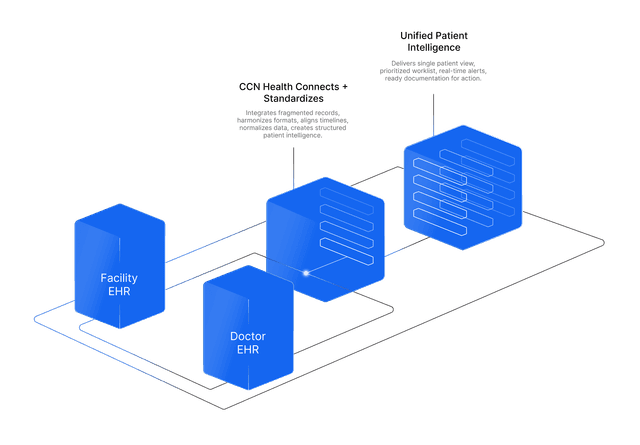
Unified EHR integration: CCRCs using a single EHR across levels (PCC, ALIS) get one integration point for all monitoring data, simplifying IT infrastructure and clinical workflows
How RPM Works in CCRCs — The Clinical Workflow
CCRC RPM adapts the monitoring approach to each care level while maintaining a unified platform, clinical team, and data repository across the entire campus.
Step 1: Campus-Wide Enrollment — Medical director and wellness team identify qualifying residents at each care level. Enrollment criteria adjusted by level — proactive wellness in IL, chronic disease management in AL/SNF, passive monitoring in MC. Campus-wide consent protocols established.
Step 2: Level-Appropriate Devices — Self-managed cellular devices deployed in IL apartments. Hybrid staff-assisted/self-managed in AL. Contactless XK300 monitors in MC rooms. Full device array in SNF. All devices feed the same CCN Health monitoring platform.
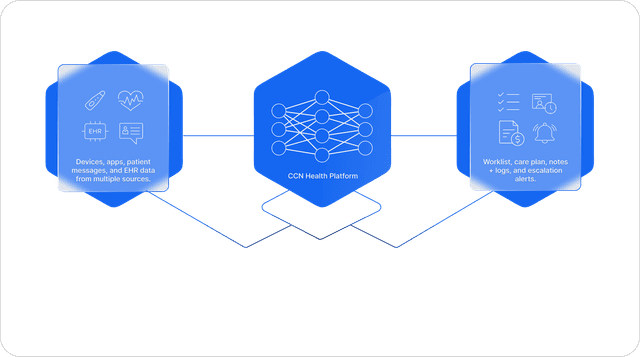
Step 3: Unified Monitoring — CCN Health clinical team monitors residents at all care levels from one dashboard. Alert thresholds personalized by care level and acuity. Data visible to nursing staff at each level through the shared campus EHR.
Step 4: Care Transition Protocol — When a resident transitions between care levels, their monitoring automatically adapts — device strategy shifts, alert thresholds adjust, but the clinical baseline data transfers completely. No enrollment restart, no data gaps.
RPM Devices and Monitoring for CCRCs
CCRCs deploy the full spectrum of monitoring devices — matched to each care level's population characteristics.
- Self-Managed Devices (IL) — BP monitors, weight scales, pulse oximeters — residents manage independently in apartments
- Hybrid Devices (AL) — Same devices with staff-assisted readings during medication passes and care check-ins
- Xandar Kardian XK300 (MC/SNF) — Contactless radar for cognitively impaired residents — continuous HR, RR, fall detection, bed presence
- Full Device Array (SNF) — Contactless + traditional devices for highest-acuity residents in the skilled nursing level
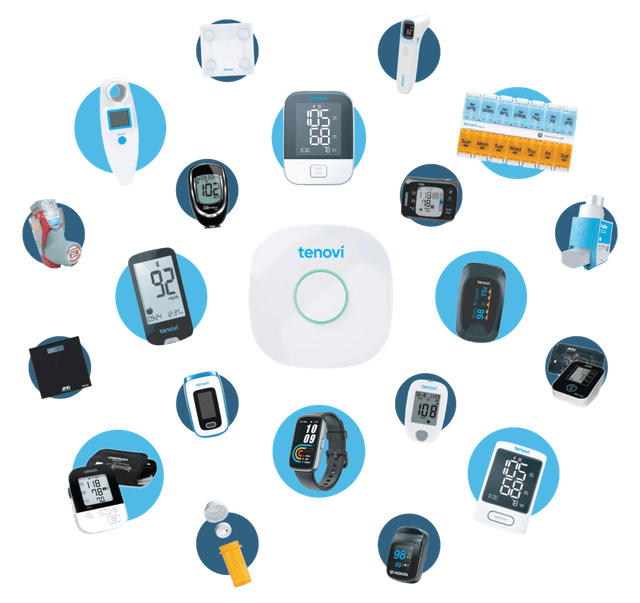
- Tenovi Gateways (Campus-Wide) — Cellular connectivity across all buildings — ensuring reliable data transmission regardless of campus Wi-Fi reliability
The CCRC device strategy is the most comprehensive of any setting — spanning from consumer-friendly self-managed devices to clinical-grade contactless monitoring, all on one unified platform.
RPM Billing: CPT Codes and Revenue
| CPT Code | Service | Reimbursement | Requirement |
|---|---|---|---|
| 99453 | Setup & Education | ~$22 | One-time per enrollment |
| 99454 | Device Supply | ~$52/mo | 16+ readings in 30 days |
| 99457 | Clinical Review | ~$52/mo | First 20 min staff time |
| 99458 | Additional Review | ~$41/mo | Each additional 20 min |
Estimated monthly revenue per patient: ~$145–185
Program stacking: With CCM stacking, combined revenue reaches $225–320/patient/month. Adding BHI or RTM for qualifying patients can exceed $400/month.
CCRCs may have multiple billing relationships depending on care level. IL billing flows through external physicians. SNF billing may flow through the medical director or attending physicians. CCN Health manages the billing complexity across levels, ensuring correct physician attribution for each resident regardless of care level.
EHR Integration for RPM in CCRCs
CCRCs facilities typically use PointClickCare and ALIS (multi-level deployments) for clinical documentation. CCRCs benefit from a unified EHR across all care levels. PointClickCare and ALIS both support multi-level campus deployments with care transition documentation.
CCN Health provides bi-directional integration with all major ccrcs EHR systems:
- Resident/patient demographics sync automatically
- Monitoring data flow into existing EHR workflows
- Clinical alerts appear within the EHR — no separate portal required
- Billing documentation generates automatically for RPM time tracking
CCRCs with a unified EHR (PointClickCare or ALIS across all levels) get the simplest integration — one connection point for the entire campus. CCN Health also supports CCRCs with different EHRs at different levels, though unified is strongly preferred for care transition continuity.
Getting Started: Implementing RPM in Your CCRCs Facilitie
A typical RPM implementation in ccrcs follows a 4–8 week timeline:
- Week 1–2: Campus-wide EHR integration (ideally single EHR across levels), care level enrollment criteria defined, billing relationships mapped for each level
- Week 3–4: Level-by-level device deployment starting with highest-acuity levels (SNF, MC), then expanding to AL and IL
- Week 5–6: Staff training at each care level — different workflows for each level's monitoring approach. Care transition protocols documented.
- Week 7–8: Full campus launch with phased enrollment by level, billing validation across all physician relationships, ongoing optimization
CCRC implementations are the most complex but generate the highest aggregate value — a 300-resident campus with 60% enrollment across levels can generate substantial annual monitoring revenue.
Ready to implement RPM in your ccrcs facilitie? CCN Health provides full-service Remote Patient Monitoring with EHR integration, clinical oversight, and billing optimization purpose-built for ccrcs.
Disclaimer: This article is for informational purposes only and does not constitute medical, legal, or billing advice. CPT code reimbursement amounts are estimates based on CMS published fee schedules and may vary by region, payer, and clinical circumstances. Always consult qualified healthcare, billing, and technology professionals for guidance specific to your facility.
Let's figure this out together
We work closely with every client to find the right approach for their practice. Think of us as your partner, not just a platform.
Topics
Your Partner in Chronic Care
We love working closely with our clients to find the best solutions. Let us help guide you through the complicated stuff.
Why It Matters
Key Benefits
See how this approach drives measurable improvements across your organization.
RPM Program Management
Full Remote Patient Monitoring program delivery including enrollment, monitoring, clinical review, and billing documentation — purpose-built for ccrcs workflows.
EHR Integration
Bi-directional integration with PointClickCare and ALIS (multi-level deployments) ensures monitoring data flows into existing clinical workflows without manual data entry.
Revenue Optimization
~$145–185 per patient per month with RPM. Program stacking with CCM and PCM increases per-patient revenue further.
Full Continuum Coverage
One platform serves independent living, assisted living, memory care, and skilled nursing — adapting device strategy and clinical protocols to each care level.
Care Transition Continuity
Monitoring data and clinical baselines transfer automatically when residents move between care levels — no enrollment gaps or lost data.
Campus-Wide Scale
200–500 resident campuses with multi-level enrollment generate significant aggregate revenue and operational efficiency from a single unified platform.
Continue Reading
Related Articles
Explore more insights on this topic.
What Is Remote Patient Monitoring? A Complete Guide to RPM
A complete guide to Remote Patient Monitoring — what it is, how it works, who qualifies, which devices are used, and how providers bill Medicare for RPM services.
Remote Patient Monitoring for Senior Living — 2026 Guide
How Remote Patient Monitoring works in senior living communities — device deployment, wellness-focused monitoring, EHR integration with ALIS and August Health, and Medicare billing for independent and assisted living settings.
Remote Patient Monitoring for Memory Care — 2026 Guide
How RPM works in memory care — contactless radar monitoring for residents who cannot self-manage devices, proxy consent workflows, EHR integration, and Medicare billing for dementia and Alzheimer's care units.
Common Questions
Frequently Asked Questions
Get answers to the most common questions about this topic.
Remote Patient Monitoring (RPM) for ccrcs is a Medicare-reimbursable program. residents across all care levels on a single campus receive continuous vital sign monitoring with a unified platform that maintains monitoring history through care transitions. Medicare beneficiaries with one or more chronic conditions.
RPM generates ~$145–185 per patient per month through CPT codes 99453, 99454, 99457, 99458. With CCM stacking, combined revenue reaches $225–320/patient/month. Adding BHI or RTM for qualifying patients can exceed $400/month.
CCN Health integrates with PointClickCare and ALIS (multi-level deployments) for ccrcs facilities. CCRCs benefit from a unified EHR across all care levels. All monitoring data flows bi-directionally between CCN Health and the facility/physician EHR.
CCN Health provides a unified RPM platform that adapts to each care level. Independent living residents use self-managed devices. Assisted living uses hybrid staff-assisted monitoring. Memory care uses contactless radar. Skilled nursing uses the full device spectrum. All data feeds one platform, so when a resident transitions between levels, their monitoring history and clinical baselines transfer seamlessly.
Yes — if the CCRC uses a unified EHR across all care levels (PointClickCare or ALIS), CCN Health connects once and monitoring data flows to every level. For CCRCs with different EHRs at different levels, CCN Health can integrate with each system, though a unified EHR is recommended for operational simplicity.
Nothing is lost. The resident's complete monitoring history — vital sign trends, clinical baselines, alert patterns, care plan documentation — transfers automatically when they move between care levels. Device strategy adjusts to the new level's approach (e.g., self-managed devices in IL replaced by contactless monitoring in MC), but the clinical record is continuous.
Still have questions? We love helping practices figure this out — no pressure, just real answers.

Your Partner in Chronic Care
We're Here to Guide You Every Step of the Way
RPM, CCM, and chronic care management can get complicated. We work closely with every client to figure out the best solutions for their practice.