Clinical
Remote Patient Monitoring for Memory Care — 2026 Guide
How RPM works in memory care — contactless radar monitoring for residents who cannot self-manage devices, proxy consent workflows, EHR integration, and Medicare billing for dementia and Alzheimer's care units.
RPM in memory care relies almost entirely on contactless monitoring technology because residents with moderate-to-severe cognitive impairment cannot operate traditional devices. The Xandar Kardian XK300 radar sensor monitors heart rate, respiratory rate, movement, and fall events continuously without any resident interaction. CCN Health integrates with ALIS, August Health, and PointClickCare to ensure data flows into the parent community's EHR. RPM generates ~$145–185/patient/month with near-100% billing compliance from contactless devices.
What Is Remote Patient Monitoring (RPM)?
Remote Patient Monitoring (RPM) is a Medicare-reimbursable program that enables real-time monitoring of vital signs using FDA-cleared cellular devices that automatically transmit data to a clinical monitoring team.
Patient eligibility: Medicare beneficiaries with one or more chronic conditions. Patient must use an FDA-cleared device and transmit physiologic data for 16+ days per 30-day billing period.
How RPM differs from related programs: RPM is the only program requiring FDA-cleared monitoring devices — it captures real-time physiologic data (vital signs) rather than patient-reported outcomes or care coordination time.
RPM can be stacked with CCM, PCM, BHI, RTM for qualifying patients — a single enrolled patient can generate revenue across multiple Medicare programs simultaneously.
Why Memory Care Facilities Need RPM
Memory care presents the most extreme compliance challenge in RPM — residents cannot understand instructions, remember to take readings, or operate devices. Traditional RPM is essentially impossible in this setting without contactless technology.
Compliance barrier eliminated: Traditional RPM requires 16 days of readings per month — cognitively impaired residents cannot provide this. Contactless radar monitors achieve near-100% compliance without any resident interaction
High clinical value: Memory care residents frequently have comorbid cardiovascular disease, diabetes, and respiratory conditions that go undetected because they cannot report symptoms — objective monitoring data fills this gap
Fall detection urgency: Falls are the leading cause of injury in memory care. Radar-based fall detection provides instant alerts without wearable pendants that residents may remove, hide, or refuse to wear
Nocturnal monitoring: Wandering, nocturnal agitation, and sleep disruption are hallmarks of dementia — continuous overnight monitoring detects pattern changes that signal disease progression or medication side effects
How RPM Works in Memory Care — The Clinical Workflow
Memory care RPM is fundamentally different from every other setting — it relies on zero-interaction monitoring technology that works despite residents' inability to participate.
Step 1: Enrollment & Consent — Medical director identifies residents with qualifying conditions. Consent obtained from healthcare proxy (family member, guardian) since residents cannot consent themselves. Clear documentation of proxy authorization.
Step 2: XK300 Installation — Contactless Xandar Kardian XK300 sensors installed in resident rooms — wall-mounted or bedside table placement. Each sensor covers one room. No resident interaction required. Traditional devices deployed only for higher-functioning residents.
Step 3: Passive Monitoring — XK300 monitors heart rate, respiratory rate, movement patterns, bed presence, and fall events 24/7. Data transmits continuously. CCN Health clinical team monitors for threshold breaches and pattern deviations against each resident's personalized baseline.
Step 4: Clinical Response — Alert-triggered clinical reviews documented for billing. Trend reports provided to attending physician for medication adjustments. Monthly 20-minute reviews completed for all enrolled residents.
Contactless Monitoring: The Only Viable Option for Memory Care
Contactless technology is not optional in memory care — it is the only monitoring approach that works reliably for this population. Passive, wearable-free sensing is best suited to residents with cognitive impairment who cannot reliably operate or tolerate devices (National Institute on Aging / NIH).
- Xandar Kardian XK300 (Primary) — 122 GHz UWB radar — continuous HR, RR, movement, bed presence, and fall detection. No wearables, no buttons, no resident interaction. The cornerstone of memory care RPM.
- Weight Scales (staff-assisted) — Bodytrace cellular scales used during staff-assisted weighing for residents with heart failure — not self-managed
- Blood Pressure (staff-assisted) — Cellular BP monitors used during nursing rounds for residents who tolerate cuff application — not self-managed
In memory care, the XK300 is the primary monitoring device for nearly all residents. Traditional devices supplement for specific clinical needs but are always staff-administered, never self-managed.
RPM Billing: CPT Codes and Revenue
| CPT Code | Service | Reimbursement | Requirement |
|---|---|---|---|
| 99453 | Setup & Education | ~$22 | One-time per enrollment |
| 99454 | Device Supply | ~$52/mo | 16+ readings in 30 days |
| 99457 | Clinical Review | ~$52/mo | First 20 min staff time |
| 99458 | Additional Review | ~$41/mo | Each additional 20 min |
Estimated monthly revenue per patient: ~$145–185
Program stacking: With CCM stacking, combined revenue reaches $220–315/patient/month. Adding BHI or RTM for qualifying patients can exceed $370/month.
Contactless devices provide continuous data transmission that easily exceeds the 16-day requirement for CPT 99454, generating near-100% billing compliance. This is the single greatest advantage of contactless RPM in memory care — traditional device programs in this setting struggle with 40–60% compliance rates.
EHR Integration for RPM in Memory Care
Memory Care facilities typically use Inherits parent community EHR (ALIS, August Health, PCC) for clinical documentation. Memory care units within larger communities inherit the parent facility's EHR. Standalone facilities often use ALIS or August Health.
CCN Health provides bi-directional integration with all major memory care EHR systems:
- Resident/patient demographics sync automatically
- Monitoring data flow into existing EHR workflows
- Clinical alerts appear within the EHR — no separate portal required
- Billing documentation generates automatically for RPM time tracking
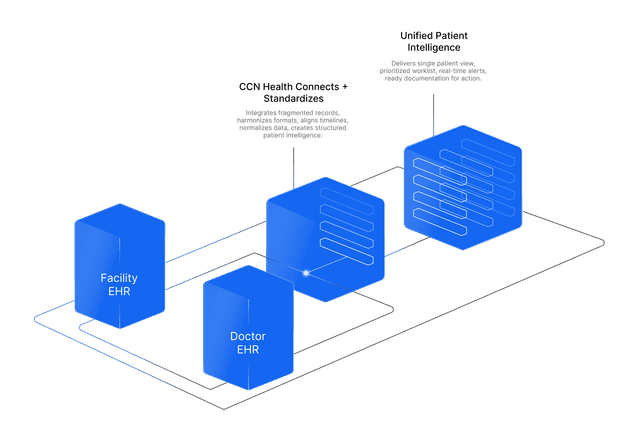
Memory care units within larger communities inherit the parent facility's EHR (typically ALIS, August Health, or PointClickCare). CCN Health integrates with all three, ensuring monitoring data and alerts appear in the resident's chart alongside behavioral assessments, medication records, and care plans.
Getting Started: Implementing RPM in Your Memory Care Facilitie
A typical RPM implementation in memory care follows a 4–8 week timeline:
- Week 1–2: Parent community EHR integration, medical director engagement, healthcare proxy consent documentation workflows established
- Week 3–4: XK300 sensor installation in resident rooms, baseline vital sign patterns established over initial monitoring period
- Week 5–6: Memory care staff training on alert protocols, behavioral-vital sign correlation awareness, family communication procedures
- Week 7–8: Full unit enrollment, billing validation, ongoing baseline calibration as residents' conditions evolve
Memory care implementations typically achieve faster enrollment than other settings because contactless devices can be deployed unit-wide without individual resident training or device education sessions.
Ready to implement RPM in your memory care facilitie? CCN Health provides full-service Remote Patient Monitoring with EHR integration, clinical oversight, and billing optimization purpose-built for memory care.
Disclaimer: This article is for informational purposes only and does not constitute medical, legal, or billing advice. CPT code reimbursement amounts are estimates based on CMS published fee schedules and may vary by region, payer, and clinical circumstances. Always consult qualified healthcare, billing, and technology professionals for guidance specific to your facility.
Let's figure this out together
We work closely with every client to find the right approach for their practice. Think of us as your partner, not just a platform.
Topics
Your Partner in Chronic Care
We love working closely with our clients to find the best solutions. Let us help guide you through the complicated stuff.
Why It Matters
Key Benefits
See how this approach drives measurable improvements across your organization.
RPM Program Management
Full Remote Patient Monitoring program delivery including enrollment, monitoring, clinical review, and billing documentation — purpose-built for memory care workflows.
EHR Integration
Bi-directional integration with Inherits parent community EHR (ALIS, August Health, PCC) ensures monitoring data flows into existing clinical workflows without manual data entry.
Revenue Optimization
~$145–185 per patient per month with RPM. Program stacking with CCM and PCM increases per-patient revenue further.
Zero-Interaction Monitoring
Contactless radar technology monitors vital signs continuously without any resident interaction — the only approach that works reliably for dementia populations.
Near-100% Compliance
Contactless devices automatically meet the 16-day transmission requirement every month — eliminating the compliance challenge that defeats traditional device programs in memory care.
Fall Detection
Passive radar-based fall detection without wearable pendants — residents cannot remove, lose, or refuse to wear a pendant they don't have.
Continue Reading
Related Articles
Explore more insights on this topic.
What Is Remote Patient Monitoring? A Complete Guide to RPM
A complete guide to Remote Patient Monitoring — what it is, how it works, who qualifies, which devices are used, and how providers bill Medicare for RPM services.
Remote Patient Monitoring for Long-Term Care — 2026 Guide
How RPM works in long-term care facilities — contactless monitoring for high-acuity residents, condition stabilization, EHR integration with PCC and MatrixCare, and Medicare billing for LTC settings.
Behavioral Health Integration for Memory Care — 2026 Guide
How BHI works in memory care — managing dementia-related behavioral symptoms (agitation, anxiety, depression), reducing unnecessary psychotropic use, supporting caregiver burden, and collaborative psychiatric care.
Common Questions
Frequently Asked Questions
Get answers to the most common questions about this topic.
Remote Patient Monitoring (RPM) for memory care is a Medicare-reimbursable program. residents with dementia and Alzheimer's receive continuous vital sign monitoring through contactless radar technology that requires zero patient interaction — solving the fundamental compliance challenge in memory care. Medicare beneficiaries with one or more chronic conditions.
RPM generates ~$145–185 per patient per month through CPT codes 99453, 99454, 99457, 99458. With CCM stacking, combined revenue reaches $220–315/patient/month. Adding BHI or RTM for qualifying patients can exceed $370/month.
Memory care units within larger communities inherit the parent facility's EHR. CCN Health integrates with ALIS, August Health, PCC. All monitoring data flows bi-directionally between CCN Health and the facility/physician EHR.
Not traditional devices — but contactless monitoring solves this entirely. The Xandar Kardian XK300 uses radar technology to measure heart rate, respiratory rate, and detect falls without any resident interaction. There are no buttons to press, no cuffs to wear, and no daily readings to remember. The device monitors continuously with near-100% billing compliance regardless of the resident's cognitive status.
Since memory care residents typically lack capacity to consent, RPM enrollment requires authorization from the resident's healthcare proxy — usually a family member or legal guardian. CCN Health provides proxy consent documentation templates that comply with state regulations. Clear documentation of proxy authorization is maintained in both the RPM platform and the facility EHR.
The XK300 monitors bed presence and room-level movement patterns. While not a dedicated wandering prevention system, it detects bed exits, unusual nighttime activity, and room vacancy — all of which can trigger alerts for potential wandering events. This data complements (but does not replace) dedicated elopement prevention systems.
Still have questions? We love helping practices figure this out — no pressure, just real answers.

Your Partner in Chronic Care
We're Here to Guide You Every Step of the Way
RPM, CCM, and chronic care management can get complicated. We work closely with every client to figure out the best solutions for their practice.