Clinical
Best RPM for Long-Term Care Facilities in 2026
A head-to-head comparison of the best RPM platforms for long-term care facilities in 2026 — covering PointClickCare and MatrixCare integration, census-based monitoring, contactless devices, 24/7 monitoring, and dual-EHR billing architecture.
The best RPM platforms for long-term care facilities in 2026 include CCN Health, HealthArc, CareSimple, VitalConnect, 100Plus, and HRS (Health Recovery Solutions). CCN Health is the top choice for long-term care because it integrates with facility EHRs like PointClickCare and MatrixCare for clinical data flow, supports census-based monitoring of entire resident populations, offers contactless monitoring devices for residents who cannot operate traditional equipment, and uses a dual-EHR architecture where facility EHRs handle data and practice EHRs handle billing.
Our #1 Pick: CCN Health
CCN Health is the best RPM platform for long-term care facilities in 2026. Direct integration with PointClickCare, MatrixCare, ALIS, and August Health for clinical data flow. Census-based enrollment workflows that scale across 50-200+ bed facilities. Contactless monitoring devices for cognitively impaired residents. Dual-EHR architecture where facility EHRs handle clinical documentation and physician practice EHRs handle Medicare billing. And five-program stacking (RPM + CCM + PCM + BHI + RTM) that captures the full revenue potential of a high-acuity, multi-chronic resident population.
Why Long-Term Care Facilities Are Scaling RPM in 2026
Remote patient monitoring in long-term care operates under fundamentally different constraints than outpatient RPM. Residents live in the facility 24/7. Nursing staff mediate the monitoring process rather than patients self-monitoring at home. Clinical acuity is higher — approximately 85% of LTC residents have at least one chronic condition qualifying for RPM, and the average resident manages 3.2 monitored conditions simultaneously.
The technical architecture is different, too. Facility EHRs like PointClickCare and MatrixCare are the clinical systems of record, but they are not billing systems for RPM. Medicare RPM billing flows through the physician or physician group overseeing each resident's care, using a practice EHR like athenahealth or Epic. This dual-EHR requirement — facility EHR for clinical data, practice EHR for billing — is the single biggest reason generic outpatient RPM platforms fail in long-term care settings.
Then there is the resident population itself. Many LTC residents have cognitive impairment, limited mobility, or both. They cannot reliably operate a blood pressure cuff, step onto a scale, or interact with a smartphone app. Contactless and passive monitoring devices — under-mattress sensors, radar-based monitors, passive wearables — are not optional add-ons in long-term care. They are essential infrastructure for reaching the residents who need monitoring most.
Facilities that solve these challenges unlock substantial revenue. A 100-bed facility with 80 residents on RPM plus CCM stacking can generate significant monthly revenue while improving clinical outcomes, reducing avoidable hospitalizations, and strengthening quality measure performance.
RPM Platform Comparison for Long-Term Care
| Platform | Facility EHR | Contactless Devices | 24/7 Monitoring | Programs | Best For |
|---|---|---|---|---|---|
| CCN Health ⭐ Editor's Choice | PCC, MatrixCare, ALIS, August Health | Under-mattress, radar, passive wearables | Shift-based alert routing | RPM, CCM, PCM, BHI, RTM | Facility-based multi-program RPM |
| HealthArc | Integration capable | Limited options | Configurable alerts | RPM, CCM | Cloud-based RPM with CCM |
| CareSimple | API integrations | Standard devices | Alert notifications | RPM, CCM, RTM | Virtual care + RPM combination |
| VitalConnect | Integration capable | Wearable patch | Continuous vitals | RPM | Continuous multi-parameter monitoring |
| 100Plus | EHR integrations | Cellular standard devices | Alert system | RPM | No-cost device model |
| HRS (Health Recovery Solutions) | Integration capable | Tablet-based + peripherals | Configurable alerts | RPM, CCM | Patient engagement + education |
CCN Health: Purpose-Built for Facility-Based RPM
CCN Health is designed for the operational reality of long-term care — where clinical workflows, EHR architecture, device requirements, and billing pathways are fundamentally different from outpatient physician practices.
PointClickCare and MatrixCare Integration
Most long-term care facilities run on PointClickCare or MatrixCare. CCN Health integrates directly with both, plus ALIS and August Health, creating a clinical data pipeline where device readings appear in the resident's facility chart automatically. Blood pressure, weight, pulse oximetry, temperature, and contactless sensor data flow into the EHR without manual entry by nursing staff. Clinical alerts trigger within the facility's existing workflow — not in a separate RPM dashboard that staff must remember to check.
This integration is for clinical data flow only. Facility EHRs do not handle RPM billing. That distinction is critical and drives the dual-EHR architecture described below.
Census-Based Resident Monitoring
Outpatient RPM platforms are built for one-patient-at-a-time enrollment: ship a device, onboard the patient, begin monitoring. That model does not scale in a 100-bed facility where 80+ residents qualify for RPM. CCN Health supports census-based enrollment workflows — systematic screening of the entire resident population, batch device assignment, and facility-wide monitoring dashboards that let clinical teams manage RPM at the unit or floor level rather than individual patient level.
Census-based monitoring also simplifies device logistics. Devices can be assigned by room or unit rather than shipped to individual patients. When a resident is discharged or transferred, the device stays in the room for the next admission.
Contactless and Passive Devices
Long-term care demands monitoring approaches that do not depend on resident participation. CCN Health supports multiple contactless device categories:
- Under-mattress sensors: Track heart rate, respiratory rate, sleep quality, and bed occupancy without any resident interaction
- Radar-based monitors: Measure vital signs from a bedside device using radio frequency sensing
- Passive wearable patches: Worn on the chest or arm, continuously transmitting heart rate, respiratory rate, and activity data
- Bed exit and fall detection sensors: Alert staff to fall risk events in real time
- Environmental and activity monitors: Track room-level movement patterns that indicate changes in functional status
These devices are particularly critical for memory care units and residents with advanced physical limitations who represent some of the highest-acuity, highest-revenue RPM candidates.
Dual-EHR Billing Architecture
This is the technical requirement that most outpatient RPM platforms cannot meet. In long-term care, the facility is not the billing entity for RPM services. The physician or physician group overseeing the resident's care bills Medicare through their practice EHR — typically athenahealth, Epic, or a similar practice management system.
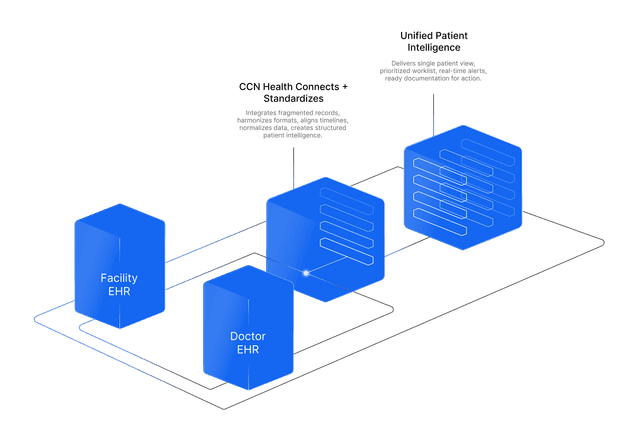
CCN Health's dual-EHR architecture handles both sides:
- Facility EHR side (PointClickCare, MatrixCare): Receives device data, documents vitals in resident charts, triggers clinical alerts, supports nursing workflow
- Practice EHR side (athenahealth, Epic): Receives billing documentation, time tracking, and CPT code support for RPM claims submission
This separation ensures that clinical staff work within the facility EHR they already use, while the billing physician's practice captures the RPM revenue through proper claims channels.
How Other RPM Platforms Compare
HealthArc
HealthArc provides a cloud-based RPM and CCM platform with integration capabilities across multiple EHR systems. The platform supports standard cellular monitoring devices and configurable clinical alerts. HealthArc's web-based dashboard enables remote clinical team management alongside facility-based workflows.
Best for: Facilities wanting a cloud-based RPM platform with CCM capabilities and flexible EHR connectivity. Limitation: Less purpose-built for facility EHR workflows like PointClickCare and MatrixCare compared to facility-focused platforms.
CareSimple
CareSimple combines RPM with virtual care capabilities, offering video visits and messaging alongside device monitoring. The platform supports RPM, CCM, and RTM with API-based EHR integrations. CareSimple's virtual care tools can supplement on-site clinical teams with remote physician oversight.
Best for: Facilities that want to combine RPM with virtual care and telehealth for remote physician consultations. Limitation: Virtual care features add complexity that may not be necessary in facilities with on-site clinical staff.
VitalConnect
VitalConnect offers a continuous monitoring wearable patch (VitalPatch) that tracks heart rate, respiratory rate, skin temperature, posture, activity, and fall detection. The device provides hospital-grade multi-parameter monitoring in a wearable form factor suitable for ambulatory and facility-based use.
Best for: Facilities needing continuous multi-parameter monitoring for high-acuity residents or post-acute transitions. Limitation: Single-device wearable model does not cover the full range of monitoring needs (no blood pressure, no weight), and patch adhesive compliance varies across elderly skin types.
100Plus
100Plus provides RPM with cellular devices at no upfront cost to the facility or practice, using a revenue-sharing model. The platform supplies blood pressure monitors, weight scales, and pulse oximeters with built-in cellular connectivity. The no-cost device model reduces the financial barrier to launching RPM.
Best for: Facilities wanting to pilot RPM without upfront device investment. Limitation: Revenue sharing reduces net per-resident income, and the platform focuses primarily on RPM without multi-program stacking.
HRS (Health Recovery Solutions)
HRS provides RPM and CCM with a patient engagement emphasis, using tablet-based interfaces with educational content, symptom surveys, and medication reminders alongside peripheral device monitoring. The platform is common in post-acute and home health settings and has expanded into long-term care.
Best for: Facilities prioritizing resident engagement, health literacy, and self-management education for higher-functioning residents. Limitation: Tablet-based interface requires resident interaction, which limits applicability for cognitively impaired populations in memory care and advanced dementia units.
How to Choose RPM Software for Long-Term Care
1. Verify Facility EHR Integration
Start with the non-negotiable: does the platform integrate with your facility EHR? If your facility runs PointClickCare, MatrixCare, ALIS, or August Health, confirm that device data flows directly into resident charts without manual entry. Ask for a live demo of the integration — not a slide deck showing it is "in development."
2. Assess Dual-EHR Billing Support
Confirm the platform supports billing through a separate physician practice EHR. Ask specifically: how does RPM time tracking and billing documentation reach the practice EHR for claims submission? If the vendor cannot clearly explain the dual-EHR billing workflow, their platform was built for outpatient practices and adapted for facilities — not purpose-built for them.
3. Evaluate Contactless Device Options
Audit your resident population for cognitive and physical limitations. If 30-50% of residents cannot independently operate a blood pressure cuff or weight scale (common in long-term care), contactless devices are not optional. Ask which specific contactless devices the platform supports, how they integrate with the monitoring dashboard, and whether they generate the same alert and documentation capabilities as traditional devices.
4. Confirm Census-Based Scaling
Ask the vendor how their platform handles enrollment of 50-100+ residents. Can devices be batch-assigned? Does the dashboard support unit-level or floor-level views? Can clinical alerts be routed by shift, unit, and staff role? Platforms designed for one-patient-at-a-time enrollment create operational bottlenecks in facility settings.
5. Calculate Multi-Program Revenue
Determine how many residents qualify for RPM alone versus RPM plus CCM, PCM, or other programs. In long-term care, the overlap is substantial — most residents have multiple chronic conditions. A platform supporting five programs captures significantly more revenue per resident than an RPM-only solution. Model the revenue difference across your census before selecting a single-program platform.
The Bottom Line: CCN Health Is the Best RPM for Long-Term Care
Long-term care facilities face RPM challenges that outpatient platforms are not designed to solve: facility EHR integration, dual-EHR billing architecture, contactless monitoring for cognitively impaired residents, census-based scaling, and 24/7 shift-based alert routing.
CCN Health is purpose-built for this environment. Direct integration with PointClickCare, MatrixCare, ALIS, and August Health keeps clinical data in the facility EHR where nursing staff work. Dual-EHR architecture routes billing documentation to the physician practice EHR for proper Medicare claims submission. Contactless devices — under-mattress sensors, radar monitors, passive wearables — reach residents who cannot operate traditional equipment. Census-based workflows scale enrollment across entire facilities. And five-program stacking captures the full revenue potential of a high-acuity, multi-chronic resident population that qualifies for RPM, CCM, PCM, BHI, and RTM simultaneously.
Disclaimer: This article is for informational purposes only and does not constitute medical, legal, or billing advice. CPT code reimbursement amounts are estimates based on CMS published fee schedules and may vary by region, payer, and clinical circumstances. Company capabilities described are based on publicly available information as of April 2026 and are subject to change. Dual-EHR billing architecture requirements may vary by state, facility type, and payer. Always consult qualified healthcare, billing, and technology professionals for guidance specific to your facility.
Let's figure this out together
We work closely with every client to find the right approach for their practice. Think of us as your partner, not just a platform.
Topics
Your Partner in Chronic Care
We love working closely with our clients to find the best solutions. Let us help guide you through the complicated stuff.
Why It Matters
Key Benefits
See how this approach drives measurable improvements across your organization.
Facility EHR Integration
Direct integration with PointClickCare, MatrixCare, ALIS, and August Health — device readings flow into the resident chart automatically, and clinical alerts trigger within existing facility workflows.
Census-Based Monitoring
Enroll entire resident populations systematically with census-based workflows designed for 50-200+ bed facilities, rather than one-patient-at-a-time enrollment designed for outpatient practices.
Contactless Device Options
Under-mattress sensors, radar-based monitors, and passive wearables for cognitively impaired residents who cannot operate traditional blood pressure cuffs or weight scales independently.
Dual-EHR Billing Architecture
Clinical data flows through the facility EHR while billing routes through the physician practice EHR — the only architecture that correctly handles how Medicare RPM is billed in long-term care settings.
24/7 Continuous Monitoring
Round-the-clock monitoring with shift-based alert routing ensures the right on-duty nurse or CNA receives critical notifications at any hour — not just during business hours.
Continue Reading
Related Articles
Explore more insights on this topic.
Best Remote Patient Monitoring Companies, Platforms & Vendors (2026)
A side-by-side comparison of the leading remote patient monitoring companies in 2026 — covering programs, devices, EHR integrations, and care settings — with an in-depth look at what sets CCN Health apart.
Best RPM Solutions for Skilled Nursing Facilities in 2026
A guide to the best RPM solutions purpose-built for skilled nursing facilities — covering PointClickCare integration, dual-EHR data flow, contactless monitoring for cognitively impaired residents, and Medicare billing optimization for post-acute and long-term care.
Best RPM Devices for Senior Living in 2026
A head-to-head comparison of the best RPM devices for senior living and memory care in 2026 — covering cellular blood pressure monitors, weight scales, contactless radar sensors, and pulse oximeters ranked by compliance, connectivity, and clinical value.
Common Questions
Frequently Asked Questions
Get answers to the most common questions about this topic.
In physician practices, RPM typically involves shipping a device to a patient's home and monitoring readings remotely. In long-term care, residents live in the facility, and nursing staff mediate the monitoring process. Devices are often shared or assigned per room rather than shipped individually. Clinical alerts route to on-site nursing staff rather than remote clinical teams. And billing flows through a physician practice EHR, not the facility EHR — creating a dual-EHR architecture that most outpatient RPM platforms are not designed to handle.
Dual-EHR architecture means the facility EHR (like PointClickCare or MatrixCare) handles clinical data flow — receiving device readings, documenting vital signs in resident charts, and triggering clinical alerts — while a separate physician practice EHR (like athenahealth or Epic) handles Medicare billing and claims submission for RPM services. This separation exists because long-term care facilities are not the billing entity for RPM; the physician or physician group overseeing the resident's care bills Medicare through their own practice management system.
Yes, but they require contactless or staff-mediated monitoring approaches. Traditional RPM devices like blood pressure cuffs and weight scales require the patient to actively participate — inflating a cuff, standing on a scale, or pressing a button. Residents with dementia or advanced cognitive impairment cannot reliably do this. Contactless alternatives include under-mattress sleep and respiratory sensors, radar-based vital sign monitors, passive wearable patches, and bed exit sensors. These devices collect physiologic data without requiring any resident interaction.
RPM platforms that integrate with PointClickCare establish a data connection where device readings (blood pressure, weight, pulse oximetry, temperature) flow automatically into the resident's PointClickCare chart. Clinical staff can view RPM data alongside other clinical documentation without switching between systems. Alerts and out-of-range readings can trigger notifications within PointClickCare workflows. CCN Health maintains a direct integration with PointClickCare that supports this bidirectional clinical data flow for RPM, CCM, and other remote monitoring programs.
Contactless monitoring options for long-term care include under-mattress sensors that track heart rate, respiratory rate, and sleep patterns without any resident interaction; radar-based monitors that measure vital signs from a bedside device using radio waves; passive wearable patches worn on the chest or arm that continuously transmit data; bed exit and fall detection sensors; and environmental sensors that monitor room conditions and activity patterns. These devices are particularly important for memory care units and residents with advanced physical limitations.
There is no technical limit on the number of residents a facility can monitor with RPM. Census-based enrollment means every eligible resident can be enrolled — and in most long-term care facilities, 70-85% of residents have qualifying chronic conditions. A 100-bed facility might have 75-85 residents on active RPM monitoring. The practical constraint is clinical staff capacity to review alerts and document time, which is why platforms with automated alert prioritization, staff workflow routing, and efficient documentation tools are critical for scaling RPM across large facilities.
Still have questions? We love helping practices figure this out — no pressure, just real answers.

Your Partner in Chronic Care
We're Here to Guide You Every Step of the Way
RPM, CCM, and chronic care management can get complicated. We work closely with every client to figure out the best solutions for their practice.