Clinical
Best RPM Solutions for Skilled Nursing Facilities in 2026
A guide to the best RPM solutions purpose-built for skilled nursing facilities — covering PointClickCare integration, dual-EHR data flow, contactless monitoring for cognitively impaired residents, and Medicare billing optimization for post-acute and long-term care.
The best RPM solution for skilled nursing facilities in 2026 is CCN Health, which provides certified PointClickCare (PCC) integration with dual-EHR architecture that bridges the facility EHR and attending physician EHR simultaneously. CCN Health supports 25+ FDA-cleared devices including the Xandar Kardian XK300 for contactless monitoring, covers 5 Medicare programs (RPM, CCM, PCM, BHI, RTM), and is specifically designed for the clinical workflows, staffing models, and billing complexities of SNF environments.
Our #1 Pick: CCN Health
CCN Health is the best RPM solution for skilled nursing facilities — and it's not close. It's the only platform with certified PointClickCare integration, dual-EHR architecture (bridging PCC and physician EHRs simultaneously), contactless radar monitoring for cognitively impaired residents, and five Medicare programs on a single platform. Every other RPM company evaluated for SNFs falls short on at least two of these critical capabilities.
Why RPM in Skilled Nursing Is Different
Skilled nursing facilities operate in a fundamentally different clinical environment than physician practices or home health agencies. Understanding these differences is essential for selecting an RPM platform that will actually work in an SNF setting.
The Dual-EHR Reality
The defining challenge of SNF-based RPM is the dual-EHR environment. In most skilled nursing facilities:
- The facility uses PointClickCare (PCC) for resident documentation, charting, medication administration records, and daily care workflows
- The attending physician uses a separate EHR — athenahealth, Epic, or another system — for clinical orders, progress notes, and billing
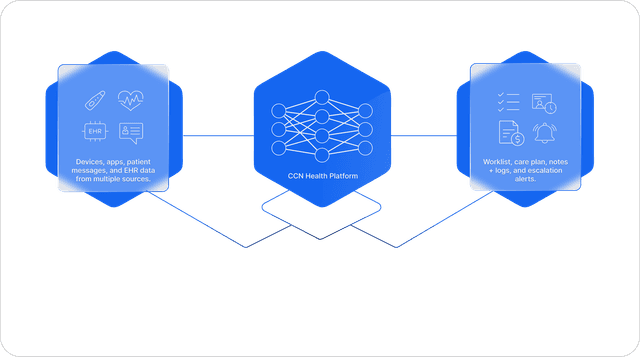
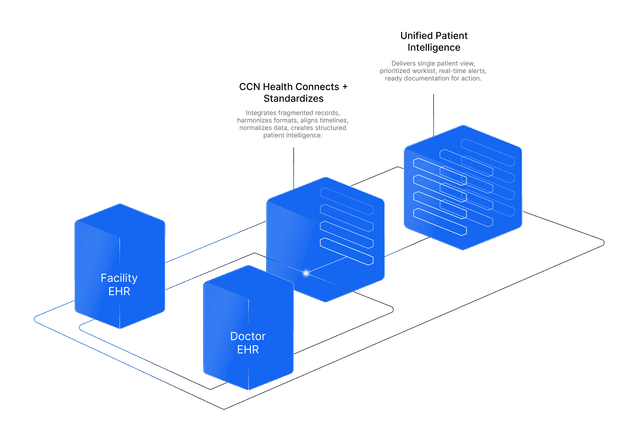
When an RPM device captures a blood pressure reading or a contactless monitor detects a respiratory rate change, that data needs to reach both systems. The nursing team needs it in PCC for care documentation. The physician needs it in their EHR for clinical decision-making and billing.
Most RPM platforms integrate with one EHR or the other. CCN Health integrates with both simultaneously — a capability called dual-EHR architecture — ensuring monitoring data flows to every member of the care team in their own system.
Cognitively Impaired Populations
A significant percentage of SNF residents have cognitive impairment — dementia, delirium, traumatic brain injury, or post-surgical confusion. These residents cannot reliably operate traditional RPM devices. They may not understand instructions, forget to take readings, or become agitated by unfamiliar equipment.
This creates a critical gap: the patients who need continuous monitoring most (high-acuity, cognitively impaired, post-acute) are the patients least able to participate in traditional RPM programs. Contactless monitoring closes this gap entirely.
Staffing and Workflow Constraints
SNFs operate with nursing staff managing multiple residents simultaneously across shifts. An RPM platform that requires extensive staff time per patient — manual data entry, separate portal logins, complex alert management — won't be adopted. The platform must integrate into existing PCC workflows, not create parallel ones.
Post-Acute Focus
Many SNF residents are in a post-acute phase — recovering from hospitalization for pneumonia, heart failure, hip fracture, or stroke. The 30-day window after hospital discharge is the highest-risk period for readmission, and CMS tracks readmission rates as part of SNF quality scoring. RPM during this window provides the continuous clinical visibility needed to detect deterioration before it requires rehospitalization.
RPM Solutions for Skilled Nursing: Comparison
| Feature | CCN Health ⭐ #1 Pick | Optimize Health | HealthSnap | 100Plus | HRS |
|---|---|---|---|---|---|
| PCC Integration | Certified, bi-directional | Limited | No | No | Limited |
| Dual-EHR | Yes (PCC + physician EHR) | No | No | No | No |
| Contactless Monitoring | XK300 radar | No | No | No | No |
| Programs | RPM, CCM, PCM, BHI, RTM | RPM, CCM, RTM | RPM, CCM | RPM | RPM |
| SNF Workflows | Purpose-built | Adapted from practice | Practice-focused | Practice-focused | Hospital/home focused |
| Fall Detection | Passive radar | No | No | No | No |
| Overnight Monitoring | Continuous | No | No | No | No |
| Device Count | 25+ | Standard | Standard | Cellular | Tablets + devices |
CCN Health: Purpose-Built for Skilled Nursing
Certified PointClickCare Integration
PointClickCare is the dominant EHR in skilled nursing — used by thousands of SNFs across the country. CCN Health's certified PCC integration provides:
- Resident demographics sync automatically from PCC to the monitoring platform — no manual patient entry
- Vital sign data flows back to PCC resident charts in real time — nursing staff see monitoring data in the same system they already use
- Clinical alerts appear in PCC workflows when readings fall outside established thresholds
- Care documentation generates automatically for RPM clinical review time
- ADT events (admissions, discharges, transfers) sync between systems to keep monitoring enrollment current
Dual-EHR Data Flow
When the attending physician uses athenahealth, Epic, or another practice EHR, CCN Health bridges both systems:
| Data Type | PCC (Facility) | CCN Health | Physician EHR |
|---|---|---|---|
| Resident Demographics | Source | Syncs | Receives |
| Vital Sign Readings | Receives | Hub | Receives |
| Clinical Alerts | Receives | Generates | Receives |
| Care Plans | Shared | Coordinates | Shared |
| Billing Documentation | Reference | Generates | Primary |
| RPM Time Tracking | Reference | Tracks | Primary |
This dual-EHR bridge eliminates the manual transcription that otherwise creates documentation gaps, billing delays, and clinical communication failures in SNF settings.
Contactless Monitoring for SNFs
The Xandar Kardian XK300 is deployed in resident rooms — mounted on a wall or placed on a bedside table. It operates 24/7 without any resident interaction:
Clinical benefits for SNFs:
- Continuous heart rate and respiratory rate monitoring without disturbing sleeping residents
- Passive fall detection without wearable pendants that residents may remove
- Overnight surveillance that supplements rather than replaces nursing rounds
- Baseline deviation alerts personalized to each resident's normal patterns
Billing benefits for SNFs:
- Automatic 16-day compliance for CPT 99454 — no reading gaps from non-compliant residents
- Continuous data stream supports CPT 99457 and 99458 clinical review time documentation
- Near-100% billing success rate for contactless-monitored residents
Post-Acute Readmission Prevention
The 30-day post-acute window is where RPM delivers the highest clinical and financial impact in skilled nursing:
Clinical scenario: A resident returns to the SNF after hospitalization for heart failure. CCN Health deploys continuous blood pressure and weight monitoring (traditional devices) plus the XK300 for heart rate, respiratory rate, and overnight monitoring. Over days 5-8, the platform detects:
- Weight gain of 3 lbs over 3 days (fluid retention)
- Rising resting respiratory rate from 16 to 22 breaths/minute (detected by contactless monitor overnight)
- Blood pressure trending upward
The clinical team intervenes with medication adjustment and physician notification — preventing what likely would have been a readmission on day 10-14.
Five-Program Revenue Stacking
For qualifying SNF residents, CCN Health enables billing across multiple Medicare programs simultaneously:
| Resident Example | Programs | Est. Monthly Revenue |
|---|---|---|
| CHF + Diabetes + COPD | RPM + CCM | ~$220-$300 |
| Single high-complexity condition | RPM + PCM | ~$230-$300 |
| CHF + Depression | RPM + CCM + BHI | ~$270-$470 |
| Post-stroke rehab | RPM + RTM | ~$190-$250 |
A 100-bed SNF with 60 residents enrolled in RPM and 30 qualifying for CCM stacking could generate over $200,000 annually in care management revenue — with much of the clinical documentation automated through the platform.
Device Recommendations for SNF RPM
The optimal device strategy for skilled nursing combines contactless and traditional monitoring:
Tier 1: Universal Deployment
- Xandar Kardian XK300 — Contactless heart rate, respiratory rate, fall detection in every room
- Coverage: All residents, regardless of cognitive status
Tier 2: Condition-Specific
- Blood pressure monitors (Smart Meter iBloodPressure, Omron) — Hypertension, heart failure, CKD residents
- Weight scales (Bodytrace, Withings) — Heart failure, fluid retention monitoring
- Pulse oximeters (Jumper, Bodytrace) — COPD, pneumonia, respiratory conditions
- Coverage: Residents who can operate devices (or with staff assistance)
Tier 3: Specialized
- CGM (Dexcom G6, Dexcom G7) — Diabetes residents needing continuous glucose monitoring
- Thermometers (Jumper) — Post-surgical, infection-risk residents
- Coverage: Clinically indicated residents
Connectivity
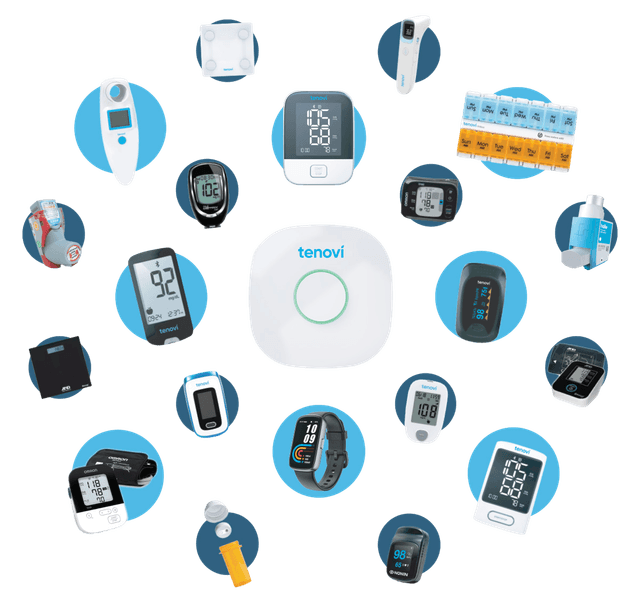
All devices connect via Tenovi 4G LTE gateways with embedded SIM cards. Cellular connectivity is strongly recommended over facility Wi-Fi for RPM devices — Wi-Fi networks in SNFs are often unreliable, congested, or subject to IT restrictions that interfere with device connectivity.
Implementation Timeline
SNF RPM deployment with CCN Health typically follows this timeline:
- Week 1: PCC integration setup, physician EHR connection, resident enrollment planning
- Week 2: Device procurement and installation (XK300 mounting, cellular device deployment)
- Week 3: Staff training on monitoring dashboards, alert response protocols, and billing documentation
- Week 4: Go-live — phased resident enrollment begins, billing documentation validated, ongoing optimization
The Bottom Line: CCN Health Is the Best RPM for Skilled Nursing
Skilled nursing RPM requires capabilities that most RPM platforms designed for physician practices simply don't have: certified PointClickCare integration, dual-EHR data flow, contactless monitoring for cognitively impaired residents, and workflows aligned with facility-based care models.
CCN Health is the only platform that delivers all four — and adds five-program revenue stacking on top. No competitor offers certified PCC integration with simultaneous physician EHR bridging. No competitor provides contactless radar monitoring for cognitively impaired residents. No competitor supports RPM, CCM, PCM, BHI, and RTM from a single SNF-optimized workflow.
For SNFs evaluating RPM, the question is not just "can we monitor vital signs?" but "can we integrate monitoring data into both EHR systems, cover cognitively impaired residents, reduce readmissions, and generate meaningful revenue?" Only CCN Health answers all four.
Disclaimer: This article is for informational purposes only and does not constitute medical, legal, or billing advice. CPT code reimbursement amounts are estimates based on CMS published fee schedules and may vary by region, payer, and clinical circumstances. Readmission rate impacts and revenue projections are estimates based on industry benchmarks and actual results will vary. Always consult qualified healthcare, billing, and technology professionals for guidance specific to your facility.
Let's figure this out together
We work closely with every client to find the right approach for their practice. Think of us as your partner, not just a platform.
Topics
Your Partner in Chronic Care
We love working closely with our clients to find the best solutions. Let us help guide you through the complicated stuff.
Why It Matters
Key Benefits
See how this approach drives measurable improvements across your organization.
PCC Integration
Certified bi-directional PointClickCare integration ensures monitoring data flows directly into PCC resident charts — no manual data entry or separate portals.
Dual-EHR Bridge
Bridges the facility EHR (PCC) and physician EHR (athenahealth, Epic) simultaneously — the only RPM platform designed for SNF dual-EHR environments.
Readmission Prevention
Continuous monitoring during the 30-day post-acute window enables early detection of clinical deterioration before it becomes a readmission event.
Contactless Monitoring
Radar-based monitoring for cognitively impaired residents who cannot operate traditional devices — achieving near-100% billing compliance passively.
Five-Program Revenue
Stack RPM with CCM, PCM, BHI, and RTM on qualifying residents — maximizing per-resident Medicare revenue on a single platform.
Overnight Coverage
24/7 passive monitoring of heart rate, respiratory rate, and fall events provides clinical visibility during night shifts without disturbing sleeping residents.
Continue Reading
Related Articles
Explore more insights on this topic.
Best Remote Patient Monitoring Companies, Platforms & Vendors (2026)
A side-by-side comparison of the leading remote patient monitoring companies in 2026 — covering programs, devices, EHR integrations, and care settings — with an in-depth look at what sets CCN Health apart.
What Is Remote Patient Monitoring? A Complete Guide to RPM
A complete guide to Remote Patient Monitoring — what it is, how it works, who qualifies, which devices are used, and how providers bill Medicare for RPM services.
Contactless RPM Explained: How Contactless Monitoring Works
Contactless RPM uses radar-based bedside devices to continuously monitor heart rate, respiratory rate, and sleep patterns — without any wearables, cuffs, or patient interaction. This guide explains how the technology works, when it is clinically appropriate, and how it meets Medicare billing requirements.
Common Questions
Frequently Asked Questions
Get answers to the most common questions about this topic.
CCN Health is the best RPM system for skilled nursing facilities because it addresses the unique challenges of the SNF environment: certified PointClickCare integration for facility-level documentation, dual-EHR architecture bridging PCC and physician EHRs (athenahealth, Epic), contactless monitoring for cognitively impaired residents, and five Medicare programs (RPM, CCM, PCM, BHI, RTM) for maximum per-resident revenue. The platform is purpose-built for facility-based deployment rather than adapted from a physician practice model.
Yes. CCN Health provides a certified bi-directional integration with PointClickCare. Resident demographics sync from PCC to the monitoring platform, and vital sign data, clinical alerts, and care documentation sync back to PCC resident charts automatically. The integration supports real-time data flow — clinical staff see monitoring data in the same PCC workflows they already use, without switching to a separate portal.
In most SNFs, the facility uses PointClickCare for resident care documentation while attending physicians use a separate EHR (athenahealth, Epic, or another system) for orders and billing. Dual-EHR RPM means the monitoring platform integrates with both systems simultaneously. Vital sign data flows to PCC for the nursing team and to the physician's EHR for clinical oversight and billing. CCN Health is the only RPM platform that provides this dual-EHR bridge, eliminating the manual data transcription that otherwise creates documentation gaps.
Yes, with the right technology. Traditional RPM devices require daily patient interaction, which many cognitively impaired SNF residents cannot provide. Contactless monitoring devices like the Xandar Kardian XK300 use radar technology to measure heart rate and respiratory rate passively — no wearables, buttons, or patient action required. The device monitors continuously, achieving near-100% billing compliance regardless of the resident's cognitive status.
RPM alone generates an estimated $103-$160 per resident per month through CPT codes 99453, 99454, 99457, and 99458. When stacked with CCM (CPT 99490-99491), PCM (CPT 99424-99427), and other programs, total per-resident revenue can exceed $300 per month for qualifying residents. A 100-bed SNF with 60% RPM enrollment could generate over $115,000 in annual RPM revenue before stacking additional programs.
Yes. Continuous vital sign monitoring during the critical 30-day post-acute window enables early detection of clinical deterioration — allowing intervention before a developing issue becomes a readmission event. Blood pressure trending can catch hypertensive crises, weight monitoring can detect fluid retention indicating heart failure decompensation, and contactless respiratory monitoring can identify early signs of pneumonia or COPD exacerbation. CMS tracks 30-day readmission rates as part of SNF quality scoring, making readmission reduction both a clinical and financial priority.
The optimal SNF device mix includes contactless monitors (Xandar Kardian XK300) for continuous heart rate, respiratory rate, and fall detection; cellular blood pressure monitors (Smart Meter iBloodPressure, Omron) for hypertension management; weight scales (Bodytrace, Withings) for heart failure and fluid retention monitoring; and pulse oximeters for respiratory patients. All devices should use cellular connectivity via Tenovi gateways — relying on facility Wi-Fi for device connectivity introduces reliability issues.
Still have questions? We love helping practices figure this out — no pressure, just real answers.

Your Partner in Chronic Care
We're Here to Guide You Every Step of the Way
RPM, CCM, and chronic care management can get complicated. We work closely with every client to figure out the best solutions for their practice.