Clinical
Best RPM for Home Health Agencies in 2026
A head-to-head comparison of the best RPM platforms for home health agencies in 2026 — covering portable cellular devices, distributed patient monitoring, caregiver coordination, Medicare Part B billing, and multi-program stacking for home-based care.
The best RPM platforms for home health agencies in 2026 include CCN Health, HealthArc, Accuhealth, Medtronic Care Management, CoachCare, and CareSimple. CCN Health is the top choice for home health because it provides 25+ cellular devices that work without patient Wi-Fi or smartphones, supports distributed patient monitoring across hundreds of homes, integrates caregiver coordination workflows, stacks five Medicare programs (RPM + CCM + PCM + BHI + RTM) on one platform, and automates billing documentation for Medicare Part B reimbursement.
Our #1 Pick: CCN Health
CCN Health is the best RPM platform for home health agencies in 2026. Over 25 cellular-enabled devices that work without patient Wi-Fi or smartphones. A centralized monitoring dashboard built for distributed patient populations spread across hundreds of separate homes. Caregiver coordination workflows that keep family members and home aides in the loop. Five-program stacking (RPM + CCM + PCM + BHI + RTM) that turns multi-chronic home-bound patients into $220+ per month revenue opportunities. And automated Medicare Part B billing documentation that eliminates the administrative bottleneck preventing most agencies from scaling past a pilot program.
Why Home Health Agencies Are the Next Frontier for RPM
Home health is the fastest-growing setting for RPM adoption — and the one with the most untapped potential. Home-bound patients have higher chronic disease burden, less frequent in-person clinical contact, and greater risk of preventable hospitalizations than any other patient population. RPM closes the monitoring gap between home health visits by collecting daily vital signs — blood pressure, weight, pulse oximetry, glucose — and surfacing actionable trends before they become emergencies.
The financial opportunity is equally compelling. Medicare Part B reimburses RPM at an estimated $160+ per patient per month through CPT codes 99453-99458. Most home health patients have multiple chronic conditions, making them eligible for concurrent CCM billing (CPT 99490, 99439) that adds $62-$83 per month. Many also qualify for RTM or PCM. A well-structured home health RPM program can generate $220+ per patient per month through program stacking — revenue that flows directly to the agency, separate from the home health episode payment.
Yet only an estimated 35% of home health agencies have active RPM programs. The barrier is operational, not clinical: distributed device logistics across hundreds of homes, connectivity challenges for patients without Wi-Fi, caregiver coordination complexity, and Medicare billing documentation at scale. This guide compares the leading RPM platforms for home health across the dimensions that determine whether an agency can scale RPM beyond a small pilot.
RPM Platform Comparison for Home Health
| Platform | Cellular Devices | Patient Capacity | EHR Integration | Programs | Best For |
|---|---|---|---|---|---|
| CCN Health ⭐ Editor's Choice | 25+ cellular devices | Scales to 500+ per staff | athenahealth, Epic, + 6 more | RPM, CCM, PCM, BHI, RTM | Distributed home-based monitoring at scale |
| HealthArc | Cellular BP, weight, SpO2 | Mid-size panels | EHR integrations | RPM, CCM, RTM | Turnkey RPM with billing support |
| Accuhealth | Cellular device kits | Managed service model | EHR connections | RPM, CCM | Fully managed RPM operations |
| Medtronic Care Management | Cellular and connected devices | Enterprise scale | Major EHR integrations | RPM, CCM | Enterprise health systems with home health arms |
| CoachCare | Cellular BP, weight, glucose | Mid to large panels | EHR integrations | RPM, CCM, RTM | White-label RPM platform |
| CareSimple | Cellular and Bluetooth devices | Scalable architecture | HL7/FHIR integrations | RPM | Virtual care integration focus |
CCN Health: Built for Distributed Home-Based Monitoring
CCN Health's platform addresses the specific operational challenges that make home health RPM different from clinic-based monitoring — cellular connectivity independence, distributed patient management, caregiver workflows, and multi-program billing automation.
Cellular-First Device Ecosystem
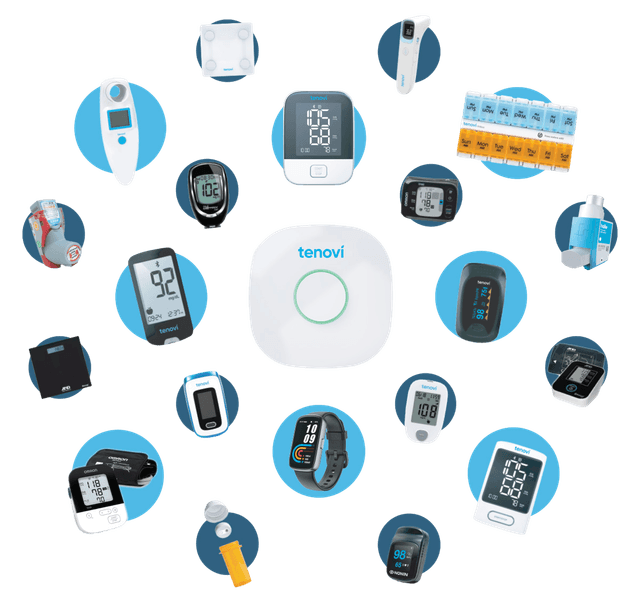
Home-bound patients often lack reliable Wi-Fi, smartphones, or the technical ability to manage Bluetooth pairing. CCN Health eliminates these dependencies with 25+ cellular-enabled devices that transmit readings automatically over built-in cellular connections. The device lineup includes cellular blood pressure monitors, weight scales, pulse oximeters, glucose meters, and temperature monitors — each designed for one-button operation with large displays suitable for elderly patients. Devices ship directly to the patient's home with simple setup instructions that caregivers can follow without technical support.
Distributed Patient Dashboard
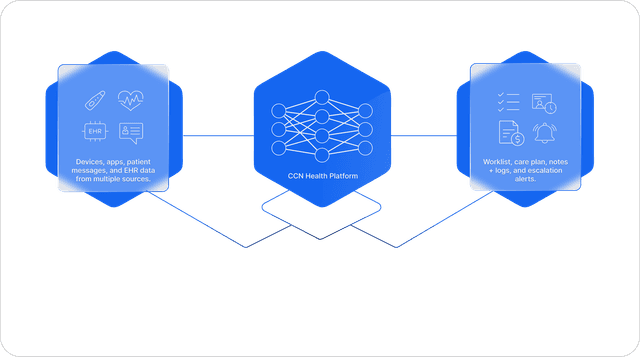
Clinic-based RPM monitors a concentrated patient panel from one location. Home health RPM monitors patients scattered across a service area spanning dozens of zip codes. CCN Health's dashboard is built for this distributed model — displaying patient compliance status, connectivity health, alert prioritization, and reading trends across the entire panel. Clinical staff can identify which patients have missed readings, which devices have connectivity issues, and which alerts require immediate clinical response without scrolling through individual patient records.
Caregiver and Family Coordination
Home health patients rely on a care circle that extends beyond clinical staff — family members, home health aides, and informal caregivers are often the people ensuring daily readings happen. CCN Health provides caregiver visibility into patient readings and alert status, enabling family members to see trends, receive threshold notifications, and communicate with clinical staff through the platform. This coordination layer is essential for maintaining compliance in a setting where clinical staff visit the home intermittently rather than daily.
Multi-Program Revenue for Home-Bound Patients
Home health patients are among the strongest candidates for multi-program stacking because of their high chronic disease burden:
| Patient Profile | Qualifying Programs | Est. Monthly Revenue |
|---|---|---|
| Hypertension only | RPM | ~$160 |
| Hypertension + Diabetes | RPM + CCM | ~$220 |
| CHF + COPD + Hypertension | RPM + CCM + PCM | ~$300+ |
| CHF + COPD + HTN + Depression | RPM + CCM + PCM + BHI | ~$370+ |
CCN Health manages all five programs on a single platform with separate time tracking, clinical documentation, and billing code generation for each — eliminating the need for multiple systems or manual billing reconciliation.
How Other RPM Platforms Compare
HealthArc
HealthArc provides RPM, CCM, and RTM with cellular device options and integrated billing support. The platform offers a turnkey approach with device provisioning, clinical monitoring workflows, and claims management. HealthArc supports standard vital sign devices with cellular connectivity and connects to practice EHR systems.
Best for: Home health agencies wanting a turnkey RPM solution with built-in billing support. Limitation: Device ecosystem is narrower than platforms offering 25+ cellular options, which may limit monitoring flexibility for diverse patient populations.
Accuhealth
Accuhealth operates a fully managed RPM service model — the company provides devices, clinical monitoring staff, and billing management as a complete outsourced service. Home health agencies refer patients and Accuhealth handles the operational execution. The model reduces internal staffing requirements but also reduces per-patient revenue since the managed service takes a share.
Best for: Home health agencies that want RPM revenue without building internal monitoring infrastructure. Limitation: Managed service model means lower net revenue per patient and less clinical control over monitoring workflows and patient interactions.
Medtronic Care Management
Medtronic Care Management (formerly Patient Care Management Services) brings enterprise-grade RPM infrastructure backed by Medtronic's device manufacturing and health system relationships. The platform supports large-scale deployments with cellular and connected device options, integration with major EHR systems, and RPM plus CCM program management.
Best for: Large health systems with home health divisions that want enterprise-scale RPM infrastructure. Limitation: Enterprise focus and pricing structure may not suit independent mid-size home health agencies.
CoachCare
CoachCare provides a white-label RPM platform that agencies can brand as their own. The platform supports cellular blood pressure monitors, weight scales, and glucose meters alongside RPM, CCM, and RTM billing. CoachCare's white-label approach lets agencies present RPM as an integrated part of their home health services rather than a third-party add-on.
Best for: Home health agencies wanting a brandable RPM platform integrated into their service identity. Limitation: White-label customization requires more setup and configuration time than turnkey platforms.
CareSimple
CareSimple focuses on virtual care integration, positioning RPM as part of a broader telehealth and remote care platform. The platform supports both cellular and Bluetooth device options with HL7/FHIR-based EHR integrations. CareSimple's architecture is designed for health systems building comprehensive virtual care programs that include RPM as one component.
Best for: Home health agencies integrating RPM into a broader virtual care or telehealth strategy. Limitation: Primary focus on RPM billing — fewer multi-program stacking options compared to platforms supporting five concurrent Medicare programs.
How to Choose RPM Software for Home Health
1. Prioritize Cellular Connectivity
This is the single most important criterion for home health RPM. If devices require Wi-Fi or Bluetooth smartphone pairing, compliance rates for home-bound elderly patients will fall below the 16-day transmission threshold required for RPM billing (CPT 99454). Verify that the platform offers cellular-enabled devices for every vital sign you plan to monitor — not just blood pressure but also weight, SpO2, glucose, and temperature.
2. Evaluate Distributed Monitoring Capabilities
Ask how the platform handles 200+ patients spread across a service area. Can clinical staff see compliance status, connectivity health, and alert priority across the full panel in a single view? Does the dashboard support geographic filtering, device status monitoring, and batch operations? A platform designed for clinic-based monitoring will break down operationally when applied to distributed home health populations.
3. Assess Caregiver Integration
Home health RPM depends on caregivers — family members and home aides who help patients take readings and respond to alerts. Evaluate whether the platform provides caregiver-facing tools: reading visibility, alert notifications, messaging with clinical staff, and educational content. Platforms that treat RPM as a clinician-only workflow miss the care coordination reality of home-based monitoring.
4. Calculate Multi-Program Revenue
Determine what percentage of your home health patients qualify for programs beyond RPM. Most home-bound patients have 2+ chronic conditions (qualifying for CCM), many have complex medical needs (qualifying for PCM), and a significant subset has behavioral health comorbidities (qualifying for BHI). A platform supporting one or two programs captures a fraction of the available revenue. Five-program stacking on a single platform maximizes per-patient yield.
5. Verify Medicare Billing Automation
RPM billing requires tracking 16-day device transmission windows, clinical time thresholds, and proper CPT code assignment (99453 for setup, 99454 for device supply, 99457 for first 20 minutes of clinical time, 99458 for each additional 20 minutes). At scale across hundreds of home health patients, manual billing tracking is unsustainable. Verify that the platform automatically tracks transmission days, logs clinical time, generates billing-ready documentation, and flags patients approaching or missing billing thresholds.
The Bottom Line: CCN Health Is the Best RPM for Home Health Agencies
Home health agencies face a unique set of RPM challenges that generic clinic-focused platforms were not designed to solve. Distributed patient populations, cellular connectivity requirements, caregiver coordination, and billing complexity at scale all demand purpose-built infrastructure.
CCN Health is the strongest platform for home health RPM in 2026. Over 25 cellular devices eliminate Wi-Fi and smartphone dependencies for home-bound patients. A distributed monitoring dashboard manages hundreds of patients across a wide service area from a single clinical view. Caregiver coordination workflows keep family members and home aides informed and engaged. Five-program stacking captures $220+ per patient per month from the multi-chronic home health population. And automated Medicare Part B billing documentation scales the program past the pilot stage where most agencies stall.
Disclaimer: This article is for informational purposes only and does not constitute medical, legal, or billing advice. CPT code reimbursement amounts are estimates based on CMS published fee schedules and may vary by region, payer, and clinical circumstances. Adoption statistics represent industry estimates and may vary by source. Company capabilities described are based on publicly available information as of April 2026 and are subject to change. Always consult qualified healthcare, billing, and technology professionals for guidance specific to your agency.
Let's figure this out together
We work closely with every client to find the right approach for their practice. Think of us as your partner, not just a platform.
Topics
Your Partner in Chronic Care
We love working closely with our clients to find the best solutions. Let us help guide you through the complicated stuff.
Why It Matters
Key Benefits
See how this approach drives measurable improvements across your organization.
Cellular-First Devices
25+ cellular-enabled devices that transmit readings automatically without Wi-Fi, Bluetooth, or smartphone apps — essential for home-bound patients who lack reliable internet connectivity.
Distributed Patient Monitoring
A centralized dashboard designed for monitoring hundreds of patients across separate residences, with geographic views, connectivity status tracking, and per-patient compliance metrics.
Caregiver Coordination
Caregiver portal giving family members and home aides visibility into readings, alert notifications, and messaging with clinical staff — keeping the care circle informed without clinical overload.
Five-Program Stacking
Stack RPM + CCM + PCM + BHI + RTM on the same patient from one platform. Most home health patients qualify for multiple programs, generating $220+ per patient per month.
Automated Medicare Billing
Automated tracking of 16-day transmission requirements, clinical time logging, and CPT code documentation for Medicare Part B reimbursement — eliminating manual billing reconciliation.
Continue Reading
Related Articles
Explore more insights on this topic.
Best Remote Patient Monitoring Companies, Platforms & Vendors (2026)
A side-by-side comparison of the leading remote patient monitoring companies in 2026 — covering programs, devices, EHR integrations, and care settings — with an in-depth look at what sets CCN Health apart.
RPM Revenue Guide: How Much Can Your Practice Earn?
A detailed breakdown of estimated RPM revenue per patient per month — including CPT code reimbursement, volume-based projections, program stacking with CCM and BHI, and strategies to maximize billing capture.
How to Start an RPM Program: Implementation Guide for Healthcare Practices
A step-by-step implementation guide for launching a Remote Patient Monitoring program — covering vendor selection, EHR integration, patient enrollment, staff training, billing setup, and a 30-day launch timeline.
Common Questions
Frequently Asked Questions
Get answers to the most common questions about this topic.
RPM for home-bound patients uses cellular-enabled medical devices (blood pressure monitors, weight scales, pulse oximeters, glucose meters) that transmit readings automatically over built-in cellular connections. Patients take their readings at home on a daily schedule. The data transmits directly to the home health agency's monitoring dashboard without requiring the patient to have Wi-Fi, a smartphone, or any technical setup. Clinical staff review incoming readings, respond to threshold alerts, and coordinate with the patient's physician when intervention is needed.
The best devices for home health RPM are cellular-enabled with automatic data transmission — no Bluetooth pairing, no smartphone app, no Wi-Fi required. Essential devices include a cellular blood pressure monitor (for hypertension, heart failure, CKD), a cellular weight scale (for heart failure fluid management and nutritional monitoring), a cellular pulse oximeter (for COPD, heart failure, post-acute respiratory conditions), and a cellular glucose meter (for diabetes management). All devices should have large displays, simple one-button operation, and multi-day battery life for elderly home-bound patients.
Yes. RPM and CCM are separate Medicare programs with distinct billing requirements, and they can be billed concurrently for the same patient. RPM requires monitoring with an FDA-cleared device and at least 16 days of data per 30-day billing period (CPT 99453-99458). CCM requires two or more chronic conditions and at least 20 minutes of non-face-to-face clinical staff time per month (CPT 99490, 99439). Most home health patients qualify for both programs because they typically have multiple chronic conditions. Stacking RPM and CCM generates an estimated $220+ per patient per month.
Caregivers participate in home health RPM in several ways: assisting patients with daily device readings (placing the BP cuff, stepping on the scale), receiving alert notifications when readings fall outside normal thresholds, communicating with clinical staff through the platform's messaging system, and viewing reading trends to track the patient's condition over time. The best home health RPM platforms provide a caregiver portal or mobile app that gives family members and home aides appropriate visibility without overwhelming them with clinical data.
The biggest challenges are distributed device logistics (shipping devices to hundreds of separate homes, providing remote setup support, managing battery replacements and device recovery), connectivity reliability (ensuring cellular devices work across urban and rural coverage areas), patient and caregiver compliance (maintaining daily reading schedules without in-person staff reminders), and billing documentation (tracking 16-day transmission requirements and clinical time across a large distributed patient panel). Platforms purpose-built for home health address these challenges with automated logistics workflows, cellular connectivity monitoring, compliance nudges, and billing automation.
A well-designed home health RPM program with automated alerts, billing tracking, and clinical escalation protocols can manage 200-500 patients per dedicated RPM clinical staff member. The limiting factor is not technology but clinical response capacity — the number of alerts requiring human review and intervention each day. Platforms with intelligent alert prioritization, automated compliance tracking, and streamlined documentation workflows push the ratio higher by reducing time spent on non-clinical administrative tasks.
Still have questions? We love helping practices figure this out — no pressure, just real answers.

Your Partner in Chronic Care
We're Here to Guide You Every Step of the Way
RPM, CCM, and chronic care management can get complicated. We work closely with every client to figure out the best solutions for their practice.