integration-guides
athenahealth RPM & CCM Integration Guide 2026
How CCN Health bridges athenahealth with PointClickCare, ALIS, MatrixCare, and August Health — enabling dual-EHR workflows for RPM, CCM, and all Medicare care management programs.
CCN Health integrates athenahealth with facility EHRs (PointClickCare, ALIS, MatrixCare, August Health) through a certified Marketplace API connection. This dual-EHR architecture enables bi-directional data flow for RPM, CCM, PCM, BHI, and RTM programs — with monitoring data flowing to facility records and billing documentation routing to athenahealth for Medicare claims submission.
The Dual-EHR Reality
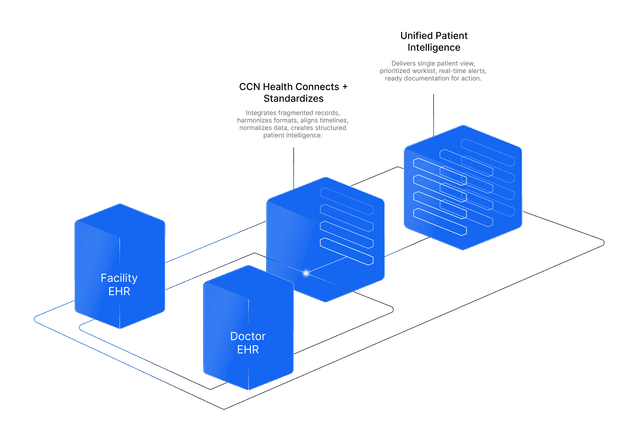
In post-acute and senior living care, two separate EHR systems operate in parallel. The facility — whether it is a skilled nursing facility, assisted living community, or memory care unit — runs its own EHR for day-to-day clinical operations: charting, medication administration, ADT tracking, and care planning. PointClickCare, ALIS, MatrixCare, and August Health are the dominant platforms in this space.
But the ordering physician who prescribes RPM, CCM, and other Medicare programs typically works out of an ambulatory practice. That physician documents in a completely separate EHR — often athenahealth. The physician's chart is where billing happens. Medicare claims for RPM (99453-99458), CCM (99490-99491), and other care management programs must be submitted by the ordering physician through their practice EHR, not through the facility system.
This creates a persistent data gap. Monitoring devices capture vital signs at the facility. Nursing staff need those readings in the facility EHR for clinical workflows. But billing documentation needs to reach athenahealth for claims submission. Without a bridge between both systems, someone is manually transferring data — printing reports, re-keying readings, or emailing PDFs. That manual process introduces transcription errors, delays claims submission, and consumes clinical staff time.
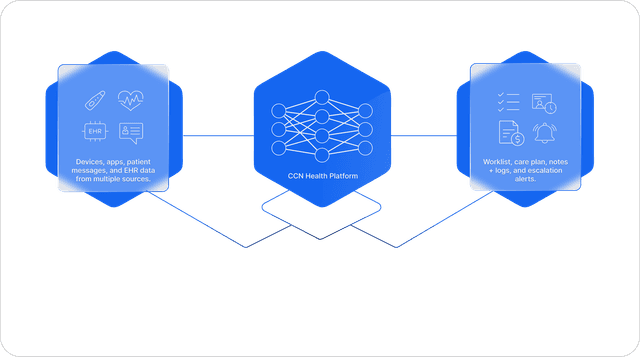
CCN Health eliminates this gap by integrating with both systems simultaneously. The facility EHR receives clinical monitoring data for nursing workflows. athenahealth receives CPT-ready billing documentation for claims submission. No manual data transfer between systems.
How CCN Health Bridges athenahealth + Facility EHRs
CCN Health connects to athenahealth through a certified Marketplace API integration using FHIR R4 and proprietary APIs. Simultaneously, it connects to the facility EHR through that system's native API. This dual-connection architecture means data flows to the right system automatically based on its purpose.
Data Flow Architecture
| Data Type | Direction | From / To |
|---|---|---|
| Patient demographics | Facility EHR to CCN Health | Census and ADT sync on admission |
| Patient conditions and medications | athenahealth to CCN Health | Problem list, active prescriptions |
| Vital sign readings | Devices to CCN Health to both EHRs | Automated posting to facility charts and athenahealth observations |
| Clinical alerts | CCN Health to both EHRs | Threshold-based notifications for nursing and physician teams |
| Care plans | Bi-directional | Synced across systems to keep monitoring protocols aligned |
| Billing documentation | CCN Health to athenahealth | CPT-ready records for claims submission |
How It Works in Practice
When a patient is enrolled in RPM at a facility, CCN Health pulls demographic data from the facility EHR (census sync) and clinical context from athenahealth (problem list, medications, existing care plans). Monitoring protocols are configured based on the combined clinical picture.
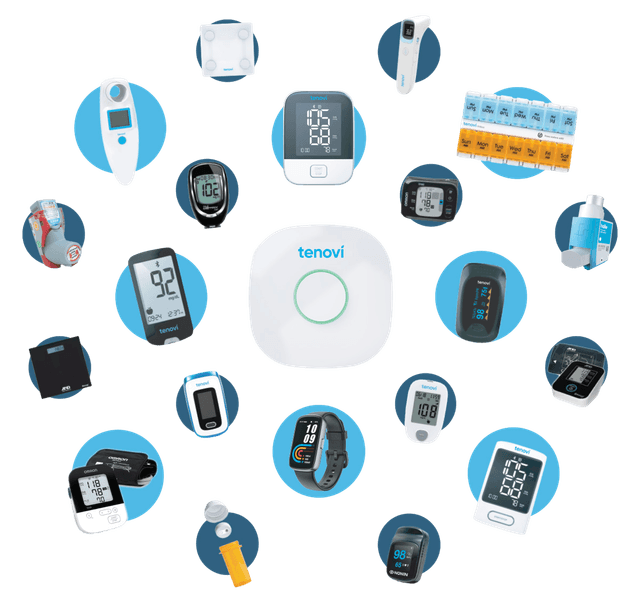
As the patient uses their monitoring device — blood pressure cuff, weight scale, glucose meter, pulse oximeter, or contactless sensor — readings transmit to CCN Health. From there, two things happen simultaneously:
- Vital signs post to the facility EHR so nursing staff see current readings in their normal workflow without logging into a separate system
- Clinical documentation and billing records route to athenahealth so the ordering physician has CPT-ready records for Medicare claims submission
This dual-posting happens automatically. No staff member copies data between systems.
athenahealth Marketplace Integration
CCN Health's athenahealth integration is certified on the athenahealth Marketplace — meaning it meets athenahealth's security, interoperability, and data integrity standards. The integration uses:
- FHIR R4 clinical observation posting for vital signs and monitoring data
- Proprietary APIs for patient matching, automated demographic sync, and revenue cycle integration
- CCDA document exchange for structured clinical documentation
- Real-time data feeds that keep patient records current without batch processing delays
The Marketplace certification ensures the integration is vendor-supported and maintained through athenahealth platform updates — not a fragile custom connection that breaks when either system upgrades.
Facility EHR Pairings
CCN Health bridges athenahealth with all four supported facility EHRs. Each pairing creates a complete dual-EHR workflow tailored to the facility type and care setting.
athenahealth + PointClickCare
PointClickCare is the dominant EHR in skilled nursing facilities and many senior living communities. The CCN Health integration connects athenahealth and PointClickCare through direct APIs on both sides:
- Connection: Direct API with bi-directional sync between both systems and CCN Health
- Data sync: Real-time vital sign posting to PCC resident charts, ADT event monitoring, census sync, and care plan data flowing to CCN Health for protocol configuration
- Billing flow: CPT-ready documentation routes from CCN Health to athenahealth for the ordering physician to submit claims
- Care settings: Skilled nursing facilities, long-term care, CCRCs, and senior living communities running PointClickCare
This pairing is the most common dual-EHR configuration. The facility's nursing team works entirely within PointClickCare while the physician practice manages billing through athenahealth — with CCN Health ensuring data reaches both systems automatically.
View all PointClickCare integration guides
athenahealth + ALIS
ALIS is built specifically for senior living operators — assisted living, independent living, and memory care communities. The ALIS integration with CCN Health provides:
- Connection: API integration with automated data exchange
- Data sync: Automated vital sign charting in ALIS resident records, resident demographic sync, and alert notifications within ALIS workflows
- Billing flow: All billing documentation routes to athenahealth — ALIS handles clinical data flow only
- Care settings: Assisted living, independent living, senior living communities, and memory care units running ALIS
Because ALIS is purpose-built for senior living rather than skilled nursing, the clinical workflows differ from PointClickCare. CCN Health adapts its data posting to match ALIS's resident record structure while maintaining the same athenahealth billing documentation flow.
View all ALIS integration guides
athenahealth + MatrixCare
MatrixCare serves post-acute care and senior living organizations with deep support for MDS documentation and PDPM-aligned workflows. The CCN Health integration connects athenahealth with MatrixCare through:
- Connection: API integration with automated vitals flow and documentation sync
- Data sync: MDS documentation context, automated vital sign posting, PDPM-aligned billing documentation, and care transition management between care levels
- Billing flow: CPT-ready records route to athenahealth for physician billing — MatrixCare's PDPM alignment supports facility-side documentation without duplicating the billing workflow
- Care settings: Post-acute care, skilled nursing, senior living, and organizations managing transitions between care levels
MatrixCare's MDS and PDPM capabilities are complementary to CCN Health's RPM/CCM documentation. Monitoring data can inform MDS assessments while billing for care management programs flows separately through athenahealth.
View all MatrixCare integration guides
athenahealth + August Health
August Health is a modern EHR designed for assisted living and memory care communities. The CCN Health integration bridges athenahealth with August Health through:
- Connection: API integration with resident record sync
- Data sync: Resident demographic and clinical record sync, medication management data, vital sign posting, and family communication portal compatibility
- Billing flow: All Medicare billing documentation routes to athenahealth — August Health handles facility-side clinical documentation and family communication
- Care settings: Assisted living, memory care, and senior living communities using August Health
August Health's family communication portal is a distinctive feature — families can see resident health information shared by the community. CCN Health's monitoring data, when posted to August Health, becomes part of the clinical picture available through those family-facing channels while billing documentation flows separately to athenahealth.
View all August Health integration guides
Supported Medicare Programs
CCN Health supports all five Medicare care management programs through the athenahealth integration. Each program has its own CPT codes, clinical requirements, and billing documentation — all generated automatically and routed to athenahealth for claims submission.
RPM (Remote Patient Monitoring)
| CPT Code | Description | 2026 Rate |
|---|---|---|
| 99453 | Initial device setup and patient education | $21.71 (one-time) |
| 99454 | Device supply, 16+ days of readings per 30-day period | $52.11/month |
| 99457 | First 20 minutes of clinical monitoring time | $51.77/month |
| 99458 | Each additional 20 minutes of monitoring time | $41.42/month |
| 99091 | Physician interpretation and review of data | $58.48/month |
CCM (Chronic Care Management)
| CPT Code | Description | 2026 Rate |
|---|---|---|
| 99490 | First 20 minutes of clinical staff time | ~$62/month |
| 99491 | First 30 minutes of physician/QHP time | ~$86/month |
| 99439 | Each additional 20 minutes of staff time | ~$47/month |
PCM (Principal Care Management)
| CPT Code | Description | 2026 Rate |
|---|---|---|
| 99424 | First 30 minutes of physician/QHP time | ~$88/month |
| 99425 | Each additional 30 minutes of physician/QHP time | ~$61/month |
| 99426 | First 30 minutes of clinical staff time | ~$68/month |
| 99427 | Each additional 30 minutes of staff time | ~$54/month |
BHI (Behavioral Health Integration)
| CPT Code | Description | 2026 Rate |
|---|---|---|
| 99484 | Care manager time, 20+ minutes | ~$53/month |
| 99492 | Psychiatric collaborative care, initial month | ~$145 |
| 99493 | Psychiatric collaborative care, subsequent months | ~$130/month |
RTM (Remote Therapeutic Monitoring)
| CPT Code | Description | 2026 Rate |
|---|---|---|
| 98975 | Initial device/software setup | ~$19 (one-time) |
| 98976 | Device supply for respiratory system | ~$50/month |
| 98977 | Device supply for musculoskeletal system | ~$50/month |
| 98980 | First 20 minutes of treatment management | ~$48/month |
| 98981 | Each additional 20 minutes | ~$38/month |
All five programs generate separate billing documentation streams. A single patient enrolled in RPM and CCM simultaneously receives two distinct sets of CPT-ready records in athenahealth — one for each program — with proper time tracking and clinical documentation to support each claim independently.
Billing & Reimbursement
The Billing Entity Rule
In a dual-EHR setup, billing responsibility is straightforward: the ordering physician practice submits all Medicare claims through athenahealth. The facility EHR — PointClickCare, ALIS, MatrixCare, or August Health — handles clinical documentation and day-to-day care workflows but does not submit care management billing.
| Role | System | Responsibility |
|---|---|---|
| Facility nursing staff | PointClickCare, ALIS, MatrixCare, or August Health | Clinical monitoring, care plans, medication administration, daily charting |
| Ordering physician practice | athenahealth | Medicare claims submission for RPM, CCM, PCM, BHI, RTM |
| CCN Health | Monitoring platform | Device management, clinical monitoring, automated billing documentation routed to athenahealth |
CCN Health generates CPT-ready billing records — including time logs, clinical documentation, and device compliance data — and routes them directly to athenahealth through the Marketplace API. The physician practice reviews and submits claims through athenahealth's revenue cycle management tools without manual documentation assembly.
What "CPT-Ready" Means
Each billing record routed to athenahealth includes:
- CPT code identification with the specific codes supported by the patient's enrollment
- Time tracking documentation showing minutes of clinical monitoring activity per program
- Device compliance data confirming 16+ days of readings for RPM device codes (99454)
- Clinical notes summarizing monitoring activity, alerts, interventions, and care coordination
- Patient consent records confirming enrollment authorization
This documentation is structured to support claims submission directly from athenahealth — reducing the back-and-forth between clinical and billing teams.
Revenue Stacking Examples
Medicare allows concurrent enrollment across multiple care management programs for patients who meet clinical criteria. CCN Health tracks time and documentation separately for each program, generating independent billing streams routed to athenahealth.
Scenario 1: RPM Only
A patient with hypertension monitored via blood pressure cuff, meeting 16+ days of device readings and 20 minutes of clinical monitoring time per month.
| Code | Description | Monthly |
|---|---|---|
| 99454 | Device supply (16+ days) | $52.11 |
| 99457 | First 20 minutes clinical time | $51.77 |
| Monthly total | $103.88 |
Scenario 2: RPM + CCM
The same patient also has diabetes and COPD, qualifying for CCM (two or more chronic conditions requiring a comprehensive care plan).
| Code | Description | Monthly |
|---|---|---|
| 99454 | RPM device supply | $52.11 |
| 99457 | RPM clinical time (20 min) | $51.77 |
| 99490 | CCM staff time (20 min) | ~$62.00 |
| Monthly total | ~$165.88 |
Scenario 3: RPM Full Stack + CCM Extended
A complex patient qualifying for full RPM code stacking (including physician interpretation and additional clinical time) plus extended CCM.
| Code | Description | Monthly |
|---|---|---|
| 99454 | RPM device supply | $52.11 |
| 99457 | RPM clinical time (20 min) | $51.77 |
| 99458 | RPM additional time (20 min) | $41.42 |
| 99091 | Physician interpretation | $58.48 |
| 99490 | CCM staff time (20 min) | ~$62.00 |
| Monthly total | ~$265.78 |
Adding 99091 physician interpretation requires documented review of monitoring data by the physician — distinct from the clinical monitoring time captured under 99457/99458. The athenahealth integration supports this by routing device data summaries and trend reports to the physician's chart for documented review.
These revenue scenarios represent per-patient monthly reimbursement. For a practice managing 50 patients on RPM + CCM, the estimated monthly revenue from care management programs alone would be approximately $8,294 per month (50 patients at $165.88 each).
How CCN Health Compares to Other Athena Health RPM Vendors
CCN Health is not the only platform with an Athena Health integration. Prevounce, TimeDoc Health, Smart Meter, Athelas, and CoachCare all maintain working RPM connections, and Medsien, ChronicCareIQ, MD Revolution, and ThoroughCare compete on the CCM side. What none of them offer is the dual-EHR bridge: posting monitoring data to the facility EHR while routing billing documentation to Athena Health, plus five-program stacking on one platform.
For vendor-by-vendor evaluations with honest strengths and limitations, see the best athenahealth RPM integrations comparison and the best athenahealth CCM integrations comparison.
Getting Started
Deploying the athenahealth dual-EHR integration through CCN Health follows a structured process:
Step 1: Integration Assessment. The CCN Health team evaluates the practice's athenahealth configuration and the facility EHR(s) in use. This determines the specific API connections needed and any workflow customization required for the practice's clinical environment.
Step 2: API Connection and Patient Matching. CCN Health establishes the Marketplace API connection with athenahealth and the facility EHR API connection simultaneously. Automated patient matching ensures records are linked correctly across both systems without manual reconciliation.
Step 3: Clinical Workflow Configuration. Monitoring protocols, alert thresholds, escalation paths, and documentation templates are configured based on the practice's clinical preferences. Billing documentation routing is tested to confirm CPT-ready records appear correctly in athenahealth.
Step 4: Enrollment and Go-Live. Patients are enrolled in qualifying programs with device assignment and consent documentation. Device readings begin flowing to both EHRs immediately, and billing documentation routes to athenahealth from the first monitoring period.
Because the athenahealth integration is Marketplace-certified and pre-built, the technical setup is typically complete within 2-3 business days. The CCN Health team handles the entire integration process — the practice does not need dedicated IT resources or development work.
Browse all athenahealth integration guides | Schedule a consultation
Disclaimer: This article is for informational purposes only and does not constitute medical, legal, or billing advice. CPT code reimbursement amounts are estimates based on CMS published fee schedules and may vary by region, payer, and clinical circumstances. Always consult qualified healthcare, billing, and technology professionals for guidance specific to your practice.
Let's figure this out together
We work closely with every client to find the right approach for their practice. Think of us as your partner, not just a platform.
Topics
Your Partner in Chronic Care
We love working closely with our clients to find the best solutions. Let us help guide you through the complicated stuff.
Why It Matters
Key Benefits
See how this approach drives measurable improvements across your organization.
Marketplace-Certified Integration
Certified on the athenahealth Marketplace with FHIR R4 and proprietary API access for reliable, vendor-supported bi-directional data exchange.
4 Facility EHR Pairings
Bridge athenahealth with PointClickCare, ALIS, MatrixCare, and August Health — covering skilled nursing, assisted living, memory care, and senior living settings.
Automated Billing Documentation
CPT-ready records for all five Medicare programs route directly to athenahealth for claims submission — no manual documentation or data re-entry required.
Revenue Cycle Integration
Billing documentation integrates with athenahealth's revenue cycle management tools, streamlining claims submission and payment tracking.
Continue Reading
Related Articles
Explore more insights on this topic.
Best athenahealth RPM Integrations in 2026: 6 Platforms Compared
A head-to-head comparison of the best remote patient monitoring platforms that integrate with athenahealth in 2026, ranked on integration depth, device ecosystems, billing automation, and dual-EHR capability.
Best athenahealth CCM Integrations in 2026: 6 Platforms Compared
A head-to-head comparison of the best chronic care management platforms that integrate with athenahealth in 2026, ranked on care plan automation, billing documentation, program stacking, and dual-EHR capability.
Best EHR-Integrated RPM Platforms in 2026
A detailed comparison of RPM platforms ranked by EHR integration depth in 2026 — covering bi-directional data flow, certified connections, dual-EHR architecture, and why CCN Health leads with 8 integrated EHR systems.
Common Questions
Frequently Asked Questions
Get answers to the most common questions about this topic.
CCN Health connects to athenahealth via the certified Marketplace API using FHIR R4 and proprietary APIs. Simultaneously, it integrates with facility EHRs like PointClickCare, ALIS, MatrixCare, and August Health. Monitoring data, vital signs, and clinical documentation flow bi-directionally — patient demographics come from both EHRs while monitoring data and billing documentation route back to athenahealth for claims submission.
The ordering physician practice submits all Medicare claims through athenahealth. Facility EHRs like PointClickCare handle clinical documentation and data flow within the facility, but billing for RPM, CCM, PCM, BHI, and RTM is always submitted by the physician through their practice EHR. CCN Health generates CPT-ready billing documentation and routes it to athenahealth automatically.
Yes. CCN Health supports concurrent enrollment across all five Medicare programs. A single patient can be enrolled in RPM and CCM simultaneously, with separate CPT code documentation generated for each program and routed to athenahealth. The 2026 CMS rates allow RPM base billing of approximately $104 per month (99454 + 99457) plus CCM base billing of approximately $62 per month (99490) for a combined monthly revenue of approximately $166 per patient.
CCN Health bridges athenahealth with all four supported facility EHRs: PointClickCare (direct API, SNF and long-term care), ALIS (API integration, senior living and assisted living), MatrixCare (API integration, post-acute and senior living), and August Health (API integration, assisted living and memory care). Each pairing creates a complete dual-EHR workflow where clinical data flows to the facility and billing documentation flows to athenahealth.
The athenahealth integration is typically live within 2-3 business days. Because CCN Health's integration is Marketplace-certified and pre-built using FHIR R4 and proprietary APIs, there is no custom development work required. The CCN Health team handles the entire setup — API credential provisioning, data flow configuration, and clinical workflow mapping — so the practice does not need dedicated IT resources.
Patient demographics, conditions, and medication lists flow from athenahealth to CCN Health for monitoring protocol setup. In return, CCN Health sends vital sign observations, clinical alerts, care management documentation, and CPT-ready billing records back to athenahealth via FHIR R4 clinical observation posting. The integration also supports care coordination documentation and revenue cycle management.
Still have questions? We love helping practices figure this out — no pressure, just real answers.

Your Partner in Chronic Care
We're Here to Guide You Every Step of the Way
RPM, CCM, and chronic care management can get complicated. We work closely with every client to figure out the best solutions for their practice.