Clinical
Remote Therapeutic Monitoring for Home Health — 2026 Guide
How Remote Therapeutic Monitoring works in home health — tracking PT/OT exercise compliance, pain assessments, and functional recovery for patients receiving home-based rehabilitation services.
Remote Therapeutic Monitoring (RTM) in home health tracks therapy outcomes for patients receiving home-based PT/OT and pulmonary rehabilitation. Home health is the primary RTM use case because home-based therapy inherently involves long gaps between skilled visits — patients do prescribed exercises independently at home with no monitoring between sessions. CCN Health enables digital exercise compliance tracking, daily pain assessments, and functional outcome monitoring that flows to the home health agency and attending physician via EHR integration (athenahealth, Epic, Charm). RTM uses CPT codes 98975-98981 and generates $50-105 per patient per month, stackable with RPM for patients who also need vital sign monitoring.
What Is Remote Therapeutic Monitoring (RTM)?
Remote Therapeutic Monitoring (RTM) is a Medicare-reimbursable program that RTM (Remote Therapeutic Monitoring) is a Medicare program that monitors therapy outcomes for musculoskeletal and respiratory conditions. Unlike RPM (vital signs), RTM tracks exercise compliance, pain assessments, range of motion progress, and respiratory therapy adherence using CPT codes 98975-98981. Home health RTM addresses the fundamental challenge: patients doing exercises alone at home with no feedback between weekly PT/OT visits..
Patient eligibility: Medicare beneficiaries undergoing physical therapy, occupational therapy, or respiratory therapy. Data must be self-reported or collected via therapy-specific devices for 16+ days per billing period.
How RTM differs from related programs: RTM tracks therapy outcomes — pain scores, range of motion, exercise compliance, functional status — rather than vital signs (RPM) or care coordination (CCM). It is the only Medicare monitoring program designed for rehabilitation.
RTM can be stacked with RPM, PCM for qualifying patients — a single enrolled patient can generate revenue across multiple Medicare programs simultaneously.
Why Home Health Agencies Need RTM
Home health therapy has the largest between-visit monitoring gap of any care setting — patients perform prescribed exercises independently with no oversight between weekly skilled visits.
Home-based PT/OT visits typically occur 1-3x per week — that leaves 4-6 days per week with zero therapy monitoring
Exercise non-compliance between visits is the #1 barrier to home health rehabilitation outcomes — therapists don't know if patients actually do their exercises
Post-discharge rehabilitation (hip fracture, joint replacement, stroke, cardiac) is the highest-acuity home health use case — RTM provides continuous recovery visibility
Pulmonary rehabilitation at home (COPD, post-pneumonia) requires daily breathing exercise compliance that can only be verified with digital monitoring
OASIS (Outcome and Assessment Information Set) functional scores benefit from objective between-visit data — RTM provides the documentation that supports accurate OASIS assessment
How RTM Works in Home Health — The Clinical Workflow
RTM in home health is patient-directed — patients complete daily digital assessments at home, with data flowing to their home health therapist and attending physician between skilled visits.
Step 1. Home health therapist evaluates patient and identifies RTM-qualifying rehabilitation need during initial skilled visit
Step 2. CCN Health deploys RTM tools (smartphone/tablet app) with personalized exercise protocol during a home visit
Step 3. Patient completes daily self-assessments at home: exercise completion, pain levels, functional status questionnaire — typically 3-5 minutes
Step 4. Platform aggregates data between visits — therapist sees daily compliance and outcome trends before next home visit
Step 5. Therapist adjusts exercise prescriptions during skilled visits based on RTM data — objective progress drives therapy plan modifications
Step 6. Attending physician receives monthly RTM outcome reports supporting continued home health orders and therapy authorization
RTM Devices and Monitoring for Home Health
Home health RTM uses patient-directed digital tools deployed during home visits — designed for unsupervised daily use in the patient's own home.
- Smartphone/tablet RTM apps — daily exercise logging, pain assessment, and functional questionnaires with reminder notifications
- Video-guided exercise platforms — therapist-prescribed exercise videos with completion tracking and form guidance
- Wearable activity monitors — step counts, active minutes, and movement patterns providing objective compliance verification
- Respiratory therapy apps — breathing exercise timing, inhaler compliance logging, peak flow tracking for pulmonary rehab patients
- Digital goniometry tools — range of motion self-measurement for joint replacement and fracture recovery tracking
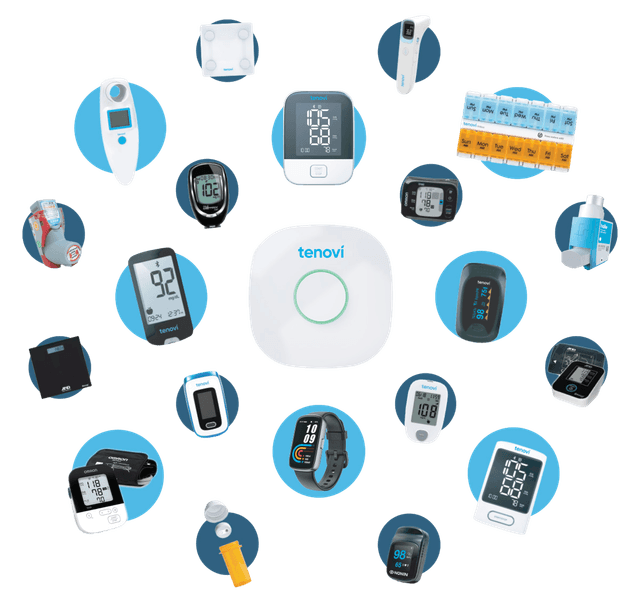
Home health RTM devices must work without facility infrastructure — cellular connectivity and patient-owned devices are the standard. CCN Health's Tenovi gateway provides cellular backup for patients without reliable home internet.
RTM Billing: CPT Codes and Revenue
| CPT Code | Service | Reimbursement | Requirement |
|---|---|---|---|
| 98975 | Setup & Education | ~$19 | One-time initial setup |
| 98976 | Respiratory RTM | ~$50/mo | 16+ days respiratory data |
| 98977 | MSK RTM | ~$50/mo | 16+ days MSK therapy data |
| 98980 | Treatment Mgmt | ~$48/mo | First 20 min treatment mgmt |
| 98981 | Additional Mgmt | ~$38/mo | Each additional 20 min |
Estimated monthly revenue per patient: ~$100–155
Program stacking: RTM + RPM generates $275–375/patient/month. For complex rehab patients, RTM + RPM + PCM can reach $350–490/month.
RTM billing in home health requires careful coordination with Home Health PPS. During a certified home health episode, some RTM services may overlap with the episode payment. RTM billing (CPT 98975-98981) is most clearly billable when provided by the attending physician rather than the home health agency — since the agency's therapy services are covered under PPS. Consult billing guidance for current CMS rules on RTM during active home health episodes.
EHR Integration for RTM in Home Health
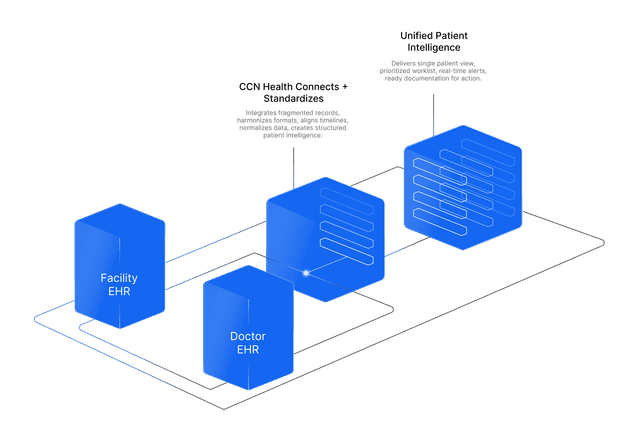
Home Health agencies typically use Practice EHRs (athenahealth, Epic, Charm Health) for clinical documentation. Home health agencies use practice EHRs rather than facility EHRs. Monitoring data routes directly to the ordering physician. No facility infrastructure to rely on.
CCN Health provides bi-directional integration with all major home health EHR systems:
- Resident/patient demographics sync automatically
- Monitoring data flow into existing EHR workflows
- Clinical alerts appear within the EHR — no separate portal required
- Billing documentation generates automatically for RTM time tracking
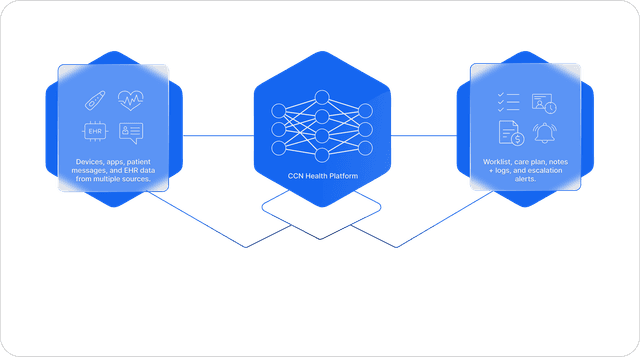
Home health agencies and attending physicians typically use practice-based EHRs — athenahealth, Epic, Charm. CCN Health integrates RTM therapy data with these systems, ensuring therapists and physicians see outcome data in their existing workflow without a separate portal.
Getting Started: Implementing RTM in Your Home Health Agencie
A typical RTM implementation in home health follows a 4–8 week timeline:
- Week 1–2: Identify home health patients with active PT/OT or pulmonary rehab orders — post-surgical, post-stroke, COPD exacerbation, joint replacement recovery
- Week 3–4: Deploy RTM apps during scheduled home visits — therapist demonstrates the daily assessment workflow and configures personalized exercise protocols
- Week 5–6: Train home health therapists to incorporate RTM data review into pre-visit preparation — knowing compliance and pain trends before arriving improves visit efficiency
- Week 7–8: Launch with post-surgical rehabilitation patients (highest motivation, clearest outcome metrics) — expand to COPD rehab and chronic pain management
Home health RTM deployment happens during existing home visits — no additional visits are needed for setup. The therapist configures RTM during a regular skilled visit, and the patient begins self-tracking immediately.
Ready to implement RTM in your home health agencie? CCN Health provides full-service Remote Therapeutic Monitoring with EHR integration, clinical oversight, and billing optimization purpose-built for home health.
Disclaimer: This article is for informational purposes only and does not constitute medical, legal, or billing advice. CPT code reimbursement amounts are estimates based on CMS published fee schedules and may vary by region, payer, and clinical circumstances. Always consult qualified healthcare, billing, and technology professionals for guidance specific to your facility.
Let's figure this out together
We work closely with every client to find the right approach for their practice. Think of us as your partner, not just a platform.
Topics
Your Partner in Chronic Care
We love working closely with our clients to find the best solutions. Let us help guide you through the complicated stuff.
Why It Matters
Key Benefits
See how this approach drives measurable improvements across your organization.
RTM Program Management
Full Remote Therapeutic Monitoring program delivery including enrollment, monitoring, clinical review, and billing documentation — purpose-built for home health workflows.
EHR Integration
Bi-directional integration with Practice EHRs (athenahealth, Epic, Charm Health) ensures monitoring data flows into existing clinical workflows without manual data entry.
Revenue Optimization
~$100–155 per patient per month with RTM. Program stacking with RPM and PCM increases per-patient revenue further.
Between-Visit Visibility
Daily therapy outcome data fills the 4-6 day gap between home health visits — therapists know what happened since they were last there.
Exercise Compliance Tracking
Objective evidence of whether patients actually do prescribed exercises at home — the #1 unknown in home health therapy.
Visit Efficiency
Pre-visit RTM data review means therapists arrive prepared — knowing pain trends, compliance patterns, and functional progress before walking in the door.
Continue Reading
Related Articles
Explore more insights on this topic.
What Is Remote Therapeutic Monitoring (RTM)? A Complete Guide
A complete guide to Remote Therapeutic Monitoring — what it is, how it differs from RPM, which conditions qualify, the five CPT codes (98975-98981), and how providers bill Medicare for RTM services.
Remote Patient Monitoring for Home Health — 2026 Guide
How RPM works in home health — post-discharge vital sign monitoring, hospital readmission prevention, cellular device deployment without facility infrastructure, and Medicare billing for home health agencies.
Chronic Care Management for Home Health — 2026 Guide
How CCM works in home health — bridging episodic skilled visits with continuous care coordination, post-discharge medication reconciliation, and multi-provider communication for homebound patients.
Common Questions
Frequently Asked Questions
Get answers to the most common questions about this topic.
Remote Therapeutic Monitoring (RTM) for home health: Remote Therapeutic Monitoring (RTM) is a Medicare program using CPT codes 98975-98981 that tracks therapy outcomes — exercise adherence, pain levels, and functional status — for patients in musculoskeletal or respiratory rehabilitation. Medicare beneficiaries undergoing physical therapy, occupational therapy, or respiratory therapy.
RTM generates ~$100–155 per patient per month through CPT codes 98975, 98976, 98977, 98980, 98981. RTM + RPM generates $275–375/patient/month. For complex rehab patients, RTM + RPM + PCM can reach $350–490/month.
CCN Health integrates with Practice EHRs (athenahealth, Epic, Charm Health) for home health facilities. Home health agencies use practice EHRs rather than facility EHRs. All monitoring data flows bi-directionally between CCN Health and the facility/physician EHR.
RTM in home health is patient-directed — patients complete brief daily digital assessments (3-5 minutes) on their own smartphone or tablet. The app provides exercise reminders, guided pain assessments, and functional questionnaires. Data transmits automatically to the therapist and physician. For patients without smartphones, CCN Health provides cellular-connected tablets.
RTM monitors between visits — not during them. Home health PT/OT addresses hands-on therapy during skilled visits, while RTM tracks exercise compliance, pain trends, and functional progress during the 4-6 days per week when no therapist is present. RTM data makes skilled visits more efficient by showing the therapist what happened since the last visit.
RTM provides objective between-visit functional data that supports accurate OASIS assessment. Daily pain tracking, exercise compliance, and functional status trends give therapists data-driven evidence for OASIS functional scoring — rather than relying solely on point-in-time observation during a single skilled visit.
Still have questions? We love helping practices figure this out — no pressure, just real answers.

Your Partner in Chronic Care
We're Here to Guide You Every Step of the Way
RPM, CCM, and chronic care management can get complicated. We work closely with every client to figure out the best solutions for their practice.