integration-guides
Epic RPM & CCM Integration Guide 2026
How CCN Health bridges Epic with PointClickCare, ALIS, MatrixCare, and August Health — enabling dual-EHR workflows for RPM, CCM, and all Medicare care management programs in enterprise health systems.
CCN Health integrates Epic with facility EHRs (PointClickCare, ALIS, MatrixCare, August Health) via FHIR R4 APIs. This dual-EHR architecture posts monitoring data to Epic Flowsheets, routes alerts to InBasket, and generates billing documentation for RPM, CCM, PCM, BHI, and RTM programs — with claims submitted through Epic by the ordering physician.
The Dual-EHR Reality
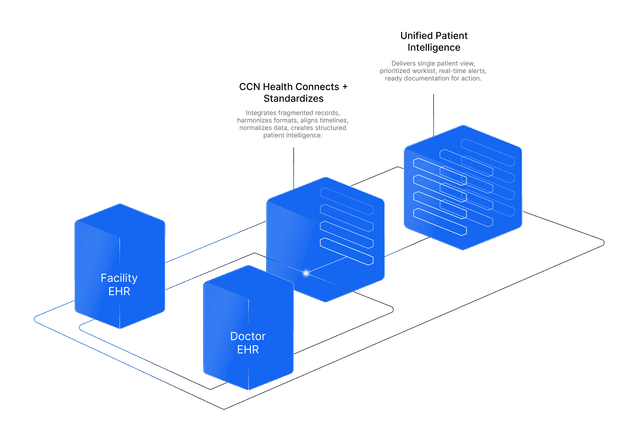
Health systems running Epic face a structural disconnect when their physicians oversee patients who reside in senior living facilities, skilled nursing communities, or long-term care settings. The physician documents in Epic. The facility documents in PointClickCare, ALIS, MatrixCare, or August Health. Two separate clinical records exist for the same patient, and neither system is aware of the other.
This gap becomes a concrete problem when a health system wants to deploy Remote Patient Monitoring or other Medicare care management programs for patients in these settings. Vital sign data from RPM devices needs to reach the physician in Epic for clinical decision-making and billing. At the same time, that data needs to reach the facility's nursing staff in their EHR for day-to-day care. Manually bridging these two systems with phone calls, faxes, or re-entered data creates delays, transcription errors, and compliance risk.
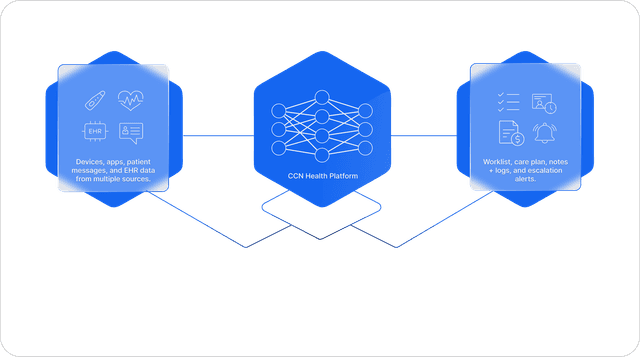
CCN Health eliminates this gap by integrating with both sides simultaneously. On the physician side, CCN Health connects to Epic through FHIR R4 APIs -- posting monitoring data to Flowsheets, routing clinical alerts to InBasket, and generating CPT-ready billing documentation. On the facility side, CCN Health connects to the facility EHR through direct API integration -- syncing census data, ADT events, care plans, and vital sign charting.
The result is a single monitoring platform that serves both the health system and the facility without requiring either side to change their existing clinical workflows.
How CCN Health Bridges Epic + Facility EHRs
Integration Architecture
CCN Health sits between Epic and the facility EHR, maintaining bidirectional connections to both systems. The Epic integration uses FHIR R4 APIs through Epic App Orchard, which enables standardized clinical data exchange without custom interface development. Key Epic-specific integration points include:
- Epic Flowsheets -- vital sign observations from RPM devices post directly to patient Flowsheets, appearing alongside clinician-collected data in the physician's normal charting workflow
- Epic InBasket -- clinical alerts for out-of-range vitals route to the ordering physician's InBasket, keeping RPM notifications within the same queue as lab results, referral responses, and staff messages
- MyChart -- patient-facing portal integration enables patients and family members to view monitoring trends and receive care management communications through the MyChart app they already use
- Care Everywhere -- health information exchange capabilities allow monitoring data to be shared across affiliated organizations within the Epic ecosystem
Data Flow Summary
| Data Type | Direction | From / To |
|---|---|---|
| Patient demographics | Facility EHR to CCN Health | Census and ADT sync from facility records |
| Patient conditions | Epic to CCN Health | Problem list, medications, and allergies via FHIR |
| Vital sign readings | Devices to CCN Health to both EHRs | Epic Flowsheet posting + facility EHR charting |
| Clinical alerts | CCN Health to Epic | InBasket routing for threshold exceedances |
| Care plans | Bidirectional | Synced between systems via Care Everywhere |
| Billing documentation | CCN Health to Epic | CPT-ready records for revenue cycle |
How It Differs From Single-EHR Integration
In a single-EHR environment, the monitoring platform connects to one system and all data flows through that connection. The dual-EHR architecture is different: CCN Health maintains two separate, simultaneous integrations and routes specific data types to the appropriate system. Monitoring data and alerts go to Epic because the physician needs them for clinical decisions and billing. Census data, ADT events, and nursing documentation flow from the facility EHR because that is where care delivery is managed.
This routing is automatic. Clinical staff at neither the facility nor the health system need to manually transfer data between platforms.
Facility EHR Pairings
Epic + PointClickCare
PointClickCare is the dominant facility EHR in skilled nursing and long-term care, making the Epic-PCC pairing the most common dual-EHR configuration CCN Health supports. The integration uses PointClickCare's direct API for bidirectional sync -- census data and ADT events flow from PCC into CCN Health, while vital sign observations post back to resident charts automatically.
Key capabilities:
- Real-time vital sign posting to PCC resident charts
- ADT event monitoring triggers automatic protocol changes (admission, discharge, transfer)
- Census sync for seamless enrollment and disenrollment
- Care plan data informs monitoring thresholds
Primary care settings: Skilled nursing facilities, long-term care communities, post-acute rehabilitation
View all PointClickCare integration guides
Epic + ALIS
ALIS is purpose-built for assisted living and senior living operations, making the Epic-ALIS pairing common in communities where physicians from academic medical centers and health systems serve as attending providers. CCN Health integrates with ALIS through its API to automate vital sign charting and resident demographic synchronization.
Key capabilities:
- Automated vital sign charting in ALIS resident records
- Resident demographic sync eliminates duplicate data entry
- Alert notifications surface in ALIS for facility nursing staff
- Enrollment workflows informed by ALIS census data
Primary care settings: Assisted living, senior living, independent living, memory care
View all ALIS integration guides
Epic + MatrixCare
MatrixCare serves a broad range of post-acute and senior care settings with particular strength in PDPM-aligned documentation for skilled nursing. The Epic-MatrixCare pairing is well-suited for organizations focused on value-based care transitions where monitoring data supports both clinical outcomes and reimbursement optimization.
Key capabilities:
- API integration with automated vitals flow to MatrixCare
- MDS documentation support aligned with RPM monitoring data
- PDPM-aligned billing documentation for post-acute settings
- Care transition management between acute and post-acute levels
Primary care settings: Post-acute care, skilled nursing, senior living, CCRCs
View all MatrixCare integration guides
Epic + August Health
August Health is a modern facility EHR designed for assisted living and memory care operations, with a focus on family communication and resident experience. The Epic-August Health pairing works well for communities where health system physicians oversee residents in these settings.
Key capabilities:
- API integration for resident record sync
- Medication management data informs monitoring thresholds
- Family communication portal provides visibility into monitoring trends
- Streamlined workflows for assisted living and memory care staff
Primary care settings: Assisted living, memory care, independent living
View all August Health integration guides
Supported Medicare Programs
CCN Health's Epic integration supports all five Medicare care management programs through a single platform. Each program generates its own billing documentation, routed automatically to Epic for claims submission by the ordering physician.
| Program | Key CPT Codes | 2026 CMS Rates | Description |
|---|---|---|---|
| RPM | 99453, 99454, 99457, 99458, 99091 | $21.71 (setup), $52.11/mo, $51.77/mo, $41.42/mo, $58.48/mo | Device-based physiologic monitoring with physician interpretation |
| CCM | 99490, 99491, 99439 | ~$62/mo, ~$86/mo, ~$47/mo (add-on) | Care coordination for patients with 2+ chronic conditions |
| PCM | 99424, 99425, 99426, 99427 | ~$88/mo, ~$61/mo, ~$68/mo, ~$54/mo | Single high-complexity condition management |
| BHI | 99484, 99492, 99493 | ~$53/mo, ~$145 (initial), ~$130/mo | Behavioral health integration for psychiatric conditions |
| RTM | 98975, 98976, 98977, 98980, 98981 | ~$19 (setup), ~$50/mo, ~$50/mo, ~$48/mo, ~$38/mo | Therapy outcome tracking for musculoskeletal and respiratory |
Patients can be enrolled in multiple programs simultaneously. A patient with hypertension (RPM for blood pressure monitoring), diabetes and COPD (CCM for multi-chronic care coordination), and depression (BHI for behavioral health) would generate revenue from three programs -- all managed on one platform with separate billing documentation for each, routed to Epic automatically.
Billing & Reimbursement
Epic Handles All Billing
In a dual-EHR configuration, billing is always submitted by the ordering physician practice through Epic. Facility EHRs like PointClickCare, ALIS, MatrixCare, and August Health handle clinical documentation within the care setting, but they do not submit Medicare claims for RPM, CCM, or other care management programs. This distinction is critical for compliance.
CCN Health generates CPT-ready billing documentation and routes it directly to Epic, where it integrates with the health system's revenue cycle workflow. Physicians and billing staff can review documentation, verify compliance, and submit claims without leaving Epic.
Revenue Stacking Examples
The 2026 CMS fee schedule allows significant per-patient monthly revenue when programs are stacked appropriately. All claims are submitted through Epic:
RPM only (single program):
- 99454 (device supply, 16+ days): $52.11
- 99457 (first 20 minutes clinical time): $51.77
- Monthly total: ~$104/patient
RPM + CCM (dual program):
- RPM 99454 + 99457: ~$104
- CCM 99490 (20 minutes care coordination): ~$62
- Monthly total: ~$166/patient
RPM full stack + CCM extended:
- RPM 99454 + 99457 + 99458 + 99091: ~$204
- CCM 99490: ~$62
- Monthly total: ~$266/patient
These figures use 2026 CMS national rates. Actual reimbursement varies by geographic region, payer, and MAC jurisdiction. CCN Health's platform tracks time and compliance requirements for each CPT code to ensure billing accuracy.
Automated Compliance Documentation
Each Medicare program has specific documentation requirements -- minimum monitoring days for RPM device codes, time thresholds for clinical service codes, and patient consent documentation. CCN Health tracks these requirements automatically and generates compliance-ready records:
- RPM 99454 requires 16+ days of device data transmission per 30-day period -- the platform tracks daily transmission counts per patient
- RPM 99457/99458 require documented clinical time in 20-minute increments -- time tracking captures clinical interactions with program attribution
- CCM 99490 requires a comprehensive care plan and 20+ minutes of non-face-to-face care coordination monthly -- care plan documentation and time logs are generated automatically
- All programs require documented patient consent -- consent tracking is built into enrollment workflows
Getting Started
Deploying CCN Health with Epic and a facility EHR follows a structured process designed to minimize disruption to existing clinical workflows:
1. Integration provisioning. CCN Health establishes the FHIR R4 connection with Epic through App Orchard and the API connection with the facility EHR. Both integrations are pre-built -- no custom development or HL7 interface engines required.
2. Clinical workflow mapping. The CCN Health team works with the health system and facility to configure alert thresholds, InBasket routing rules, escalation paths, and notification preferences based on existing clinical protocols and physician preferences.
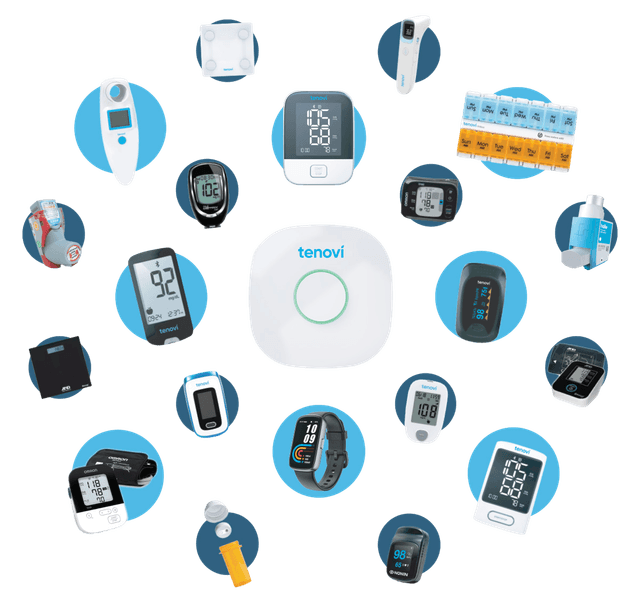
3. Patient enrollment and device deployment. Eligible patients are enrolled in RPM and other applicable programs. FDA-cleared monitoring devices are assigned based on clinical need -- blood pressure monitors, weight scales, glucose meters, pulse oximeters, CGMs, or contactless sensors for memory care residents. Readings begin flowing to both Epic and the facility EHR immediately.
4. Billing activation. CPT billing documentation routes to Epic's revenue cycle, and the health system's billing team begins submitting claims. CCN Health provides ongoing compliance monitoring to ensure documentation requirements are met for every billable code.
The entire deployment -- from integration provisioning to first patient monitored -- is measured in days, not months. Because the FHIR R4 integration is built to Epic's published specifications and the facility EHR integrations are pre-built APIs, there is no custom development timeline.
Browse all Epic integration guides | Schedule a consultation
Disclaimer: This article is for informational purposes only and does not constitute medical, legal, or billing advice. CPT code reimbursement amounts are estimates based on CMS published fee schedules and may vary by region, payer, and clinical circumstances. Always consult qualified healthcare, billing, and technology professionals for guidance specific to your organization.
Let's figure this out together
We work closely with every client to find the right approach for their practice. Think of us as your partner, not just a platform.
Topics
Your Partner in Chronic Care
We love working closely with our clients to find the best solutions. Let us help guide you through the complicated stuff.
Why It Matters
Key Benefits
See how this approach drives measurable improvements across your organization.
FHIR R4 Integration
Industry-standard FHIR R4 APIs enable secure, bidirectional data exchange — monitoring data posts to Flowsheets and alerts route to InBasket within existing Epic workflows.
4 Facility EHR Pairings
Bridge Epic with PointClickCare, ALIS, MatrixCare, and August Health — covering every major senior care setting from SNFs to memory care.
Epic Flowsheet Integration
Vital sign data posts directly to patient Flowsheets, enabling physicians to view RPM trends alongside clinician-collected data without switching platforms.
InBasket Alert Routing
Clinical alerts for threshold exceedances route directly to the ordering physician's InBasket, keeping notifications within existing Epic workflows.
Continue Reading
Related Articles
Explore more insights on this topic.
athenahealth RPM & CCM Integration Guide 2026
How CCN Health bridges athenahealth with PointClickCare, ALIS, MatrixCare, and August Health — enabling dual-EHR workflows for RPM, CCM, and all Medicare care management programs.
Charm Health RPM & CCM Integration Guide 2026
How CCN Health bridges Charm Health with PointClickCare, ALIS, MatrixCare, and August Health — enabling dual-EHR workflows for independent practices managing patients in senior care facilities.
Ethizo RPM & CCM Integration Guide 2026
How CCN Health bridges Ethizo with PointClickCare, ALIS, MatrixCare, and August Health — enabling dual-EHR workflows purpose-built for senior care physicians managing patients across facilities.
Common Questions
Frequently Asked Questions
Get answers to the most common questions about this topic.
CCN Health connects to Epic via FHIR R4 APIs for bidirectional clinical data exchange. Simultaneously, it integrates with facility EHRs like PointClickCare, ALIS, MatrixCare, and August Health. Monitoring data flows into Epic Flowsheets, alerts route to InBasket, and billing documentation is generated automatically. Patient demographics from both the facility and Epic inform monitoring protocols.
Yes. CCN Health posts vital sign observations directly to Epic Flowsheets via FHIR R4 clinical observations. Blood pressure, weight, glucose, SpO2, and other monitored vitals appear in the patient's chart alongside clinician-collected data. This enables physicians to view trending data within their normal Epic workflow without switching platforms.
When a patient's vital signs exceed configured thresholds, CCN Health generates a clinical alert that routes to the appropriate physician's Epic InBasket. This keeps the alert within the physician's existing notification workflow rather than requiring them to monitor a separate platform. Alert routing can be configured per physician, care team, or patient panel.
The ordering physician practice submits all Medicare claims through Epic. Facility EHRs handle clinical documentation within the care setting, but billing for RPM, CCM, PCM, BHI, and RTM programs is submitted by the physician through Epic's revenue cycle tools. CCN Health generates CPT-ready billing documentation and routes it to Epic automatically.
Yes. CCN Health supports concurrent enrollment across all five Medicare programs. A single patient can be enrolled in RPM and CCM simultaneously, with separate CPT code documentation generated for each program. The 2026 CMS rates allow combined monthly revenue of approximately $166 per patient (RPM 99454 + 99457 at approximately $104 plus CCM 99490 at approximately $62).
Still have questions? We love helping practices figure this out — no pressure, just real answers.

Your Partner in Chronic Care
We're Here to Guide You Every Step of the Way
RPM, CCM, and chronic care management can get complicated. We work closely with every client to figure out the best solutions for their practice.