RPM for Physician Practices.
Remote patient monitoring and chronic care management designed for physician practices — extending care between visits while generating recurring Medicare revenue.
Challenges
Physician Practices challenges we solve.
Understanding the unique needs of physician practices facilities.
Visit-Based Revenue Limits
Traditional fee-for-service models limit revenue to in-office visits. Practices need recurring revenue streams that don't require additional appointment slots.
Between-Visit Gaps
Patients with chronic conditions may not be seen for months between appointments. Clinical changes during these gaps can lead to emergency visits and hospitalizations.
Chronic Disease Panel Size
Most primary care panels include hundreds of patients with chronic conditions. Manual outreach and monitoring at scale is not feasible with existing staff.
EHR Workflow Integration
New programs must fit into existing clinical workflows. Systems that require separate logins, manual data entry, or disruptive processes see low adoption.
Billing Complexity
RPM and CCM have specific documentation, time tracking, and compliance requirements that practices must meet to avoid claim denials and audit risk.
Patient Engagement
Patient compliance with daily monitoring requires devices that are simple to use and don't depend on smartphone apps or complex setup procedures.
Solutions
How CCN Health helps.
Recurring Revenue Programs
RPM, CCM, PCM, and BHI create predictable monthly revenue per enrolled patient — estimated at $160+/month for RPM alone based on CMS fee schedules.
Seamless EHR Integration
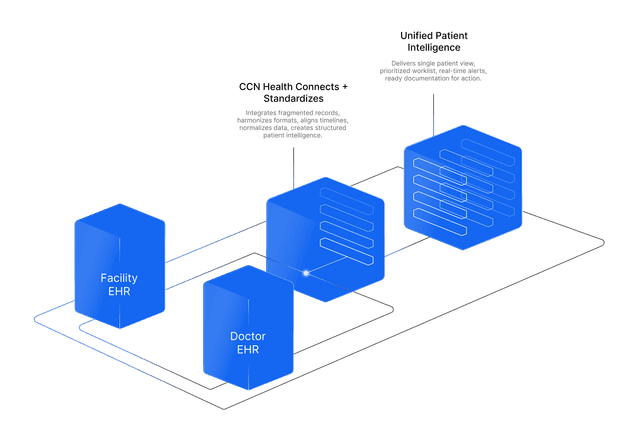
CCN Health integrates with athenahealth, Epic, Charm Health, and Ethizo. Device readings and care coordination notes flow directly into patient charts.
Turnkey Clinical Support
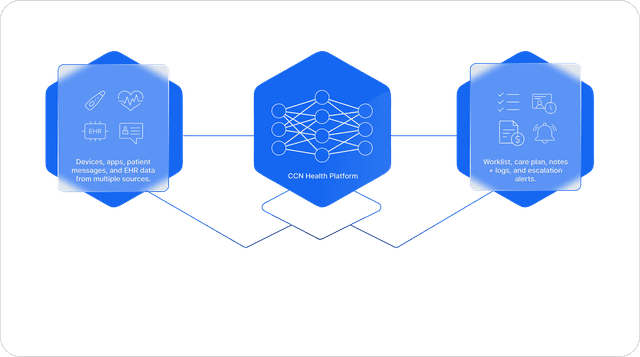
CCN Health provides monitoring staff who review device data, manage alerts, and document care interactions — extending your clinical capacity without additional hires.
Simple Patient Devices
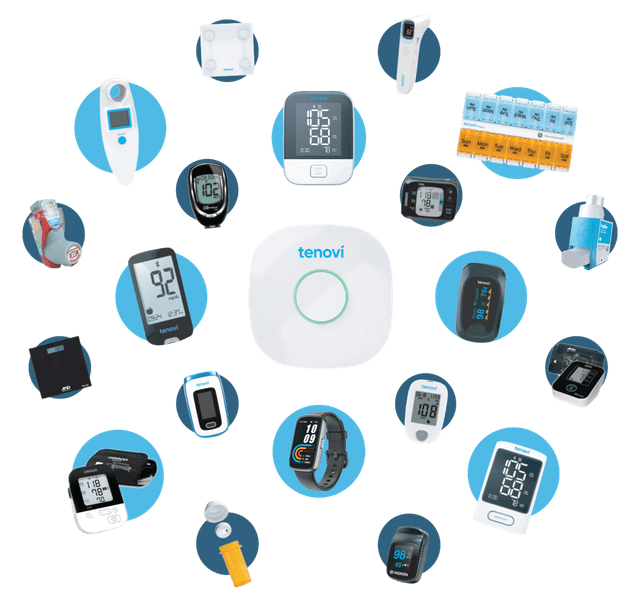
Cellular-connected blood pressure monitors, scales, and glucose meters transmit data automatically. No apps, no Wi-Fi, no patient setup required.
Automated Compliance
Built-in time tracking, 16-day transmission monitoring, and CPT-ready documentation reduce billing complexity and audit risk.
Scalable Enrollment
Start with your highest-risk patients and expand enrollment as the program proves results. Most practices launch within 30 days.
Why Physician Practices Are Adding RPM and CCM
Physician practices managing chronic disease patients face a structural limitation: the traditional visit-based model provides visibility into a patient's condition for a few minutes every few months. Between visits, clinical changes go undetected until the patient presents with symptoms — often in an emergency setting.
RPM and CCM programs solve this by creating structured touchpoints between office visits. RPM provides continuous physiologic data from connected devices, while CCM provides care coordination and medication management through regular patient outreach. Both programs are reimbursable through Medicare and are increasingly covered by commercial payers.
Program Options for Practices
Remote Patient Monitoring (RPM)
RPM uses FDA-cleared devices to monitor patient vitals between visits. The practice identifies qualifying patients, devices are shipped directly to the patient, and data flows into your EHR automatically.
Estimated RPM revenue per patient (CMS fee schedule):
- 99453: Setup & education (~$19, one-time)
- 99454: Device supply & transmission (~$55/month)
- 99457: First 20 min clinical review (~$48/month)
- 99458: Additional 20 min review (~$38/month)
Chronic Care Management (CCM)
CCM provides structured care coordination for patients with two or more chronic conditions. Monthly activities include care plan management, medication reconciliation, and care team coordination.
Estimated CCM revenue per patient (CMS fee schedule):
- 99490: 20+ min staff time (~$62/month)
- 99491: 60+ min physician time (~$86/month)
- 99439: Each additional 20 min (~$47/month)
Stacking Programs
Practices may bill RPM and CCM for the same patient in the same month if requirements for each are independently met. This can increase estimated per-patient revenue significantly.
Implementation Timeline
Most practices are live within 30 days:
- Week 1 — Discovery call, EHR integration setup, patient identification
- Week 2 — Staff training, workflow configuration, device procurement
- Week 3 — Pilot enrollment with 10–20 highest-risk patients
- Week 4 — Full enrollment expansion, billing activation, outcomes tracking
EHR Integration
CCN Health integrates with the practice EHR systems your team already uses — athenahealth, Epic, Charm Health, Ethizo, and August Health. Device readings, clinical notes, and billing documentation flow directly into patient records.
Information on this page is for educational purposes. Reimbursement amounts are estimates based on CMS published fee schedules and may vary by region, payer, and clinical circumstances. Consult qualified billing professionals for guidance specific to your practice.
Questions?
Want to learn more about RPM for physician practices for your facility?
Our team can answer your questions and show you how it works with your current workflow.