Clinical
Remote Therapeutic Monitoring for Skilled Nursing — 2026 Guide
How Remote Therapeutic Monitoring works in skilled nursing facilities — tracking post-acute rehabilitation outcomes, PT/OT compliance, and discharge readiness for Medicare Part A and Part B residents.
Remote Therapeutic Monitoring (RTM) in skilled nursing facilities tracks post-acute rehabilitation outcomes — PT/OT exercise compliance, pain assessments, functional recovery milestones, and discharge readiness indicators. SNFs are the ideal RTM environment because post-acute rehabilitation is their core clinical mission. CCN Health integrates RTM therapy data with PointClickCare, giving therapy directors and attending physicians objective outcome data that supports discharge planning, continued therapy authorization, and PDPM therapy classification. RTM uses CPT codes 98975-98981 and generates $50-105 per resident per month — stackable with RPM for residents who also need vital sign monitoring.
What Is Remote Therapeutic Monitoring (RTM)?
Remote Therapeutic Monitoring (RTM) is a Medicare-reimbursable program that RTM (Remote Therapeutic Monitoring) is a Medicare program that monitors therapy outcomes for musculoskeletal and respiratory conditions. Unlike RPM (vital signs), RTM tracks exercise compliance, pain assessments, range of motion, and respiratory therapy adherence using CPT codes 98975-98981. In skilled nursing, RTM aligns directly with the post-acute rehabilitation mission — providing continuous therapy outcome data between PT/OT sessions..
Patient eligibility: Medicare beneficiaries undergoing physical therapy, occupational therapy, or respiratory therapy. Data must be self-reported or collected via therapy-specific devices for 16+ days per billing period.
How RTM differs from related programs: RTM tracks therapy outcomes — pain scores, range of motion, exercise compliance, functional status — rather than vital signs (RPM) or care coordination (CCM). It is the only Medicare monitoring program designed for rehabilitation.
RTM can be stacked with RPM, PCM for qualifying patients — a single enrolled patient can generate revenue across multiple Medicare programs simultaneously.
Why Skilled Nursing Facilities Need RTM
Post-acute rehabilitation is the core mission of skilled nursing facilities. RTM provides the objective therapy outcome data that supports this mission.
Post-acute rehab (hip fracture, joint replacement, stroke, cardiac) is the primary SNF admission driver — every rehab admission is a potential RTM enrollment
PDPM (Patient-Driven Payment Model) therapy classification benefits from objective therapy outcome documentation
Discharge planning requires functional progress evidence — RTM provides the data that supports safe discharge timing
Therapy directors need compliance tracking across large resident populations — manual tracking doesn't scale
- Readmission prevention during the 30-day post-acute window benefits from therapy progress monitoring alongside vital sign monitoring (RPM)
How RTM Works in Skilled Nursing — The Clinical Workflow
RTM in skilled nursing embeds into existing PT/OT workflows — adding digital outcome tracking to the rehabilitation programs that SNFs already deliver.
Step 1. Post-acute resident admitted with rehabilitation orders — PT/OT evaluation triggers RTM enrollment assessment
Step 2. Therapy director prescribes RTM protocol aligned with rehabilitation goals (mobility milestones, pain targets, exercise progression)
Step 3. Daily therapy data collection: exercise completion between PT/OT sessions, pain levels, functional status assessments
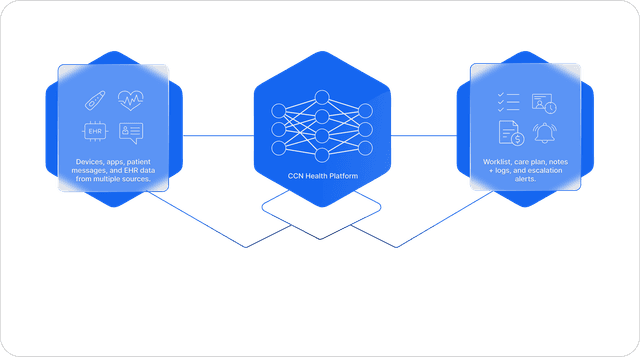
Step 4. CCN Health aggregates therapy data in PCC — therapy directors and attending physicians see progress alongside clinical documentation
Step 5. Weekly therapy data review supports continued stay justification, therapy plan adjustments, and discharge readiness assessment
Step 6. Discharge planning incorporates RTM trend data — objective functional progress supports safe transition to lower level of care
RTM Devices and Monitoring for Skilled Nursing
SNF RTM uses therapy-focused digital assessments rather than vital sign devices — tracking rehabilitation progress through exercise logs, pain scales, and functional outcome measures.
- Digital exercise compliance trackers — automated logging of prescribed PT/OT exercises between formal therapy sessions
- Pain assessment tools — validated NRS (0-10) and VAS scales delivered digitally at scheduled intervals
- Functional outcome measures — digital Timed Up and Go, 6-Minute Walk Test tracking, grip strength logging
- Respiratory therapy monitors — breathing exercise compliance, incentive spirometry tracking for post-surgical and COPD residents
- Range of motion tracking — digital goniometry progress for joint replacement and fracture recovery
In SNFs, therapy staff often assist with RTM data collection — residents in post-acute rehab may have cognitive or physical limitations that require guided assessment sessions.
RTM Billing: CPT Codes and Revenue
| CPT Code | Service | Reimbursement | Requirement |
|---|---|---|---|
| 98975 | Setup & Education | ~$19 | One-time initial setup |
| 98976 | Respiratory RTM | ~$50/mo | 16+ days respiratory data |
| 98977 | MSK RTM | ~$50/mo | 16+ days MSK therapy data |
| 98980 | Treatment Mgmt | ~$48/mo | First 20 min treatment mgmt |
| 98981 | Additional Mgmt | ~$38/mo | Each additional 20 min |
Estimated monthly revenue per patient: ~$100–155
Program stacking: RTM + RPM generates $275–375/patient/month. For complex rehab patients, RTM + RPM + PCM can reach $350–490/month.
RTM billing in SNFs has a critical distinction: during Medicare Part A covered stays, RTM is typically bundled into the SNF PPS rate. RTM billing (CPT 98975-98981) is most applicable to Part B residents (long-stay) or post-Part A transition. Therapy directors should coordinate with billing to ensure RTM is billed appropriately based on Medicare benefit status.
EHR Integration for RTM in Skilled Nursing
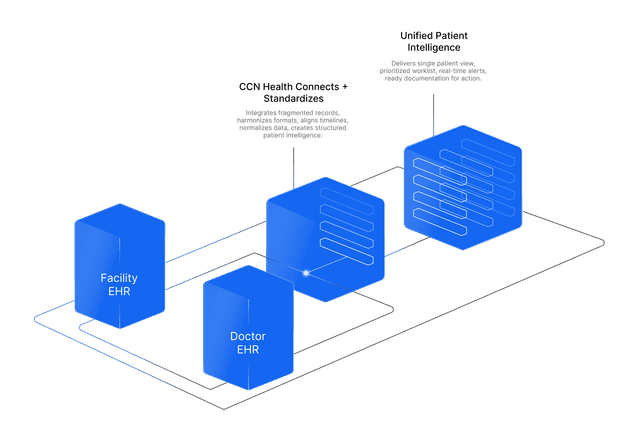
Skilled Nursing facilities typically use PointClickCare (~75%), MatrixCare for clinical documentation. PointClickCare dominates the SNF market. MatrixCare is the leading alternative. Attending physicians use separate EHRs (athenahealth, Epic) requiring dual-EHR integration.
CCN Health provides bi-directional integration with all major skilled nursing EHR systems:
- Resident/patient demographics sync automatically
- Monitoring data flow into existing EHR workflows
- Clinical alerts appear within the EHR — no separate portal required
- Billing documentation generates automatically for RTM time tracking
PointClickCare integration ensures RTM therapy data flows into the same resident record used by nursing, therapy, and physicians — therapy progress is visible alongside MDS assessments, care plans, and clinical documentation without a separate portal.
Getting Started: Implementing RTM in Your Skilled Nursing Facilitie
A typical RTM implementation in skilled nursing follows a 4–8 week timeline:
- Week 1–2: Identify post-acute rehabilitation population — hip fracture, joint replacement, stroke, cardiac, COPD exacerbation residents with active PT/OT orders
- Week 3–4: Configure RTM protocols in CCN Health aligned with therapy director's outcome goals and PDPM therapy classifications
- Week 5–6: Train therapy staff on digital outcome assessment tools, pain scale administration, and exercise compliance logging
- Week 7–8: Go live with post-acute rehab residents first — highest therapy intensity and clearest outcome metrics — then expand to long-stay residents with ongoing therapy
RTM implementation in SNFs should be led by the therapy director — they understand rehabilitation goals, staffing models, and how RTM data feeds into discharge planning and PDPM documentation.
Ready to implement RTM in your skilled nursing facilitie? CCN Health provides full-service Remote Therapeutic Monitoring with EHR integration, clinical oversight, and billing optimization purpose-built for skilled nursing.
Disclaimer: This article is for informational purposes only and does not constitute medical, legal, or billing advice. CPT code reimbursement amounts are estimates based on CMS published fee schedules and may vary by region, payer, and clinical circumstances. Always consult qualified healthcare, billing, and technology professionals for guidance specific to your facility.
Let's figure this out together
We work closely with every client to find the right approach for their practice. Think of us as your partner, not just a platform.
Topics
Your Partner in Chronic Care
We love working closely with our clients to find the best solutions. Let us help guide you through the complicated stuff.
Why It Matters
Key Benefits
See how this approach drives measurable improvements across your organization.
RTM Program Management
Full Remote Therapeutic Monitoring program delivery including enrollment, monitoring, clinical review, and billing documentation — purpose-built for skilled nursing workflows.
EHR Integration
Bi-directional integration with PointClickCare (~75%), MatrixCare ensures monitoring data flows into existing clinical workflows without manual data entry.
Revenue Optimization
~$100–155 per patient per month with RTM. Program stacking with RPM and PCM increases per-patient revenue further.
Post-Acute Outcome Tracking
Objective PT/OT compliance and functional progress data for every post-acute rehab resident — the core SNF population.
Discharge Readiness Data
Functional progress trends support evidence-based discharge planning — reducing premature discharges and readmissions.
PDPM Documentation
Digital therapy outcome data strengthens PDPM classification documentation — supporting appropriate therapy resource utilization.
Continue Reading
Related Articles
Explore more insights on this topic.
What Is Remote Therapeutic Monitoring (RTM)? A Complete Guide
A complete guide to Remote Therapeutic Monitoring — what it is, how it differs from RPM, which conditions qualify, the five CPT codes (98975-98981), and how providers bill Medicare for RTM services.
Best RPM Solutions for Skilled Nursing Facilities in 2026
A guide to the best RPM solutions purpose-built for skilled nursing facilities — covering PointClickCare integration, dual-EHR data flow, contactless monitoring for cognitively impaired residents, and Medicare billing optimization for post-acute and long-term care.
Chronic Care Management for Skilled Nursing — 2026 Guide
How CCM works in skilled nursing — post-acute care coordination, multi-provider communication, medication reconciliation for polypharmacy, and Medicare billing for SNF residents with multiple chronic conditions.
Common Questions
Frequently Asked Questions
Get answers to the most common questions about this topic.
Remote Therapeutic Monitoring (RTM) for skilled nursing: Remote Therapeutic Monitoring (RTM) is a Medicare program using CPT codes 98975-98981 that tracks therapy outcomes — exercise adherence, pain levels, and functional status — for patients in musculoskeletal or respiratory rehabilitation. Medicare beneficiaries undergoing physical therapy, occupational therapy, or respiratory therapy.
RTM generates ~$100–155 per patient per month through CPT codes 98975, 98976, 98977, 98980, 98981. RTM + RPM generates $275–375/patient/month. For complex rehab patients, RTM + RPM + PCM can reach $350–490/month.
CCN Health integrates with PointClickCare (~75%), MatrixCare for skilled nursing facilities. PointClickCare dominates the SNF market. All monitoring data flows bi-directionally between CCN Health and the facility/physician EHR.
RTM billing during Part A covered stays is complex — CPT 98975-98981 may be bundled into the SNF PPS rate during the covered stay. RTM billing is most clearly applicable to Part B (long-stay) residents or after Part A benefits exhaust. Consult your billing team for current CMS guidance on RTM billing during Part A stays.
PDPM classifies residents based on therapy needs — RTM provides objective documentation of therapy engagement, functional progress, and rehabilitation complexity that supports appropriate PDPM classification. Digital therapy outcome data strengthens the clinical record supporting therapy resource utilization.
Yes — RTM monitors therapy outcomes between formal PT/OT sessions, not during them. RTM tracks what happens after the therapist leaves: exercise compliance, pain trends, functional status changes. This between-session monitoring complements the direct therapy services that SNFs bill separately.
Still have questions? We love helping practices figure this out — no pressure, just real answers.
Your Partner in Chronic Care
We're Here to Guide You Every Step of the Way
RPM, CCM, and chronic care management can get complicated. We work closely with every client to figure out the best solutions for their practice.