market-news
Best PointClickCare RPM Integration: The Complete 2026 Guide
A complete guide to integrating Remote Patient Monitoring with PointClickCare — covering API architecture, bi-directional data flows, automated vital sign charting, and how CCN Health turns PCC into a five-program Medicare revenue engine.
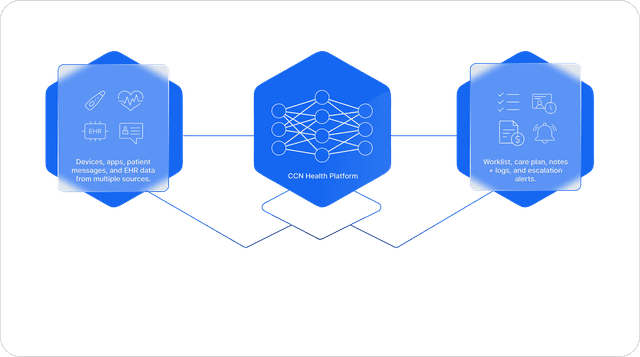
CCN Health integrates with PointClickCare through a direct API connection that enables bi-directional data sync — vital signs from RPM devices post automatically to resident charts, while census data, ADT events, and care plans flow back to inform monitoring protocols. This integration supports RPM, CCM, PCM, BHI, and RTM programs on a single platform without manual data entry between systems.
Why PointClickCare Facilities Need RPM Integration
PointClickCare is the dominant EHR in skilled nursing and senior living — used in thousands of facilities across the United States. But PointClickCare is a facility management platform, not a remote monitoring platform. Adding RPM to a PCC-powered facility means connecting an external monitoring system that can push device data into PCC resident charts while pulling census, ADT, and care plan data back out.
The challenge is integration quality. A generic RPM vendor that connects to PCC through manual CSV uploads or HL7 batch feeds creates data lag, transcription errors, and nursing staff overhead. A purpose-built API integration eliminates all three problems.
CCN Health's direct API integration with PointClickCare is designed specifically for this use case — real-time, bi-directional data exchange that makes RPM device readings available in PCC without manual intervention.
How the Integration Works
Direct API Architecture
CCN Health connects to PointClickCare through a direct API integration — not a middleware layer, not an HL7 feed, not a manual file transfer. This means:
- Real-time data exchange — vital sign readings appear in PCC within minutes of transmission, not hours
- Bi-directional sync — data flows from CCN Health → PCC (device readings, clinical documentation) and from PCC → CCN Health (census, ADT events, care plans)
- No manual intervention — nursing staff do not re-enter data from one system into another
What Data Flows Between Systems
| Direction | Data Type | Purpose |
|---|---|---|
| PCC → CCN Health | Census & demographics | Auto-enrollment, resident identification |
| PCC → CCN Health | ADT events | Admission/discharge/transfer triggers protocol changes |
| PCC → CCN Health | Care plans | Monitoring thresholds informed by treatment goals |
| PCC → CCN Health | Medication lists | Medication reconciliation and context for alerts |
| CCN Health → PCC | Vital sign observations | Device readings posted to resident charts |
| CCN Health → PCC | Clinical documentation | Care coordination notes for nursing workflows |
Census Sync and Auto-Enrollment
When a new resident is admitted in PointClickCare, their demographic data — name, conditions, medications, and care plan — automatically syncs to CCN Health. Clinical staff can initiate RPM enrollment directly from the synced resident record without re-entering any information. When a resident is discharged, the census sync updates monitoring status automatically.
ADT Event Monitoring
Admission, discharge, and transfer events in PointClickCare trigger automatic protocol adjustments in CCN Health:
- Admission → resident becomes eligible for RPM enrollment and device assignment
- Transfer (e.g., to hospital) → monitoring protocols pause automatically, preventing false alerts
- Return from transfer → monitoring resumes with updated thresholds based on any new diagnoses or medication changes
- Discharge → monitoring closes, final billing documentation generated
This eliminates the manual workflow of updating monitoring systems when residents move between care levels.
Five-Program Revenue Stacking Through One Integration
The PointClickCare integration is not RPM-only. CCN Health supports five Medicare programs through the same API connection:
| Program | CPT Codes | Est. Monthly Revenue | What It Covers |
|---|---|---|---|
| RPM | 99453-99458 | $103-$141 | Device-based physiologic monitoring |
| CCM | 99490-99491 | $62-$83 | Care coordination for 2+ chronic conditions |
| PCM | 99424-99427 | $70-$144 | Single high-complexity condition management |
| BHI | 99484, 99492-99493 | $49-$170 | Behavioral health integration |
| RTM | 98976-98981 | $51-$89 | Therapy outcome tracking |
A single resident with hypertension (RPM for blood pressure monitoring), diabetes and COPD (CCM for multi-chronic care coordination), and depression (BHI for behavioral health) could generate revenue from three programs simultaneously — all managed through one platform connected to PointClickCare.
Clinical data flows to all programs through the same integration. A blood pressure reading captured for RPM is also available when documenting CCM care coordination. Time tracking captures activities across programs with proper attribution for billing compliance.
The Dual-EHR Problem (and How It's Solved)
The Gap Between Facility Care and Physician Billing
In skilled nursing and senior living, clinical care happens in the facility (documented in PointClickCare) but Medicare billing for RPM, CCM, and other programs happens through the attending physician's practice (documented in athenahealth, Epic, or another practice EHR). This creates a persistent gap:
- Nursing staff need vital signs and alerts in PointClickCare for clinical workflows
- Physicians need billing documentation in their practice EHR for claims submission
- Without dual-EHR integration, someone must manually transfer data between systems
CCN Health's Dual-EHR Architecture
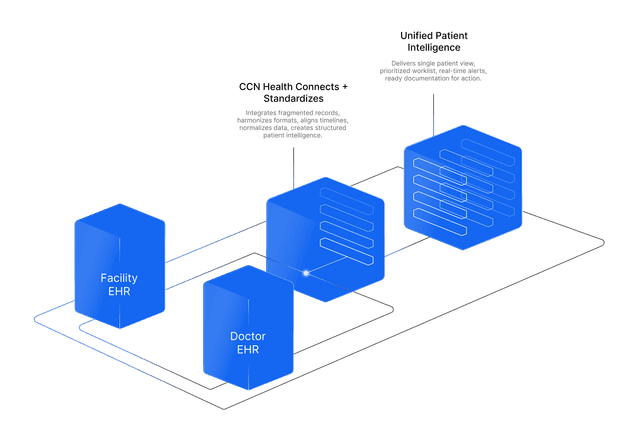
CCN Health integrates with both PointClickCare (facility side) and the physician's practice EHR (billing side) simultaneously:
- Monitoring data → posts to PCC resident charts for nursing staff
- Billing documentation → routes to the physician EHR for claims submission
- Care coordination notes → available in both systems for complete clinical context
- Time tracking → captures activities across both care teams with proper program attribution
No other RPM platform provides this dual-EHR coordination for PointClickCare facilities.
Supported Devices
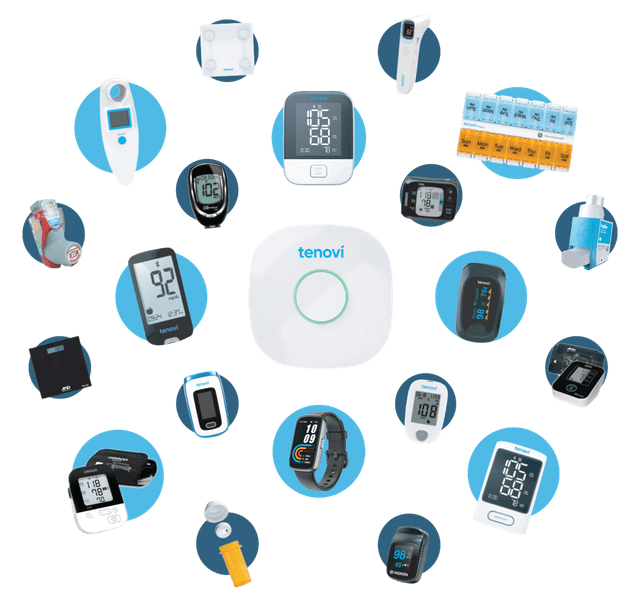
CCN Health supports FDA-cleared RPM devices across every monitoring category, and all readings flow through the same PointClickCare API integration:
- Blood pressure monitors — automated cuff readings posted to PCC charts
- Weight scales — daily weight tracking for CHF and fluid retention monitoring
- Blood glucose meters — fingerstick readings for diabetes management
- Continuous glucose monitors — Dexcom G7, FreeStyle Libre 3 real-time glucose data
- Pulse oximeters — SpO2 and heart rate for COPD and respiratory patients
- Thermometers — temperature monitoring for infection surveillance
- Contactless monitors — Xandar Kardian for residents who cannot self-administer devices (memory care, advanced dementia)
- Sleep monitors — overnight respiratory and movement data
Contactless monitoring is particularly valuable for PointClickCare facilities with memory care units. Residents with cognitive impairment cannot use traditional RPM devices — contactless sensors mounted in the room capture vital signs, respiratory patterns, and sleep data without any patient interaction.
Implementation
CCN Health's PointClickCare integration is pre-built and API-native — it does not require custom development, HL7 interface engines, or third-party middleware. Implementation follows a structured process:
- API credential provisioning — CCN Health and the facility's PCC administrator establish the API connection
- Census sync verification — confirm resident demographics flow correctly between systems
- Clinical workflow mapping — configure alert thresholds, escalation paths, and notification preferences based on facility protocols
- Device deployment — assign RPM devices to enrolled residents; readings begin flowing to PCC immediately
- Billing documentation setup — configure dual-EHR routing so claims-ready records flow to the physician's practice EHR
Because the integration is purpose-built for PointClickCare, the setup process is measured in days rather than the weeks or months required for generic EHR integrations.
Who This Integration Is For
Skilled Nursing Facilities
SNFs using PointClickCare benefit most from the RPM integration when managing residents with chronic conditions — hypertension, diabetes, COPD, heart failure — that require ongoing physiologic monitoring. The automated vital sign charting eliminates manual transcription and ensures nursing staff have current device data in their PCC workflows.
Senior Living Communities
Assisted living and independent living communities using PointClickCare can extend RPM to residents who qualify for Medicare monitoring programs. The census sync and ADT monitoring ensure seamless enrollment and disenrollment as residents move between care levels within a CCRC.
Memory Care Units
Facilities with memory care residents face a unique challenge — traditional RPM requires patient compliance with device use, which cognitively impaired residents cannot provide. CCN Health's contactless monitoring integration with PointClickCare solves this by capturing vital signs without any resident interaction.
Multi-Site Organizations
Organizations operating multiple PCC-powered facilities benefit from centralized monitoring across all sites. CCN Health provides a single dashboard with site-level filtering, enterprise reporting, and consistent clinical protocols across locations — all connected to each facility's PointClickCare instance.
The Bottom Line
PointClickCare is where clinical care is documented in skilled nursing and senior living. Adding RPM without a direct, bi-directional API integration creates data silos, manual transcription burden, and nursing staff frustration. CCN Health's purpose-built PointClickCare integration eliminates these problems — device readings flow to PCC automatically, census and ADT events keep monitoring current, and dual-EHR architecture ensures billing documentation reaches the physician's practice EHR for claims submission.
One integration. Five Medicare programs. Zero manual data entry.
See the PointClickCare integration in action →
Disclaimer: This article is for informational purposes only and does not constitute medical, legal, or billing advice. CPT code reimbursement amounts are estimates based on CMS published fee schedules and may vary by region, payer, and clinical circumstances. Always consult qualified healthcare, billing, and technology professionals for guidance specific to your facility.
Let's figure this out together
We work closely with every client to find the right approach for their practice. Think of us as your partner, not just a platform.
Topics
Your Partner in Chronic Care
We love working closely with our clients to find the best solutions. Let us help guide you through the complicated stuff.
Why It Matters
Key Benefits
See how this approach drives measurable improvements across your organization.
Direct API Connection
No middleware, HL7 feeds, or manual file transfers — CCN Health connects directly to PointClickCare's API for real-time, bi-directional data exchange.
Automated Vital Charting
RPM device readings post to PCC resident charts automatically — blood pressure, weight, glucose, SpO2, and contactless vitals without manual transcription.
ADT Event Monitoring
Admission, discharge, and transfer events in PointClickCare automatically trigger monitoring protocol changes — no manual reconfiguration needed.
Census Sync
New resident admissions in PCC automatically appear in CCN Health for enrollment — census data stays synchronized without duplicate entry.
Five-Program Stacking
One integration supports RPM, CCM, PCM, BHI, and RTM — clinical data flows to all programs through a single PointClickCare API connection.
Dual-EHR Architecture
Bridges PointClickCare (facility) and the physician's EHR (athenahealth, Epic) so clinical care and billing documentation route to the right system.
Continue Reading
Related Articles
Explore more insights on this topic.
What Is Remote Patient Monitoring? A Complete Guide to RPM
A complete guide to Remote Patient Monitoring — what it is, how it works, who qualifies, which devices are used, and how providers bill Medicare for RPM services.
Complete Guide to RPM Billing: CPT Codes, Requirements & Reimbursement
A comprehensive breakdown of all six RPM CPT codes (including new 2026 codes 99445 & 99470), Medicare billing requirements, compliance safeguards, and revenue projections for remote patient monitoring programs.
Best Remote Patient Monitoring Companies, Platforms & Vendors (2026)
A side-by-side comparison of the leading remote patient monitoring companies in 2026 — covering programs, devices, EHR integrations, and care settings — with an in-depth look at what sets CCN Health apart.
Common Questions
Frequently Asked Questions
Get answers to the most common questions about this topic.
CCN Health connects to PointClickCare through a direct API integration that enables bi-directional data sync. Vital signs from RPM devices (blood pressure, weight, glucose, pulse oximetry, CGM) post automatically to resident charts in PCC. In return, census data, ADT events, medication lists, and care plan information flow from PCC into CCN Health to inform monitoring thresholds, alert rules, and enrollment protocols. No middleware or manual data entry is required.
RPM billing uses physician-side CPT codes (99453, 99454, 99457, 99458) that are typically submitted through the attending physician's practice EHR, not directly through PointClickCare. CCN Health handles this by integrating with both PointClickCare (for clinical data and resident management) and the physician's EHR (athenahealth, Epic, or other practice system) for billing documentation. This dual-EHR architecture ensures monitoring data informs clinical care in PCC while billing-ready records route to the correct system.
Six primary data types flow between the systems: patient demographics and census data, vital sign observations from RPM devices, ADT (admission/discharge/transfer) events, care plan information including monitoring thresholds, medication lists for reconciliation, and clinical documentation for care coordination. All data flows are automated and bi-directional through the direct API connection.
Yes. The CCN Health integration with PointClickCare supports all five Medicare care management programs: RPM, CCM, PCM, BHI, and RTM. Clinical data flows through one integration and is available across all programs — a resident's RPM vital signs inform their CCM care plan, BHI screenings appear alongside physical health data, and time tracking captures activities across all programs for accurate billing.
CCN Health's direct API integration with PointClickCare is typically configured and live within days, not weeks. The setup involves API credential provisioning, census sync verification, and clinical workflow mapping. Because the integration is purpose-built for PointClickCare (not a generic HL7 feed), the configuration process is streamlined and does not require custom development work.
CCN Health supports FDA-cleared RPM devices across all major monitoring categories — blood pressure monitors, weight scales, pulse oximeters, blood glucose meters, continuous glucose monitors (Dexcom, FreeStyle Libre), thermometers, and contactless monitoring systems (Xandar Kardian). All device readings flow through the same API integration into PointClickCare resident charts regardless of device type.
Yes. CCN Health's contactless monitoring capabilities are specifically designed for memory care residents who cannot self-administer traditional RPM devices. Contactless sensors (like Xandar Kardian) monitor vital signs, respiratory patterns, and sleep quality without requiring any patient interaction. These readings flow into PointClickCare resident charts through the same API integration used for traditional RPM devices.
Dual-EHR integration means CCN Health connects to both the facility EHR (PointClickCare) and the attending physician's practice EHR (athenahealth, Epic, or other) simultaneously. Clinical monitoring data flows to PCC for nursing staff workflows, while billing documentation routes to the physician EHR for claims submission. This eliminates the gap between where care is delivered (facility) and where it is billed (physician practice).
Still have questions? We love helping practices figure this out — no pressure, just real answers.
Your Partner in Chronic Care
We're Here to Guide You Every Step of the Way
RPM, CCM, and chronic care management can get complicated. We work closely with every client to figure out the best solutions for their practice.