Guides
CPT Code 99490: Chronic Care Management Billing Guide
CPT 99490 is the foundational billing code for Chronic Care Management — covering the first 20 minutes of clinical staff time for patients with two or more chronic conditions. This guide covers requirements, 2026 rates, documentation, and how 99490 pairs with 99491 and 99439.
CPT code 99490 covers the first 20 minutes of clinical staff time per calendar month spent on non-face-to-face chronic care management services for patients with two or more chronic conditions expected to last at least 12 months. The estimated 2026 Medicare reimbursement rate is approximately $62. Services must be performed under the general supervision of the billing physician or qualified healthcare professional. 99490 requires documented patient consent, an established care plan, and detailed time logs. It pairs with 99439 (each additional 20 minutes, ~$47) and is mutually exclusive with 99491 (complex CCM) in the same month.
What Is CPT Code 99490?
CPT 99490 is the foundational billing code for Medicare's Chronic Care Management (CCM) program. It covers the first 20 minutes of clinical staff time per calendar month spent on non-face-to-face care coordination services for patients with two or more chronic conditions expected to last at least 12 months or until the death of the patient. In practical terms, it reimburses the ongoing work that happens between office visits — medication reconciliation, care plan updates, coordination with specialists, patient outreach calls, and management of transitions between care settings.
CMS introduced CPT 99490 in January 2015 as part of a broader effort to recognize and reimburse the care coordination work that practices had been performing for chronically ill patients without compensation. Before 99490, practices absorbed the cost of phone calls, care plan management, and inter-provider communication as overhead. The creation of a dedicated billing code transformed these activities from cost centers into a reimbursable service line.
Since its introduction, 99490 has become the most widely billed CCM code in the Medicare program. Its accessibility — clinical staff can perform the work under general supervision, with no requirement for physician involvement in the actual care coordination time — makes it the entry point for most practices building a CCM program.
Where 99490 Fits in the CCM Code Family
The complete set of CCM-related CPT codes includes:
- 99490 — Standard CCM, first 20 minutes of clinical staff time (~$62/month)
- 99439 — Standard CCM add-on, each additional 20 minutes of clinical staff time (~$47/month, up to 2x)
- 99491 — Complex CCM, first 30 minutes of physician/QHP time (~$86/month)
- 99437 — Complex CCM add-on, each additional 30 minutes of physician/QHP time (~$63/month)
The critical distinction between the two CCM tracks is who performs the work. CPT 99490 (standard CCM) allows clinical staff — nurses, medical assistants, social workers, care coordinators — to perform the care coordination under the general supervision of the billing physician. CPT 99491 (complex CCM) requires the billing physician or qualified healthcare professional to personally perform the care management time. This difference in staffing requirements drives most of the clinical and financial decision-making around which code to use.
2026 Reimbursement Rate
The estimated 2026 Medicare reimbursement rate for CPT 99490 is approximately ~$62 per patient per month. This rate is based on the CMS Physician Fee Schedule and represents the national average — actual reimbursement varies by geographic region and Medicare Administrative Contractor (MAC) jurisdiction due to geographic practice cost index (GPCI) adjustments.
CCM Code Rate Comparison
| CPT Code | Description | Time Requirement | Who Performs | Estimated 2026 Rate |
|---|---|---|---|---|
| 99490 | Standard CCM (first 20 min) | 20 minutes/month | Clinical staff under general supervision | ~$62 |
| 99439 | Standard CCM add-on (each additional 20 min) | Each additional 20 min | Clinical staff under general supervision | ~$47 |
| 99491 | Complex CCM (first 30 min) | 30 minutes/month | Physician/QHP directly | ~$86 |
| 99437 | Complex CCM add-on (each additional 30 min) | Each additional 30 min | Physician/QHP directly | ~$63 |
All figures are estimates based on CMS published fee schedules. Actual rates vary by geographic region, MAC jurisdiction, and payer.
While the per-unit rate for 99491 ($86) is higher than 99490 ($62), the staffing requirement makes 99490 far more scalable. A single care coordinator billing 99490 can manage dozens of patients per month. A physician billing 99491 is limited by their personal clinical availability. For most practices, the volume advantage of 99490 outweighs the higher per-unit rate of 99491.
Geographic Variation
Reimbursement rates vary based on the practice's geographic location. Urban areas with higher cost of living generally receive higher reimbursement due to GPCI adjustments. A practice in Manhattan may receive several dollars more per claim than a practice in rural Kansas for the same code. When modeling CCM revenue, use your practice's actual fee schedule rather than national averages.
Requirements for Billing 99490
Patient Eligibility
The patient eligibility requirement for CPT 99490 is specific and must be clearly documented:
Two or more chronic conditions. The patient must have at least two chronic conditions that are expected to last at least 12 months or until the death of the patient. These conditions must place the patient at significant risk of death, acute exacerbation/decompensation, or functional decline.
Common qualifying condition combinations include:
- Hypertension and diabetes
- Heart failure and chronic kidney disease
- COPD and depression
- Diabetes and chronic pain
- Atrial fibrillation and hypertension
- Obesity and osteoarthritis
- Chronic kidney disease and anemia
- Heart failure and diabetes
The conditions must be actively managed — historical diagnoses that are resolved or inactive do not qualify. Each condition should have an associated ICD-10 code on the claim and be reflected in the comprehensive care plan.
Time Threshold
CPT 99490 requires a minimum of 20 minutes of cumulative clinical staff time per calendar month spent on non-face-to-face care coordination services. Key rules governing the time requirement:
- Cumulative, not continuous. The 20 minutes do not need to occur in a single session. A care coordinator who spends 5 minutes on a medication reconciliation call, 8 minutes coordinating with a specialist, and 10 minutes updating the care plan has exceeded the threshold.
- Non-face-to-face. The time must be spent on care coordination activities that occur outside of an office visit. Time spent during an E/M encounter does not count toward the 99490 threshold.
- Calendar month basis. The 20-minute threshold resets on the first of each month. Time does not carry over — 35 minutes in March does not allow billing 99490 in both March and April if April has only 5 minutes of documented activity.
- Qualifying activities include: Medication reconciliation, care plan development and updates, care team communication, patient and caregiver outreach, coordination with home health and community services, specialist referral coordination, transition-of-care management, and review of test results with care plan implications.
Patient Consent
Patient consent is a prerequisite for billing 99490 — it must be obtained and documented before any CCM services are billed. The consent process must address:
- Services to be provided. The patient must understand that they will receive ongoing care coordination between office visits, including phone outreach, medication management, and care plan oversight.
- Cost-sharing responsibility. Medicare patients are subject to standard cost-sharing (typically 20% coinsurance) for CCM services. The patient must be informed of this financial responsibility.
- Single-provider rule. Only one provider can bill CCM for a given patient in any calendar month. The patient must acknowledge this restriction and agree to receive CCM services from the billing practice.
- Right to revoke. The patient can discontinue CCM services at any time. The consent must inform them of this right and how to exercise it.
- Electronic health information exchange. The patient should consent to electronic sharing of health information among care team members as needed for care coordination.
Consent can be obtained verbally or in writing. CMS does not mandate written consent, but written documentation provides stronger audit protection. Many practices use a standardized CCM consent form that the patient signs at enrollment.
Care Plan
A comprehensive care plan must be established for every patient enrolled in CCM. The care plan is not a one-time document — it must be maintained, updated, and accessible to all providers in the care team. Required elements include:
- Problem list. All active chronic conditions being managed, with associated ICD-10 codes.
- Expected outcomes and prognosis. Clinical goals for each condition (target blood pressure, A1c goals, weight management targets).
- Measurable treatment goals. Specific, time-bound objectives that guide care coordination activities.
- Symptom management. Documentation of how symptoms are being monitored and managed between visits.
- Medication list. Complete medication reconciliation including prescriptions, OTC medications, and supplements, with dosages and frequencies.
- Community and social services. Referrals to or coordination with community resources (transportation, meal delivery, behavioral health support).
- Responsible individuals. Identification of all care team members and their roles, including the patient's caregiver if applicable.
The care plan must be stored in a certified electronic health record (EHR) system and be electronically shareable with other providers involved in the patient's care.
Who Can Bill CPT 99490?
Understanding the supervision and staffing rules for 99490 is critical for compliance and for structuring an efficient CCM program.
Billing Provider
CPT 99490 is billed under the name and NPI of the physician or qualified healthcare professional (QHP) who has an established patient relationship and is responsible for the patient's care plan. Qualifying billing providers include:
- Physicians (MD/DO)
- Nurse practitioners (NP)
- Physician assistants (PA)
- Clinical nurse specialists (CNS)
- Certified nurse midwives (CNM)
The billing provider does not need to personally perform the 20 minutes of care coordination. They must establish the care plan and provide general supervision over the clinical staff who perform the work.
Clinical Staff (Who Performs the Work)
The actual care coordination activities for 99490 can be performed by clinical staff working under the general supervision of the billing provider. General supervision means the billing provider is available to provide oversight and guidance, but does not need to be physically present or directly involved in each care coordination activity. Qualifying clinical staff include:
- Registered nurses (RN)
- Licensed practical nurses (LPN)
- Medical assistants (MA)
- Certified nursing assistants (CNA)
- Social workers
- Care coordinators
- Health coaches (when functioning under clinical supervision)
This delegation model is the primary advantage of 99490 over 99491. A practice can hire a dedicated care coordinator to manage the CCM program, scaling enrollment to dozens or hundreds of patients, while the billing physician provides supervisory oversight and signs off on care plans.
Key Difference from 99491
CPT 99491 (complex CCM) requires the billing physician or QHP to personally perform the 30 minutes of care management time. The work cannot be delegated to clinical staff. This distinction drives the entire clinical and financial calculus between the two codes — 99490 scales with clinical staff headcount, while 99491 is constrained by physician availability.
"Incident To" and General Supervision Explained
Services billed under 99490 operate under "incident to" billing rules. The clinical staff performs the service, but it is billed under the physician's NPI because the staff is working under the physician's general supervision as part of an established care plan. General supervision requires that the physician has authorized the care coordination activities and is available (by phone or in person) for questions and guidance, but does not need to be in the building while the work occurs.
This is less restrictive than "direct supervision" (required for some office-based services), where the physician must be in the same office suite. The general supervision requirement for 99490 allows practices to run CCM programs with care coordinators working remotely or from satellite offices.
Billing Frequency
Once Per Calendar Month
CPT 99490 can be billed once per patient per calendar month. The calendar month boundary is firm — January 1 through January 31 constitutes one billing period, February 1 through February 28/29 constitutes the next. If the 20-minute threshold is met in a given month, the code can be billed. If not, it cannot.
Single Provider Rule
Only one provider can bill CCM services (99490, 99491, or their add-on codes) for a given patient in any calendar month. This rule prevents duplicate billing when a patient sees multiple providers. The patient's consent documentation establishes which provider is the CCM billing provider.
If a patient transfers CCM services from one provider to another, the transition must be documented. Both providers cannot bill CCM for the same patient in the same month. The outgoing provider should stop billing and document the transfer. The incoming provider begins billing in the first full month after the transition.
No Time Carry-Over
Time does not carry over between months. If a care coordinator spends 40 minutes on a patient in March, the practice bills 99490 (first 20 min) and one unit of 99439 (additional 20 min) for March. The extra minutes do not reduce the threshold for April. Each month starts fresh at zero.
Related CCM Codes
CPT 99491 — Complex Chronic Care Management
CPT 99491 covers the first 30 minutes of physician or QHP time spent per calendar month on care management for patients with two or more chronic conditions. The estimated 2026 reimbursement rate is approximately ~$86 per month.
The defining characteristic of 99491 is that the billing physician or QHP must personally perform the care management work. This code is appropriate when the physician is directly involved in complex clinical decision-making for a patient between visits — personally calling the patient, coordinating with specialists, making medication adjustments, and managing a complicated clinical picture that requires physician-level judgment throughout.
When to use 99491 instead of 99490:
- The physician personally performs 30+ minutes of care management per month
- The patient's clinical complexity requires direct physician involvement (not delegable to clinical staff)
- The patient has multiple interacting conditions requiring physician-level clinical reasoning for ongoing management
- The practice model relies on physician-driven care management rather than staff-driven coordination
CPT 99439 — Additional Clinical Staff Time
CPT 99439 is the add-on code for 99490, covering each additional 20-minute increment of clinical staff care coordination time beyond the initial 20 minutes. The estimated 2026 reimbursement rate is approximately ~$47 per additional 20-minute increment.
Key rules for 99439:
- Must be billed with 99490. CPT 99439 cannot be billed as a standalone code — it is an add-on to 99490.
- Up to 2 units per month. CMS allows up to two units of 99439 per patient per calendar month, covering an additional 40 minutes beyond the base 20 minutes.
- Same staffing rules. Clinical staff perform the work under general supervision, the same as 99490.
- Same documentation standard. Each additional 20-minute increment requires the same level of time documentation and activity description as the base code.
For patients requiring 45 minutes of care coordination: bill 99490 + one unit of 99439 ($62 + ~$47 = ~$109). For patients requiring 65 minutes: bill 99490 + two units of 99439 ($62 + ~$94 = ~$156).
99490 vs 99491 Comparison
| Factor | 99490 (Standard CCM) | 99491 (Complex CCM) |
|---|---|---|
| Time requirement | 20 minutes/month | 30 minutes/month |
| Who performs | Clinical staff under general supervision | Physician/QHP personally |
| Estimated reimbursement | ~$62/month | ~$86/month |
| Add-on code | 99439 (~$47 per additional 20 min) | 99437 (~$63 per additional 30 min) |
| Scalability | High — limited by staff capacity | Low — limited by physician time |
| Common use case | Staff-driven care coordination programs | Physician-driven complex patient management |
| Supervision level | General supervision | N/A — physician performs directly |
| Mutual exclusivity | Cannot bill with 99491 same month | Cannot bill with 99490 same month |
Common Code Pairing Questions
Can 99490 and 99439 Be Billed Together?
Yes. This is the most common pairing in CCM billing. When a patient requires more than 20 minutes of care coordination in a calendar month, 99439 captures the additional time in 20-minute increments. Billing both codes for a single patient in a single month is appropriate and expected when the time documentation supports it.
Can 99490 Be Billed with RPM Codes (99453, 99454, 99457, 99458)?
Yes. CCM and RPM are separate Medicare programs with independent billing requirements. A patient can be enrolled in both CCM and RPM simultaneously, and the practice can bill 99490 for care coordination alongside 99454 for device data transmission and 99457 for interactive RPM management — provided the documentation for each code reflects distinct clinical activities. The time counted toward 99490 (care coordination) must be separate from time counted toward RPM codes (device-related management).
Can 99490 Be Billed with PCM Codes (99424, 99425, 99426, 99427)?
No. Standard CCM (99490/99439) and Principal Care Management (PCM) codes (99424/99425/99426/99427) are mutually exclusive in the same calendar month for the same patient. A practice must choose one pathway or the other based on the patient's clinical profile. PCM is designed for patients with a single complex chronic condition, while CCM covers patients with two or more conditions.
Can 99490 Be Billed with BHI Codes (99484, 99492, 99493, 99494)?
Yes. Behavioral Health Integration (BHI) services are a separate program from CCM. A patient receiving CCM for diabetes and hypertension can simultaneously receive BHI services for depression, with both 99490 and the applicable BHI code billed in the same month. The documentation must reflect distinct clinical activities for each program.
Can 99490 Be Billed with an Annual Wellness Visit (AWV)?
Yes. The Annual Wellness Visit (G0438/G0439) is a face-to-face preventive service. CCM services under 99490 are non-face-to-face care coordination. They are complementary — the AWV is often an ideal opportunity to establish or update the CCM care plan and obtain or renew patient consent for CCM services.
Can 99490 Be Billed with E/M Visit Codes?
Yes, with a caveat. CCM services (99490) can be billed in the same month as an E/M office visit (99213, 99214, etc.), but the time counted toward 99490 must be separate from the E/M encounter. Care coordination time that occurs during a face-to-face visit is part of the E/M service, not CCM. Only non-face-to-face time between visits counts toward the 20-minute threshold.
Documentation Requirements
Audit-ready documentation for CPT 99490 must demonstrate five things: the patient qualifies, consent was obtained, a care plan exists, sufficient time was documented, and the activities performed were genuine care coordination.
What Auditors Examine
1. Patient eligibility verification. Documentation must establish that the patient has two or more chronic conditions expected to last at least 12 months. The conditions should be reflected in the problem list, the care plan, and the diagnosis codes submitted with the claim. Auditors compare the billed diagnosis codes against the documented conditions and care plan.
2. Consent documentation. The patient's consent to receive CCM services must be documented with a date. If consent was verbal, the note should include who obtained consent, the date, and a summary of what was communicated. If written, the signed form should be in the patient's record. Auditors look for consent dated before the first CCM claim.
3. Care plan currency. The comprehensive care plan must be established and actively maintained. A care plan created two years ago with no updates suggests the patient is not actively receiving care coordination. Auditors expect the care plan to reflect current medications, recent clinical events, and updated goals. At minimum, the care plan should be reviewed and updated each billing period.
4. Time logs with specificity. Each care coordination session must be documented with the date, duration, staff member performing the activity, and a description of the specific care coordination work performed. Generic entries like "CCM services — 20 min" are insufficient and will not survive an audit. A compliant entry describes the actual work.
5. Clinical relevance of activities. The documented activities must constitute genuine care coordination — not administrative tasks. Scheduling a follow-up appointment, filing insurance paperwork, or calling to remind a patient of an upcoming visit may not qualify as care coordination. Medication reconciliation, care team communication about clinical concerns, and patient outreach about symptom management do qualify.
Documentation Template Example
A compliant 99490 time entry follows this structure:
- Date: [Date of activity]
- Staff member: [Name and credential]
- Patient: [Patient identifier]
- Activity: [Specific care coordination task performed]
- Details: [Clinical specifics — medications reviewed, conditions discussed, providers contacted]
- Time spent: [Minutes for this session]
- Cumulative time this month: [Running total toward 20-minute threshold]
Example entry: "April 3, 2026 — RN Sarah M. called patient to review recent A1c result (7.8%, up from 7.2% in January). Discussed adherence to metformin schedule. Patient reports occasional missed evening doses. Coordinated with endocrinology office regarding potential medication adjustment. Updated care plan with revised glucose management goals. Time: 14 minutes. Cumulative April: 14 minutes."
Example entry: "April 11, 2026 — Care coordinator James T. completed monthly medication reconciliation. Identified new prescription for lisinopril 20mg from cardiology visit on April 8 — confirmed with cardiology office and updated medication list. Reviewed for drug interactions with existing regimen. Updated care plan. Time: 9 minutes. Cumulative April: 23 minutes."
These two entries satisfy the 20-minute threshold with clear documentation of clinical activities, staff identification, and running time totals.
Common Denial Reasons
Understanding the most frequent reasons 99490 claims are denied helps practices build processes that prevent these issues before they occur.
Missing or Inadequate Consent Documentation
The most preventable denial. If the patient's record does not contain documented consent — or if consent is dated after the first billed CCM service — the claim will be denied. Solution: establish a standard enrollment workflow that captures consent at the beginning of every CCM relationship, and verify consent documentation before the first claim is submitted.
Insufficient Time Documentation
Claims are denied when time logs do not demonstrate that the 20-minute threshold was met, or when entries lack sufficient detail to establish that the time was spent on qualifying care coordination activities. Solution: use structured time-entry templates that require staff to document specific activities and link them to the care plan. Monitor cumulative time throughout the month rather than reconciling at billing time.
Patient Does Not Meet Eligibility Criteria
If the documented conditions do not establish two or more chronic conditions expected to last 12+ months, the claim is denied. This occurs when the care plan references acute conditions (fracture, pneumonia) rather than chronic conditions, or when only one chronic condition is documented despite the patient having multiple qualifying diagnoses. Solution: verify the problem list and diagnosis codes at enrollment and at each care plan review.
Billing 99490 and 99491 in the Same Month
These codes are mutually exclusive. If a practice bills both 99490 and 99491 for the same patient in the same calendar month, one or both claims will be denied. This typically occurs due to billing system errors or provider confusion when a patient transitions between standard and complex CCM tracks. Solution: build billing system logic that prevents both codes from being submitted for the same patient in the same period.
Stale or Missing Care Plan
If the care plan has not been updated recently, or if no care plan exists in the patient's record, the entire basis for billing 99490 is undermined. CMS expects the care plan to be a living document that reflects active care coordination. Solution: tie care plan reviews to the monthly billing cycle — the care plan should be reviewed and updated (even if the update is "no changes needed, plan remains current") each month that CCM is billed.
Duplicate Provider Billing
When two providers bill CCM for the same patient in the same month, both claims are typically denied. This occurs most often when a patient switches providers mid-month or when a PCP and a specialist both attempt to run CCM for the same patient. Solution: verify single-provider status at enrollment by checking the patient's Medicare claims history, and document the single-provider acknowledgment in the consent form.
Revenue Modeling
Per-Patient Monthly Scenarios
| Scenario | Codes Billed | Estimated Monthly Revenue |
|---|---|---|
| CCM base only | 99490 | ~$62 |
| CCM + 1 add-on | 99490 + 99439 | ~$109 |
| CCM + 2 add-ons | 99490 + 99439 x2 | ~$156 |
| CCM + RPM base | 99490 + 99454 + 99457 | ~$165 |
| CCM + RPM extended | 99490 + 99454 + 99457 + 99458 | ~$205 |
| CCM + RPM + BHI | 99490 + 99454 + 99457 + 99484 | ~$216 |
All figures are estimates based on CMS published fee schedules. Actual rates vary by geographic region, MAC jurisdiction, and payer.
Program stacking — billing CCM alongside RPM, BHI, and other qualifying programs for the same patient — is the most effective way to maximize per-patient revenue. A patient with hypertension, diabetes, and depression can qualify for CCM (99490), RPM (99454 + 99457), and BHI (99484) simultaneously, provided each program's independent documentation requirements are met.
Practice-Level Revenue Projections
Using 99490 alone (~$62 per patient per month) as the baseline:
| Enrolled CCM Patients | Estimated Monthly Revenue | Estimated Annual Revenue |
|---|---|---|
| 50 | ~$3,100 | ~$37,200 |
| 100 | ~$6,200 | ~$74,400 |
| 200 | ~$12,400 | ~$148,800 |
| 500 | ~$31,000 | ~$372,000 |
With 99439 add-on for 30% of patients (average of 1 add-on unit):
| Enrolled CCM Patients | Estimated Monthly Revenue | Estimated Annual Revenue |
|---|---|---|
| 50 | ~$3,805 | ~$45,660 |
| 100 | ~$7,610 | ~$91,320 |
| 200 | ~$15,220 | ~$182,640 |
| 500 | ~$38,050 | ~$456,600 |
These projections assume consistent enrollment and monthly billing compliance. Actual revenue depends on staff capacity, patient engagement, and documentation quality. A single dedicated care coordinator can typically manage 150-250 CCM patients, depending on the average acuity of the patient panel and the level of care coordination each patient requires.
How CCN Health Supports CCM Billing
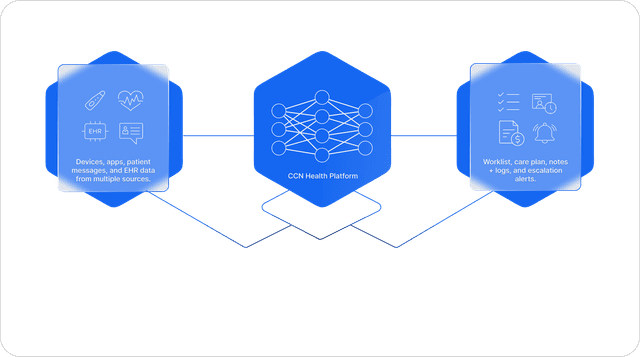
CCN Health's care management platform is built to support the complete CCM workflow — from patient enrollment and consent capture through care plan management, time tracking, and billing documentation.
Care Coordination Platform
The CCN Health platform provides a unified workspace for care coordinators to manage their CCM patient panel. The dashboard surfaces patients approaching their monthly time threshold, patients due for care plan reviews, and patients with recent clinical events requiring coordination. This workflow organization ensures that care coordinators spend their time on clinical activities rather than administrative tracking.
Automated Time Tracking
Every care coordination activity performed in the platform — phone calls, care plan updates, medication reconciliations, provider communications — is automatically logged with timestamps, staff identification, and activity categorization. The system maintains a running cumulative time total for each patient each month, flagging when the 20-minute threshold is met and when additional time qualifies for 99439 billing. This eliminates manual timekeeping and ensures documentation is generated in real time, not reconstructed at month-end.
Care Plan Templates
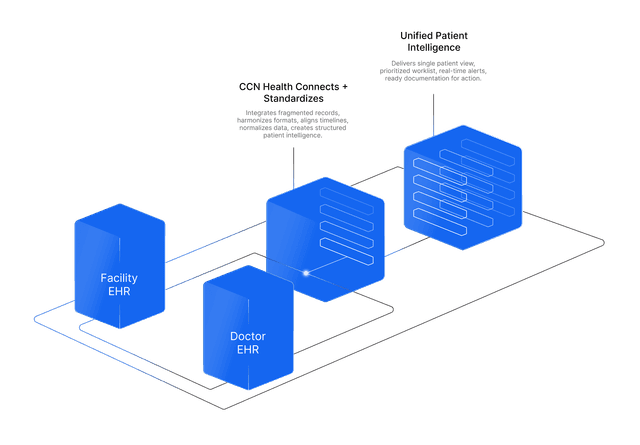
The platform includes comprehensive care plan templates aligned with CMS requirements. Templates pre-populate with the patient's active conditions, current medications, and existing care team information drawn from the EHR integration. Care coordinators update and review the care plan within the normal workflow, ensuring the plan stays current without requiring a separate documentation step.
Consent and Enrollment Workflow
The patient enrollment workflow guides staff through the consent process, capturing all required elements (services description, cost-sharing notification, single-provider acknowledgment, right to revoke) in a structured format. Consent documentation is stored in the patient's record with date stamps and staff identification, providing audit-ready evidence that consent was obtained before services began.
Billing Support
CCN Health's billing team reviews documentation before claims are submitted, verifying that eligibility criteria are met, time thresholds are documented, care plans are current, and codes are correctly assigned. This pre-submission review catches common denial triggers — missing consent, insufficient time documentation, stale care plans — before they result in rejected claims.
Disclaimer: This article is for informational purposes only and does not constitute medical, legal, or billing advice. CPT code reimbursement amounts are estimates based on CMS published fee schedules and may vary by region, payer, and clinical circumstances. State-specific regulatory information is subject to change. Always consult qualified healthcare and billing professionals for guidance specific to your practice.
Let's figure this out together
We work closely with every client to find the right approach for their practice. Think of us as your partner, not just a platform.
Topics
Your Partner in Chronic Care
We love working closely with our clients to find the best solutions. Let us help guide you through the complicated stuff.
Why It Matters
Key Benefits
See how this approach drives measurable improvements across your organization.
Accessible Entry Point
99490 is the most commonly billed CCM code because it allows clinical staff — not just physicians — to perform the documented care coordination work under general supervision.
Recurring Monthly Revenue
At approximately ~$62 per patient per month, 99490 generates predictable recurring revenue for care coordination activities practices are often already performing.
No Devices Required
Unlike RPM billing codes, 99490 requires no medical devices, data transmission infrastructure, or patient technology — just documented clinical staff time on care coordination.
Scalable with Add-On Code
When patients require more than 20 minutes of coordination, 99439 adds approximately ~$47 per additional 20-minute increment — scaling revenue for complex patients.
Large Eligible Population
Approximately 70% of Medicare beneficiaries have two or more chronic conditions, creating a substantial addressable patient population for CCM enrollment via 99490.
Program Stacking
CCM (99490) can be billed alongside RPM, BHI, and RTM for qualifying patients, multiplying per-patient revenue when clinical documentation supports each program independently.
Continue Reading
Related Articles
Explore more insights on this topic.
CCM Billing Guide: CPT Codes 99490, 99491, 99439 & Requirements
A comprehensive breakdown of all CCM CPT codes — 99490, 99491, and 99439 — covering patient eligibility, consent requirements, documentation standards, complex CCM criteria, common denials, and revenue projections for chronic care management programs.
Complete Guide to RPM, CCM, BHI, PCM & RTM CPT Codes for 2026
The single-page reference for every Medicare remote care CPT code — RPM, CCM, BHI, PCM, and RTM. Side-by-side comparison tables, stacking compatibility matrix, combined revenue models, and compliance requirements for all five programs.
CPT Code 99091: RPM Data Collection and Interpretation Billing Guide
CPT 99091 reimburses physicians for collecting and interpreting physiologic data transmitted remotely — a distinct RPM billing code often overlooked alongside 99453-99458. This guide covers requirements, rates, and documentation.
Common Questions
Frequently Asked Questions
Get answers to the most common questions about this topic.
CPT 99490 is the primary billing code for Medicare's Chronic Care Management (CCM) program. It covers the first 20 minutes of clinical staff time spent per calendar month on non-face-to-face care coordination for patients with two or more chronic conditions expected to last at least 12 months. Services include medication reconciliation, care plan management, care team communication, and patient outreach between office visits. The estimated 2026 Medicare reimbursement rate is approximately ~$62 per patient per month.
Yes. CPT 99439 is specifically designed as an add-on to 99490. When clinical staff spend more than 20 minutes on care coordination for a CCM patient in a calendar month, 99439 can be billed for each additional 20-minute increment. For example, if a patient requires 45 minutes of care coordination, the practice bills 99490 (first 20 min, ~$62) plus one unit of 99439 (additional 20 min, ~$47) for a combined estimated reimbursement of ~$109. CPT 99439 can be billed up to two times per month.
CPT 99490 is billed by the physician or qualified healthcare professional (QHP) who has established the patient relationship, but the clinical work can be performed by clinical staff — including nurses, medical assistants, social workers, and care coordinators — working under the general supervision of the billing provider. This is a key distinction from complex CCM (99491), which requires the billing physician or QHP to personally perform the clinical time.
CPT 99490 can be billed once per patient per calendar month when the minimum 20 minutes of documented care coordination time is met. Only one provider can bill CCM for a given patient in any calendar month — the patient must consent to receiving CCM services from a single billing provider. If the patient changes CCM providers, the transition must be documented.
CPT 99490 (standard CCM) covers 20+ minutes of clinical staff time at approximately ~$62/month, where the work can be performed by nurses, MAs, and other staff under general supervision. CPT 99491 (complex CCM) covers 30+ minutes of physician or QHP time at approximately ~$86/month, requiring the billing provider to personally perform the care management. They are mutually exclusive — only one can be billed per patient per month. Use 99491 when the physician personally manages a complex patient; use 99490 when clinical staff perform the coordination under supervision.
To bill CPT 99490: (1) Verify the patient has two or more chronic conditions expected to last 12+ months, (2) obtain and document patient consent for CCM services, (3) establish a comprehensive care plan, (4) track all non-face-to-face care coordination time with date, duration, and activity description, (5) ensure at least 20 minutes of documented time in the calendar month, and (6) submit the claim with the appropriate diagnosis codes linking to the chronic conditions being managed. Documentation must clearly show the care coordination activities performed.
Use CPT 99490 when clinical staff — not the billing physician personally — perform care coordination activities for a patient with two or more chronic conditions. Common activities include medication reconciliation, care plan updates, patient outreach calls, specialist coordination, and transition-of-care management. If the physician or QHP personally performs 30+ minutes of care management, consider billing 99491 (complex CCM) instead. The choice should reflect who actually performed the work.
Procedure code 99490 is the CPT (Current Procedural Terminology) code for standard Chronic Care Management services under Medicare. It was introduced by CMS to reimburse providers for the non-face-to-face care coordination work they perform for patients with multiple chronic conditions between office visits. The code specifically covers the first 20 minutes of clinical staff time per calendar month, with additional time captured by the add-on code 99439.
Still have questions? We love helping practices figure this out — no pressure, just real answers.

Your Partner in Chronic Care
We're Here to Guide You Every Step of the Way
RPM, CCM, and chronic care management can get complicated. We work closely with every client to figure out the best solutions for their practice.