Guides
CPT Code 99091: RPM Data Collection and Interpretation Billing Guide
CPT 99091 reimburses physicians for collecting and interpreting physiologic data transmitted remotely — a distinct RPM billing code often overlooked alongside 99453-99458. This guide covers requirements, rates, and documentation.
CPT code 99091 covers the collection and interpretation of physiologic data digitally stored and/or transmitted by the patient or caregiver to a physician or qualified healthcare professional. It requires a minimum of 30 minutes of clinical time per 30-day period reviewing and interpreting RPM data. The 2026 Medicare reimbursement rate is approximately $58. Unlike CPT 99457, which covers interactive communication with patients, 99091 specifically covers the physician's time spent analyzing the transmitted monitoring data.
What Is CPT Code 99091?
CPT 99091 is a billing code that covers the collection and interpretation of physiologic data that has been digitally stored and/or transmitted by the patient or caregiver to a physician or other qualified healthcare professional. In practical terms, it reimburses the physician's time spent reviewing and analyzing remote patient monitoring data — blood pressure trends, glucose readings, weight fluctuations, pulse oximetry logs, and other device-generated physiologic measurements.
This code has a distinct history within the RPM billing landscape. CPT 99091 predates the 99453-99458 code family that CMS introduced in 2018-2019 to formalize Remote Patient Monitoring as a structured program. Before those codes existed, 99091 was the primary mechanism for billing physician interpretation of remotely transmitted data. When CMS released the 99453-99458 series, many practices shifted their billing workflows to the newer codes — and 99091 was largely overlooked.
However, 99091 remains a valid and active CPT code with a specific clinical niche. For physicians whose primary RPM activity is data interpretation rather than interactive patient communication, 99091 offers a cleaner billing pathway with a single, straightforward time requirement.
Where 99091 Fits in the RPM Code Landscape
The full set of RPM-related CPT codes includes:
- 99453 — Initial device setup and patient education (~$22, one-time)
- 99454 — Device supply with daily data transmission for 16+ days (~$52/month)
- 99457 — Interactive clinical staff time reviewing data and communicating with the patient (first 20 min, ~$52/month)
- 99458 — Additional interactive clinical staff time (each additional 20 min, ~$41/month)
- 99091 — Physician collection and interpretation of digitally transmitted physiologic data (30 min, ~$58/month)
The critical distinction: 99457 and 99458 cover interactive management — clinical staff engaging directly with the patient about monitoring data. CPT 99091 covers data interpretation — the physician's analytical review of the transmitted data, without a requirement for patient interaction during that review.
99091 Requirements
Time Threshold
CPT 99091 requires a minimum of 30 minutes of physician or qualified healthcare professional time per patient per 30-day period. This time must be spent on the collection and interpretation of physiologic data — reviewing device readings, identifying clinical trends, assessing data against treatment goals, and making clinical determinations based on the analysis.
The 30-minute requirement is cumulative over the 30-day period. It does not need to occur in a single session. A physician who spends 10 minutes reviewing a patient's blood pressure data on three separate occasions within the month satisfies the threshold, provided each session is documented.
Who Can Bill
CPT 99091 must be billed by or under the direction of the physician or qualified healthcare professional who performs the data interpretation. This is a key difference from 99457, where clinical staff (nurses, medical assistants) can contribute time under general supervision. For 99091, the 30-minute interpretation must be performed by the billing provider — the physician or QHP who is clinically responsible for analyzing the data and making treatment decisions.
This requirement makes 99091 particularly relevant for specialist physicians who personally review high volumes of monitoring data: cardiologists analyzing blood pressure and heart rate trends, endocrinologists interpreting glucose and CGM data, pulmonologists reviewing pulse oximetry patterns, and nephrologists monitoring weight and fluid status trends.
Eligible Data Types
The data interpreted under 99091 must be physiologic and digitally transmitted. Qualifying data includes:
- Blood pressure readings from connected cuffs
- Weight measurements from connected scales
- Blood glucose readings from glucometers or continuous glucose monitors
- Pulse oximetry data from connected devices
- Heart rate and rhythm data
- Temperature readings
- Respiratory rate measurements
- Any other physiologic parameter collected by a monitoring device and transmitted digitally
Self-reported data (pain scores, symptom diaries) does not qualify for 99091. The data must originate from a monitoring device and be digitally stored or transmitted.
Mutual Exclusivity with 99457/99458
CPT 99091 cannot be billed for the same patient in the same service period as 99457 or 99458. Providers must choose one billing pathway or the other based on the nature of the clinical services delivered during that period. This is the most important billing rule for 99091 and the one most likely to trigger claim denials if violated.
The Two RPM Billing Pathways
Practices running RPM programs have two distinct billing pathways available. Both begin with device setup (99453) and data transmission (99454), but diverge on how the clinical review and management component is billed.
| Component | Pathway A: Data Interpretation | Pathway B: Interactive Management |
|---|---|---|
| Device Setup | 99453 (~$22, one-time) | 99453 (~$22, one-time) |
| Data Transmission | 99454 (~$52/month) | 99454 (~$52/month) |
| Clinical Review | 99091 (~$58/month) | 99457 (~$52/month) |
| Additional Time | Not available | 99458 (~$41/month per additional 20 min) |
| Time Requirement | 30 min physician interpretation | 20 min clinical staff (interactive) |
| Who Performs | Physician/QHP only | Clinical staff under general supervision |
| Patient Interaction Required | No | Yes — must include live interaction |
| Estimated Monthly Revenue | ~$110 | ~$104 (base) or ~$145 (with 99458) |
Pathway A (99453 + 99454 + 99091) is optimal when the physician personally reviews monitoring data in depth but does not have extensive interactive exchanges with the patient about that data during the billing period. This is common in specialist practices where the physician reviews trends, adjusts treatment plans, and communicates changes through scheduled visits or orders rather than ad hoc calls.
Pathway B (99453 + 99454 + 99457 + 99458) is optimal when clinical staff actively communicate with patients about their monitoring data each month — conducting check-in calls, providing education on readings, and coordinating care adjustments in real time. The addition of 99458 for time beyond 20 minutes makes this pathway higher-revenue when clinical staff consistently exceed the base time threshold.
99091 vs 99457: When to Use Each
Choosing between 99091 and 99457 is not arbitrary. The decision should reflect the actual clinical workflow for each patient. Here is a framework for making the determination:
| Factor | Favors 99091 | Favors 99457/99458 |
|---|---|---|
| Primary clinical activity | Physician reviews data, updates orders | Staff calls patient, discusses readings |
| Patient interaction | Minimal between scheduled visits | Regular phone/video check-ins |
| Who does the work | Physician/QHP directly | Clinical staff (RN, MA, care coordinator) |
| Practice type | Specialist (cardiology, endocrinology) | Primary care with care management team |
| Patient panel | High volume, data-review-focused | Moderate volume, relationship-focused |
| Revenue ceiling | Fixed (~$58/month from 99091) | Scalable (99457 + 99458 additions) |
| Documentation complexity | Single time log (30 min interpretation) | Time log with interactive contact proof |
When 99091 Makes the Most Sense
CPT 99091 is strongest in clinical scenarios where the physician's contribution to RPM is analytical rather than communicative. Consider a cardiologist managing 80 hypertensive patients on blood pressure monitoring. Each week, the cardiologist reviews the dashboard, identifies patients with readings outside target ranges, adjusts medications, and documents clinical decisions. The physician may spend 8-10 minutes per patient per month on this review — well above the 30-minute threshold for patients with complex trend data — but has no direct patient conversation about the data outside of scheduled office visits.
In this scenario, 99091 accurately reflects the clinical work being performed. Attempting to bill 99457 would require documenting interactive patient contact that did not occur.
When 99457/99458 Makes More Sense
For primary care practices with dedicated RPM care coordinators who call patients monthly, review readings together on the phone, provide education on managing their conditions, and escalate concerns to the physician, the 99457/99458 pathway captures the full scope of clinical effort. The interactive component is genuine, the time is well-documented, and the potential to bill 99458 for additional time increases per-patient revenue beyond what 99091 alone can generate.
Documentation Requirements
Audit-ready documentation for CPT 99091 must demonstrate four things: the right provider performed the work, enough time was spent, the data was genuinely reviewed, and clinical value was derived.
What Auditors Look For
1. Provider identification — Documentation must clearly establish that the physician or QHP (not delegated clinical staff) performed the data interpretation. The billing provider's name should be associated with each time entry.
2. Time logs with dates — Each data review session must be documented with the date, duration, and a description of the data reviewed. Entries such as "Reviewed RPM data — 30 min" without supporting detail are insufficient. A compliant entry looks like: "Reviewed 21 days of blood pressure readings (systolic range 128-156, diastolic range 78-94). Identified upward trend in evening readings. Adjusted lisinopril from 10mg to 20mg. Updated care plan. 12 minutes."
3. Clinical interpretation — The documentation must reflect that the physician actually analyzed the data, not merely opened the dashboard. Notes should reference specific trends, outlier readings, comparisons to treatment targets, and clinical reasoning.
4. Care plan impact — The strongest documentation connects data interpretation to clinical action: medication adjustments, referrals, diagnostic orders, care plan modifications, or a documented clinical decision that the current treatment plan remains appropriate based on the data reviewed. Even a determination that no changes are needed constitutes a valid clinical interpretation — as long as it is documented.
Documentation Template Example
A compliant 99091 time entry might follow this structure:
- Date: [Date of review]
- Patient: [Patient identifier]
- Data reviewed: [Device type, date range of readings, number of readings]
- Clinical findings: [Trends identified, readings outside target, notable patterns]
- Clinical action: [Orders placed, care plan updates, or rationale for no change]
- Time spent: [Minutes for this session]
- Cumulative time this period: [Running total toward 30-minute threshold]
Reimbursement Rates and Revenue Modeling
Per-Patient Revenue: Pathway A vs Pathway B
Using estimated 2026 Medicare fee schedule rates, here is how the two RPM billing pathways compare on a per-patient, per-month basis after the initial setup month:
| Billing Pathway | Monthly Codes | Estimated Monthly Revenue |
|---|---|---|
| Pathway A: 99454 + 99091 | Data transmission + physician interpretation | ~$110 |
| Pathway B (base): 99454 + 99457 | Data transmission + interactive management (20 min) | ~$104 |
| Pathway B (extended): 99454 + 99457 + 99458 | Data transmission + interactive management (40 min) | ~$145 |
| Pathway B (max): 99454 + 99457 + 99458 x2 | Data transmission + interactive management (60 min) | ~$186 |
All figures are estimates based on CMS published fee schedules. Actual rates vary by geographic region, MAC jurisdiction, and payer.
At the base level, Pathway A (with 99091) yields slightly higher per-patient revenue than Pathway B (with 99457 alone). However, when clinical staff consistently exceed 20 minutes of interactive time and bill 99458, Pathway B surpasses Pathway A. The decision should be driven by clinical workflow, not revenue optimization — billing a code that does not reflect the actual services rendered creates compliance risk.
Practice-Level Revenue Modeling
For a specialist practice using Pathway A (99454 + 99091) with an average of ~$110 per patient per month in recurring codes:
| Active RPM Patients | Estimated Monthly Revenue | Estimated Annual Revenue |
|---|---|---|
| 25 | ~$2,750 | ~$33,000 |
| 50 | ~$5,500 | ~$66,000 |
| 100 | ~$11,000 | ~$132,000 |
| 200 | ~$22,000 | ~$264,000 |
For specialist practices that already review monitoring data as part of their clinical workflow, much of this revenue represents billing for work that is currently uncompensated.
How CCN Health Supports 99091 Billing
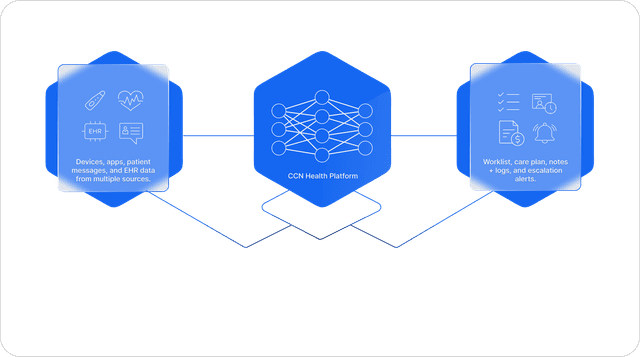
CCN Health's RPM platform is designed to support both billing pathways — including the data interpretation workflow that 99091 requires.
Physician Data Dashboard
The CCN Health provider dashboard aggregates all transmitted physiologic data into a clinical review interface organized by patient, device type, and date range. Physicians can review blood pressure trends, glucose patterns, weight trajectories, and other monitored parameters in a format designed for efficient clinical interpretation. The dashboard surfaces out-of-range readings and trend alerts so physicians can focus their review time on clinically significant data.
Automated Time Tracking
Every interaction with the data dashboard — including login timestamps, patient records reviewed, and time spent per patient — is logged automatically. This creates the documentation foundation for 99091 billing without requiring physicians to manually track time. The system generates per-patient time summaries that map directly to the 30-minute threshold requirement.
Clinical Interpretation Notes
The platform includes structured documentation templates where physicians can record their clinical findings alongside the data review. These notes link directly to the monitoring data that was analyzed, creating an auditable chain from raw readings to clinical interpretation to care plan decisions.
Billing Pathway Optimization
CCN Health's billing support team helps practices determine the optimal billing pathway for each patient based on the actual clinical workflow. For patients where the physician's primary contribution is data analysis, the team ensures 99091 documentation requirements are met. For patients with significant interactive management, the team supports 99457/99458 documentation instead.
Conclusion
CPT 99091 fills a specific and valuable niche in the RPM billing landscape: it reimburses physicians for the clinical interpretation of remotely transmitted monitoring data. For specialist practices that review high volumes of device data without extensive patient interaction during the review process, 99091 offers a cleaner, more accurate billing pathway than the interactive management codes.
The estimated ~$58 per patient per month — combined with 99453 for device setup and 99454 for data transmission — creates a recurring revenue stream of approximately ~$110 per patient per month. For practices already reviewing monitoring data as part of standard care, this represents compensation for work that would otherwise go unbilled.
The keys to successful 99091 billing are straightforward: ensure the physician or QHP performs the data interpretation personally, document 30+ minutes of cumulative review time per 30-day period with clinical detail, and never bill 99091 in the same month as 99457/99458 for the same patient.
Whether 99091 or 99457 is the right code depends entirely on the clinical workflow. Both are valid. Both generate revenue. The right choice is the one that accurately reflects how your practice delivers RPM care.
Disclaimer: This article is for informational purposes only and does not constitute medical, legal, or billing advice. CPT code reimbursement amounts are estimates based on CMS published fee schedules and may vary by region, payer, and clinical circumstances. State-specific regulatory information is subject to change. Always consult qualified healthcare and billing professionals for guidance specific to your practice.
Let's figure this out together
We work closely with every client to find the right approach for their practice. Think of us as your partner, not just a platform.
Topics
Your Partner in Chronic Care
We love working closely with our clients to find the best solutions. Let us help guide you through the complicated stuff.
Why It Matters
Key Benefits
See how this approach drives measurable improvements across your organization.
Physician-Focused Revenue
99091 captures reimbursement specifically for the physician's data interpretation time — recognizing the clinical value of reviewing and acting on monitoring trends.
Alternative Billing Pathway
For practices where data analysis exceeds patient interaction, 99091 provides a simpler billing pathway than 99457/99458 interactive management codes.
Specialist-Friendly
Particularly valuable for cardiologists, endocrinologists, pulmonologists, and nephrologists who review high volumes of monitoring data across patient panels.
Complementary Revenue
Stacks with 99453 (device setup) and 99454 (data transmission) for comprehensive RPM billing without requiring the interactive component of 99457.
Data-Driven Documentation
The monitoring platform generates the clinical data that serves as both the basis for interpretation and the documentation supporting the billing claim.
Simplified Compliance
Single time threshold (30 minutes) is straightforward to track compared to the multi-component requirements of 99457/99458 with interactive patient contact.
Continue Reading
Related Articles
Explore more insights on this topic.
CCM Billing Guide: CPT Codes 99490, 99491, 99439 & Requirements
A comprehensive breakdown of all CCM CPT codes — 99490, 99491, and 99439 — covering patient eligibility, consent requirements, documentation standards, complex CCM criteria, common denials, and revenue projections for chronic care management programs.
RTM Billing Guide: Remote Therapeutic Monitoring CPT Codes & Requirements
A detailed breakdown of all RTM CPT codes — 98975, 98976, 98977, 98980, and 98981 — covering the key difference from RPM, qualifying conditions like COPD rehabilitation and post-surgical recovery, self-reported data rules, and revenue projections for remote therapeutic monitoring programs.
BHI Billing Guide: Behavioral Health Integration CPT Codes & Requirements
A detailed guide to Behavioral Health Integration billing — covering CPT codes 99484, 99492, and 99493, the Collaborative Care Model (CoCM), PHQ-9 and GAD-7 screening requirements, qualifying behavioral health conditions, and strategies for integrating BHI into primary care practice.
Common Questions
Frequently Asked Questions
Get answers to the most common questions about this topic.
CPT 99091 covers the collection and interpretation of physiologic data — the physician's time spent reviewing and analyzing transmitted monitoring data. CPT 99457 covers interactive communication with the patient or caregiver about the monitoring data, requiring at least 20 minutes of clinical staff time per month including live interaction. The key distinction is data analysis (99091) versus patient interaction (99457). They cannot be billed together for the same patient in the same service period.
Yes. CPT 99091 can be billed alongside 99453 (initial device setup and patient education) and 99454 (device supply and daily data transmission for 16+ days). The combination of 99453 + 99454 + 99091 provides an alternative RPM billing pathway to the more common 99453 + 99454 + 99457/99458 combination. The choice depends on whether the physician's primary RPM activity is data interpretation (99091) or interactive patient management (99457).
CPT 99091 must be billed by or under the direction of a physician or other qualified healthcare professional (QHP). The 30 minutes of data interpretation time must be performed by the billing provider — it cannot be delegated to clinical staff in the same way that 99457 time tracking can include auxiliary personnel under general supervision. This makes 99091 particularly relevant for specialist physicians who personally review monitoring data.
Documentation for CPT 99091 must include: identification of the patient and the monitoring data reviewed, the dates of data collection covered by the review, the total time spent on data interpretation (must meet the 30-minute minimum), clinical findings from the data analysis, and any clinical decisions or care plan modifications resulting from the review. Many practices use timestamped clinical notes linked to the monitoring data dashboard to satisfy these requirements.
CPT 99091 reimburses approximately $58 per 30-day period at the 2026 Medicare fee schedule rates. CPT 99457 reimburses approximately $52 for the initial 20 minutes of interactive management, with 99458 adding approximately $41 for each additional 20 minutes. If significant interactive patient communication occurs, the 99457/99458 pathway may yield higher total reimbursement. If the physician's primary activity is data review without extensive patient interaction, 99091 may be simpler to document and bill.
No. CPT 99091 has its own requirement: 30 minutes of data interpretation time per 30-day period. However, when billed alongside 99454, the 99454 component still requires 16 days of data transmission. The 99091 requirement is time-based (30 minutes of physician interpretation), not transmission-frequency-based. That said, having sufficient data to justify 30 minutes of clinical interpretation generally implies regular data transmission.
Still have questions? We love helping practices figure this out — no pressure, just real answers.

Your Partner in Chronic Care
We're Here to Guide You Every Step of the Way
RPM, CCM, and chronic care management can get complicated. We work closely with every client to figure out the best solutions for their practice.