Clinical
Remote Therapeutic Monitoring for CCRCs — 2026 Guide
How Remote Therapeutic Monitoring works in CCRCs — unified therapy outcome tracking from independent living through skilled nursing, with consistent rehabilitation data across every care level transition.
Remote Therapeutic Monitoring (RTM) in Continuing Care Retirement Communities (CCRCs) provides unified therapy outcome tracking across all care levels — independent living, assisted living, and skilled nursing. CCRCs are the ideal RTM environment because residents frequently transition between levels, and each transition typically involves rehabilitation needs. A CCRC resident who fractures a hip moves from IL to SNF for post-acute rehab, then to AL for recovery — RTM tracks therapy outcomes continuously through every transition. CCN Health integrates with both PCC (SNF) and ALIS/August Health (IL/AL) to maintain a unified therapy record across the campus. RTM uses CPT codes 98975-98981 and generates $50-105 per resident per month.
What Is Remote Therapeutic Monitoring (RTM)?
Remote Therapeutic Monitoring (RTM) is a Medicare-reimbursable program that RTM (Remote Therapeutic Monitoring) is a Medicare program that monitors therapy outcomes for musculoskeletal and respiratory conditions. Unlike RPM (vital signs), RTM tracks exercise compliance, pain assessments, range of motion progress, and respiratory therapy adherence using CPT codes 98975-98981. In CCRCs, RTM provides continuity through care level transitions — rehabilitation data follows the resident from IL to AL to SNF and back..
Patient eligibility: Medicare beneficiaries undergoing physical therapy, occupational therapy, or respiratory therapy. Data must be self-reported or collected via therapy-specific devices for 16+ days per billing period.
How RTM differs from related programs: RTM tracks therapy outcomes — pain scores, range of motion, exercise compliance, functional status — rather than vital signs (RPM) or care coordination (CCM). It is the only Medicare monitoring program designed for rehabilitation.
RTM can be stacked with RPM, PCM for qualifying patients — a single enrolled patient can generate revenue across multiple Medicare programs simultaneously.
Why CCRCs Facilities Need RTM
CCRCs encompass the full continuum of care — and rehabilitation needs arise at every level and during every transition between levels.
- Care level transitions (IL→SNF, SNF→AL, AL→IL) almost always involve rehabilitation — RTM ensures therapy continuity through transitions
The SNF level within a CCRC is the highest-intensity rehabilitation setting — post-acute PT/OT is the core mission, making SNF the natural RTM entry point
- IL residents recovering from outpatient joint replacement or fall benefit from self-directed RTM — the highest compliance of any care level
AL residents in rehabilitation need staff-assisted RTM — capturing therapy outcomes during care rounds
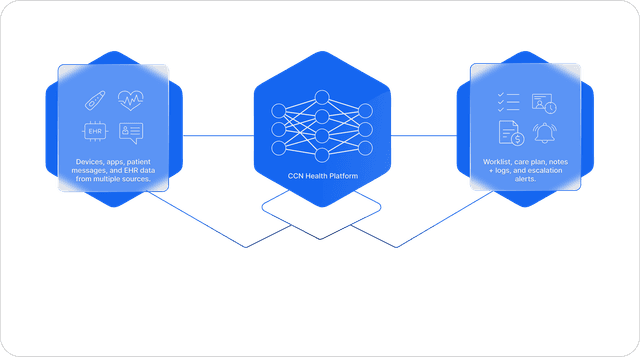
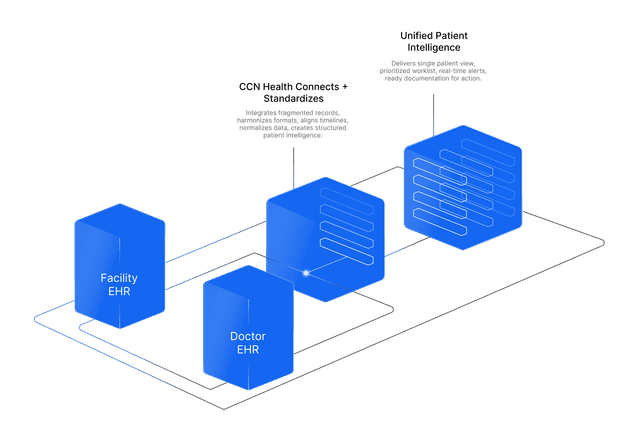
One campus, one platform, one therapy record — CCN Health provides unified RTM across all CCRC levels through multi-EHR integration (PCC for SNF + ALIS/August Health for IL/AL)
How RTM Works in CCRCs — The Clinical Workflow
RTM in a CCRC adapts its collection model to each care level while maintaining a unified therapy record across the campus.
Step 1. Rehabilitation need triggers RTM enrollment — post-surgical at any level, post-acute admission to SNF, post-fall at IL or AL
Step 2. CCN Health configures level-appropriate RTM protocol: self-directed in IL, staff-assisted in AL, therapy-integrated in SNF
Step 3. Daily data collection method adapts to care level: resident self-reports in IL, caregiver-guided in AL, therapy staff in SNF
Step 4. Platform maintains unified therapy record — when resident transitions between levels, RTM data and rehabilitation history transfer seamlessly
Step 5. Level-appropriate clinical review: therapy director in SNF, attending physician in IL/AL, with full cross-level visibility
Step 6. Rehabilitation graduation across levels: SNF post-acute → AL recovery → IL maintenance — RTM tracks the entire recovery arc
RTM Devices and Monitoring Across CCRC Levels
Each CCRC level uses the appropriate RTM assessment approach — from self-directed digital tools in IL to therapy-integrated clinical assessments in SNF.
- Independent Living — smartphone/tablet RTM apps for self-directed exercise logging, pain assessment, and functional tracking
- Assisted Living — staff-administered digital assessments during care rounds for pain, exercise compliance, and mobility
- Skilled Nursing — therapy-integrated clinical outcome measures aligned with PT/OT programs and PDPM documentation
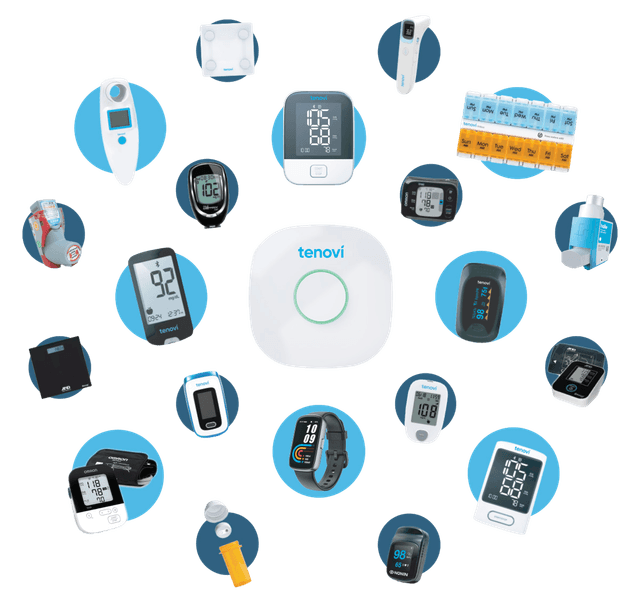
- Cross-level — wearable activity monitors that travel with residents through transitions, providing continuous mobility data
- Campus-wide — unified dashboard showing rehabilitation progress across all levels for therapy directors and attending physicians
The cross-level data model is the CCRC differentiator — a resident's RTM record doesn't restart when they change care levels. Therapy providers see the complete rehabilitation arc from initial event through full recovery.
RTM Billing: CPT Codes and Revenue
| CPT Code | Service | Reimbursement | Requirement |
|---|---|---|---|
| 98975 | Setup & Education | ~$19 | One-time initial setup |
| 98976 | Respiratory RTM | ~$50/mo | 16+ days respiratory data |
| 98977 | MSK RTM | ~$50/mo | 16+ days MSK therapy data |
| 98980 | Treatment Mgmt | ~$48/mo | First 20 min treatment mgmt |
| 98981 | Additional Mgmt | ~$38/mo | Each additional 20 min |
Estimated monthly revenue per patient: ~$100–155
Program stacking: RTM + RPM generates $275–375/patient/month. For complex rehab patients, RTM + RPM + PCM can reach $350–490/month.
RTM billing in CCRCs involves multiple billing entities: the SNF therapy department bills during the post-acute phase, while the attending physician or outpatient therapy provider bills for IL and AL residents. During transitions, billing responsibility transfers with the care level. CCN Health tracks billing eligibility by level to ensure appropriate claims — avoiding duplicate billing during transition periods.
EHR Integration for RTM in CCRCs
CCRCs facilities typically use PointClickCare and ALIS (multi-level deployments) for clinical documentation. CCRCs benefit from a unified EHR across all care levels. PointClickCare and ALIS both support multi-level campus deployments with care transition documentation.
CCN Health provides bi-directional integration with all major ccrcs EHR systems:
- Resident/patient demographics sync automatically
- Monitoring data flow into existing EHR workflows
- Clinical alerts appear within the EHR — no separate portal required
- Billing documentation generates automatically for RTM time tracking
CCRCs typically run multiple EHR systems — PCC for SNF and ALIS or August Health for IL/AL. CCN Health integrates with both systems, routing RTM therapy data to the appropriate EHR based on the resident's current care level while maintaining the unified cross-level therapy record in the CCN Health platform.
Getting Started: Implementing RTM in Your CCRCs Facilitie
A typical RTM implementation in ccrcs follows a 4–8 week timeline:
- Week 1–2: Map rehabilitation flows across CCRC levels — identify which transitions generate therapy needs and which levels have the highest rehab volume (typically SNF first)
- Week 3–4: Deploy RTM at the SNF level first (highest therapy intensity, clearest billing) then extend to AL (staff-assisted) and IL (self-directed)
- Week 5–6: Configure cross-level data sharing so therapy directors and attending physicians see unified rehabilitation records regardless of current care level
- Week 7–8: Train level-specific staff: therapy teams in SNF, caregivers in AL, wellness coordinators in IL — each with appropriate RTM data collection responsibilities
Start with the SNF level — it has the highest rehabilitation volume, the most therapy staff, and the clearest billing pathway. Once SNF RTM is running, extending to AL and IL leverages the same platform and therapy relationships.
Ready to implement RTM in your ccrcs facilitie? CCN Health provides full-service Remote Therapeutic Monitoring with EHR integration, clinical oversight, and billing optimization purpose-built for ccrcs.
Disclaimer: This article is for informational purposes only and does not constitute medical, legal, or billing advice. CPT code reimbursement amounts are estimates based on CMS published fee schedules and may vary by region, payer, and clinical circumstances. Always consult qualified healthcare, billing, and technology professionals for guidance specific to your facility.
Let's figure this out together
We work closely with every client to find the right approach for their practice. Think of us as your partner, not just a platform.
Topics
Your Partner in Chronic Care
We love working closely with our clients to find the best solutions. Let us help guide you through the complicated stuff.
Why It Matters
Key Benefits
See how this approach drives measurable improvements across your organization.
RTM Program Management
Full Remote Therapeutic Monitoring program delivery including enrollment, monitoring, clinical review, and billing documentation — purpose-built for ccrcs workflows.
EHR Integration
Bi-directional integration with PointClickCare and ALIS (multi-level deployments) ensures monitoring data flows into existing clinical workflows without manual data entry.
Revenue Optimization
~$100–155 per patient per month with RTM. Program stacking with RPM and PCM increases per-patient revenue further.
Cross-Level Continuity
Therapy record transfers seamlessly through IL→AL→SNF transitions — one rehabilitation history regardless of current care level.
Level-Adapted Collection
Self-directed in IL, staff-assisted in AL, therapy-integrated in SNF — each level uses the appropriate RTM assessment model.
Campus-Wide Visibility
Therapy directors see rehabilitation progress across the entire CCRC from one dashboard — identifying trends and optimizing therapy programs campus-wide.
Continue Reading
Related Articles
Explore more insights on this topic.
What Is Remote Therapeutic Monitoring (RTM)? A Complete Guide
A complete guide to Remote Therapeutic Monitoring — what it is, how it differs from RPM, which conditions qualify, the five CPT codes (98975-98981), and how providers bill Medicare for RTM services.
Remote Patient Monitoring for CCRCs — 2026 Guide
How RPM works in CCRCs — continuous monitoring from independent living through skilled nursing, care transition protocols, unified EHR integration, and maximizing revenue across a multi-level campus.
Chronic Care Management for CCRCs — 2026 Guide
How CCM works in CCRCs — unified care coordination from independent living through skilled nursing, care transition management, medication reconciliation across levels, and campus-wide Medicare billing.
Common Questions
Frequently Asked Questions
Get answers to the most common questions about this topic.
Remote Therapeutic Monitoring (RTM) for ccrcs: Remote Therapeutic Monitoring (RTM) is a Medicare program using CPT codes 98975-98981 that tracks therapy outcomes — exercise adherence, pain levels, and functional status — for patients in musculoskeletal or respiratory rehabilitation. Medicare beneficiaries undergoing physical therapy, occupational therapy, or respiratory therapy.
RTM generates ~$100–155 per patient per month through CPT codes 98975, 98976, 98977, 98980, 98981. RTM + RPM generates $275–375/patient/month. For complex rehab patients, RTM + RPM + PCM can reach $350–490/month.
CCN Health integrates with PointClickCare and ALIS (multi-level deployments) for ccrcs facilities. CCRCs benefit from a unified EHR across all care levels. All monitoring data flows bi-directionally between CCN Health and the facility/physician EHR.
Yes — CCN Health maintains a unified therapy record across all CCRC levels. When a resident transitions from SNF post-acute rehab to AL recovery to IL maintenance, their RTM data transfers seamlessly. The therapy provider sees the complete rehabilitation arc — from initial injury or surgery through full recovery — regardless of which care level the resident is currently in.
The SNF level typically has the highest RTM enrollment because post-acute rehabilitation is the core SNF mission — almost every SNF admission involves PT/OT. Independent Living often has the second-highest enrollment for joint replacement recovery and COPD rehab. Assisted Living enrollment grows as fall recovery programs expand.
Billing responsibility follows the care level. During SNF post-acute stays, the therapy department typically bills RTM. When the resident transitions to AL or IL, the attending physician or outpatient therapy provider assumes RTM billing. CCN Health tracks these transitions and ensures appropriate billing entity assignment at each level.
Still have questions? We love helping practices figure this out — no pressure, just real answers.

Your Partner in Chronic Care
We're Here to Guide You Every Step of the Way
RPM, CCM, and chronic care management can get complicated. We work closely with every client to figure out the best solutions for their practice.