Clinical
Chronic Care Management for Assisted Living — 2026 Guide
How CCM works in assisted living — bridging limited nursing staff with remote care coordination, medication management for residents with multiple conditions, and billing through external physicians.
CCM in assisted living provides remote care coordination for residents with 2+ chronic conditions — supplementing the community's limited nursing staff with professional care plan management, medication reconciliation, and multi-provider communication. Since assisted living is not Medicare-certified, CCM billing flows through external physicians. CCN Health generates ~$80–130/patient/month and integrates with ALIS, August Health, and PointClickCare.
What Is Chronic Care Management (CCM)?
Chronic Care Management (CCM) is a Medicare-reimbursable program that provides non-face-to-face care coordination for Medicare beneficiaries with two or more chronic conditions, including care plan development, medication reconciliation, and coordination across multiple healthcare providers.
Patient eligibility: Medicare beneficiaries with two or more chronic conditions expected to last at least 12 months, placing the patient at significant risk of death, acute exacerbation, or functional decline.
How CCM differs from related programs: CCM requires no monitoring devices — it bills for care coordination time including care plan development, medication reconciliation, and multi-provider coordination. The 2+ chronic condition requirement is the key qualifier.
CCM can be stacked with RPM, BHI for qualifying patients — a single enrolled patient can generate revenue across multiple Medicare programs simultaneously.
Why Assisted Living Facilities Need CCM
Assisted living communities have significantly fewer RNs than skilled nursing facilities, yet their residents are increasingly medically complex. CCM provides the care coordination infrastructure that limited on-site staffing cannot deliver.
Staffing gap: AL communities have fewer clinical staff per resident than SNFs — CCM provides professional care coordination remotely, supplementing the community's limited nursing resources
Growing complexity: Today's AL residents have more chronic conditions than a decade ago — many have 2–4 conditions requiring active coordination that exceeds what medication pass oversight can provide
External physician dependency: AL residents see external physicians who may not communicate with the community's nursing staff — CCM bridges this communication gap with structured monthly coordination
Medication management: Residents on 6–10 medications from multiple prescribers need regular reconciliation — a task that overwhelmed AL nursing staff often cannot perform systematically
How CCM Works in Assisted Living — The Clinical Workflow
CCM in assisted living operates through a partnership between the community wellness team, CCN Health's coordination staff, and the residents' external physicians.
Step 1: Resident Screening — Community wellness nurse identifies residents with 2+ chronic conditions. External physician confirms eligibility and orders CCM enrollment. Most AL residents qualify.
Step 2: Care Plan Creation — CCN Health builds comprehensive care plans with input from the community wellness team and external physicians. Plans document all conditions, medications, providers, and treatment goals.
Step 3: Monthly Coordination — CCN Health provides 20+ minutes of monthly coordination — medication reconciliation, external physician communication, care plan updates, and family outreach. Community wellness staff notified of relevant changes.
Step 4: Physician Billing — External physician practice bills Medicare for CCM. Community benefits from improved resident health outcomes and reduced liability without billing responsibility.
No Monitoring Devices Required for CCM
CCM focuses on care coordination — no devices needed. This makes it immediately deployable in assisted living without hardware logistics.
- No devices required — CCM is billed for coordination time. No devices, data transmission, or compliance thresholds.
- RPM can be added — Residents who need vital sign monitoring can enroll in RPM concurrently — separate program with separate devices and billing codes.
The device-free nature of CCM makes it the fastest Medicare program to deploy in assisted living — enrollment to billing in 2–3 weeks.
CCM Billing: CPT Codes and Revenue
| CPT Code | Service | Reimbursement | Requirement |
|---|---|---|---|
| 99490 | CCM Services | ~$62/mo | 20+ min clinical staff time |
| 99491 | Complex CCM | ~$86/mo | 60+ min physician/QHP time |
| 99439 | Additional 20 min | ~$47/mo | Each additional 20 min |
Estimated monthly revenue per patient: ~$80–130
Program stacking: Stacking CCM with RPM generates $255–350/patient/month. Adding BHI for patients with comorbid behavioral health conditions can reach $303–513/month.
Since assisted living is not Medicare-certified, all CCM billing flows through external physician practices. The physician-community partnership is the operational foundation — physicians bill Medicare while the community facilitates access to residents and coordinates with on-site staff.
EHR Integration for CCM in Assisted Living
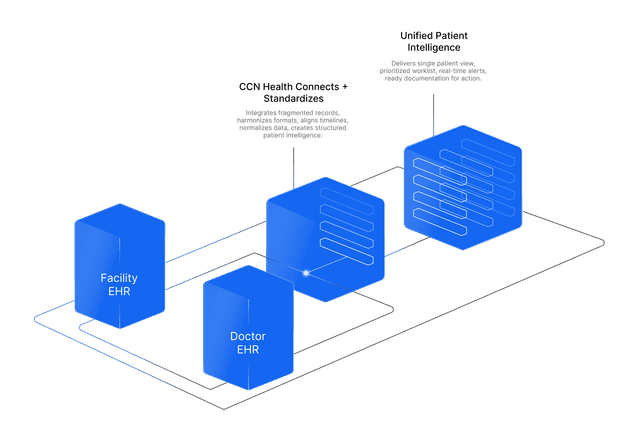
Assisted Living facilities typically use ALIS, August Health, some PointClickCare for clinical documentation. ALIS and August Health are purpose-built for assisted living. Larger communities may use PointClickCare. External physicians use athenahealth, Epic, or Charm.
CCN Health provides bi-directional integration with all major assisted living EHR systems:
- Resident/patient demographics sync automatically
- Monitoring data flow into existing EHR workflows
- Clinical alerts appear within the EHR — no separate portal required
- Billing documentation generates automatically for CCM time tracking
ALIS and August Health are the dominant AL EHRs. CCN Health integrates care plan documentation and coordination notes with both platforms, ensuring the community wellness team has visibility into CCM activities alongside their own resident care records.
Getting Started: Implementing CCM in Your Assisted Living Facilitie
A typical CCM implementation in assisted living follows a 4–8 week timeline:
- Week 1–2: External physician practice recruitment, community wellness team orientation, resident eligibility screening
- Week 3–4: Care plan development for initial cohort, medication lists compiled, provider contacts established
- Week 5–6: Monthly coordination workflows activated, physician communication protocols established, family outreach initiated
- Week 7–8: Billing activation through physician practices, enrollment expansion, ongoing coordination optimization
Success depends on strong physician practice partnerships — communities should identify 2–3 physician practices that serve the majority of residents and onboard them as CCM billing partners.
Ready to implement CCM in your assisted living facilitie? CCN Health provides full-service Chronic Care Management with EHR integration, clinical oversight, and billing optimization purpose-built for assisted living.
Disclaimer: This article is for informational purposes only and does not constitute medical, legal, or billing advice. CPT code reimbursement amounts are estimates based on CMS published fee schedules and may vary by region, payer, and clinical circumstances. Always consult qualified healthcare, billing, and technology professionals for guidance specific to your facility.
Let's figure this out together
We work closely with every client to find the right approach for their practice. Think of us as your partner, not just a platform.
Topics
Your Partner in Chronic Care
We love working closely with our clients to find the best solutions. Let us help guide you through the complicated stuff.
Why It Matters
Key Benefits
See how this approach drives measurable improvements across your organization.
CCM Program Management
Full Chronic Care Management program delivery including enrollment, monitoring, clinical review, and billing documentation — purpose-built for assisted living workflows.
EHR Integration
Bi-directional integration with ALIS, August Health, some PointClickCare ensures monitoring data flows into existing clinical workflows without manual data entry.
Revenue Optimization
~$80–130 per patient per month with CCM. Program stacking with RPM and BHI increases per-patient revenue further.
Staff Supplementation
Professional remote care coordination supplements limited on-site nursing staff — adding a coordination layer that staffing ratios prevent communities from providing internally.
Fast Deployment
No devices needed — CCM can go from enrollment to billing in 2–3 weeks, the fastest deployment timeline of any Medicare care management program.
Physician Alignment
Structured monthly coordination ensures external physicians stay informed about their patients' status in the community — reducing communication gaps.
Continue Reading
Related Articles
Explore more insights on this topic.
What Is Chronic Care Management? Complete Guide to CCM (2026)
A complete guide to Chronic Care Management — what it is, how it works, who qualifies, what services CCM covers, and how providers bill Medicare for care coordination.
Remote Patient Monitoring for Assisted Living — 2026 Guide
How RPM works in assisted living — monitoring residents with limited nursing staff, device selection for ADL-dependent populations, ALIS and August Health integration, and Medicare billing through external physicians.
Behavioral Health Integration for Assisted Living — 2026 Guide
How BHI works in assisted living — addressing transition depression from loss of independence, anxiety management, PHQ-9/GAD-7 screening, and collaborative psychiatric care for AL residents.
Common Questions
Frequently Asked Questions
Get answers to the most common questions about this topic.
Chronic Care Management (CCM) for assisted living is a Medicare-reimbursable program. residents with multiple chronic conditions receive remote care coordination that supplements limited on-site nursing staff — including medication management, physician communication, and care plan updates. Medicare beneficiaries with two or more chronic conditions expected to last at least 12 months, placing the patient at significant risk of death, acute exacerbation, or functional decline.
CCM generates ~$80–130 per patient per month through CPT codes 99490, 99491, 99439. Stacking CCM with RPM generates $255–350/patient/month. Adding BHI for patients with comorbid behavioral health conditions can reach $303–513/month.
CCN Health integrates with ALIS, August Health, some PointClickCare for assisted living facilities. ALIS and August Health are purpose-built for assisted living. All monitoring data flows bi-directionally between CCN Health and the facility/physician EHR.
No — assisted living is not Medicare-certified, so CCM billing flows through the resident's external physician practice. The community facilitates the program (identifying eligible residents, coordinating with on-site staff) while the physician practice manages billing. Many physician practices welcome this arrangement because CCM generates revenue with clinical support from CCN Health.
CCM provides professional care coordination remotely through CCN Health — medication reconciliation, physician communication, and care plan management that overwhelmed AL nursing staff cannot perform systematically. This isn't replacing on-site care; it's adding a coordination layer that limited staffing ratios prevent the community from providing internally.
Most AL communities provide basic medication oversight and physician communication as needed. CCM provides structured, documented monthly coordination — comprehensive medication reconciliation across all prescribers, proactive care plan management, and systematic communication with all treating physicians. The structure and documentation are what make it billable under Medicare.
Still have questions? We love helping practices figure this out — no pressure, just real answers.

Your Partner in Chronic Care
We're Here to Guide You Every Step of the Way
RPM, CCM, and chronic care management can get complicated. We work closely with every client to figure out the best solutions for their practice.