Guides
Best Overnight Monitoring Solutions for Assisted Living (2026)
A comprehensive comparison of overnight monitoring technologies for assisted living communities — from contactless radar sensors to bed sensors and wearables — covering accuracy, privacy, cost, and resident acceptance.
The best overnight monitoring solutions for assisted living in 2026 use contactless radar sensors that track heart rate, respiratory rate, sleep patterns, and bed exits without any wearable device or resident interaction. CCN Health's integration with the Xandar Kardian XK300 is the leading solution, combining FDA-cleared 60GHz radar with dual-EHR data flow, automated clinical alerts for night-shift staff, and Medicare RPM billing compliance — all from a single bedside sensor that requires zero resident cooperation.
Why Overnight Monitoring Matters in Assisted Living
Nighttime is the most dangerous period in any assisted living community. Research consistently shows that the majority of unwitnessed falls in senior care settings occur between 10 PM and 6 AM. Residents get up to use the bathroom, become disoriented in the dark, or experience acute clinical events while staff coverage is at its lowest.
Assisted living communities typically operate with night-shift staffing ratios three to five times lower than daytime levels. A community with 80 residents might have two or three staff members on the floor overnight, conducting scheduled rounds every one to two hours. Between those rounds, a resident who falls, experiences respiratory distress, or wanders can go undetected for extended periods.
Family expectations have also shifted. Families evaluating assisted living options increasingly ask what monitoring technology is in place during overnight hours. They want assurance that their loved one is being watched even when staffing is limited — and they expect more than a pull-cord on the wall that requires the resident to actively call for help.
The result is a growing demand for technology that provides continuous overnight monitoring without depending on resident compliance, scheduled staff rounds, or reactive call systems. This guide compares the four major categories of overnight monitoring technology available to assisted living communities in 2026 and evaluates each on clinical accuracy, privacy, resident acceptance, and cost.
Types of Overnight Monitoring Technology
Overnight monitoring solutions for assisted living fall into four broad technology categories. Each has distinct strengths, trade-offs, and ideal use cases.
1. Contactless Radar Sensors
Contactless radar sensors use ultra-wideband (UWB) or millimeter-wave radar to detect the micro-movements of a person's chest wall caused by breathing and heartbeat. The sensor is mounted on a wall or placed on a bedside table within a few meters of the resident and operates continuously through clothing and bedding. No physical contact, wearable device, or resident action is required.
Leading devices: Xandar Kardian XK 300, Vayyar Home, Neteera
What they measure: Heart rate, respiratory rate, sleep stages, bed presence, restlessness, movement patterns, fall events, room presence
Pros:
- Captures actual physiologic vital signs (heart rate, respiratory rate), not just activity data
- Zero resident compliance required — operates passively 24/7
- Detects falls and bed exits even when the resident is out of bed
- No images, video, or audio captured — strong privacy profile
- Continuous data collection meets Medicare RPM billing thresholds automatically
- Works for residents with cognitive impairment who remove wearable devices
Cons:
- Higher per-unit cost than bed sensors or wearables
- Cannot measure specific vital signs like blood pressure, blood glucose, or SpO2
- Requires power outlet and connectivity (cellular or Wi-Fi) in each room
- Accuracy varies between vendors — FDA clearance status differs by device
2. Bed and Mattress Sensors
Bed sensors use pressure-sensing pads or thin strips placed under the mattress to detect weight distribution and movement. When a resident is lying on the mattress, the sensor detects their presence; when they get up, it registers the weight change and can trigger a bed-exit alert.
Leading devices: Wellsense MAP, Sensara bed sensor, EarlySense (now part of Hillrom), various generic pressure pad systems
What they measure: Bed occupancy, bed exit events, restlessness/movement frequency, time in bed
Pros:
- Low cost per unit ($100-$400 typically)
- Simple installation — no wall mounting, no resident interaction
- Reliable bed-exit detection with straightforward alert logic
- Invisible to residents, causing no behavioral disruption
- No privacy concerns — captures only pressure data
Cons:
- Cannot measure vital signs (heart rate, respiratory rate, blood pressure)
- Only functions while the resident is on the mattress — no fall detection once standing
- Prone to false alarms from residents shifting position, adjusting pillows, or sitting on the bed edge
- Limited clinical value beyond bed presence data — does not support RPM billing for physiologic monitoring
- Pads can shift or degrade over time requiring replacement
3. Wearable Devices (Pendants and Wristbands)
Wearable overnight monitoring devices include fall detection pendants, smartwatch-style wristbands, and clip-on sensors worn during sleep. These devices track movement, heart rate (via optical sensor), and in some cases blood oxygen saturation.
Leading devices: Medical Guardian, Bay Alarm Medical pendants, Apple Watch (with clinical monitoring apps), Biobeat wrist patch, Masimo SafetyNet
What they measure: Heart rate (optical), movement/steps, fall events, blood oxygen (some models), sleep stages (some models)
Pros:
- Relatively affordable per unit ($50-$200 for pendants, $200-$500 for clinical wristbands)
- Can measure physiologic data including heart rate
- Portable — works anywhere the resident goes, not limited to one room
- Established product category with many vendor options
Cons:
- Compliance is the critical weakness: residents remove pendants before bed, forget to charge wristbands, or find them uncomfortable during sleep
- Residents with cognitive impairment frequently remove wearables entirely
- Optical heart rate sensors can be inaccurate during sleep due to low perfusion and motion artifacts
- Requires resident to wear and maintain the device — creates ongoing staff burden
- Charging requirements introduce another failure point
4. Camera-Based Systems
Camera-based monitoring uses standard or infrared cameras combined with computer vision algorithms to detect movement, falls, and in some cases estimate vital signs through remote photoplethysmography (rPPG) — analyzing skin color changes to infer heart rate.
Leading solutions: Various AI-enabled camera platforms, institutional CCTV with fall detection overlays
What they measure: Movement and activity patterns, fall events (via motion analysis), estimated heart rate (rPPG, limited accuracy), room presence
Pros:
- Visual verification of events (staff can confirm alerts before responding)
- Broad spatial coverage — can monitor an entire room
- Can detect specific behaviors (wandering patterns, unsafe activities)
Cons:
- Major privacy and dignity concerns — in-room cameras in bedrooms face strong resistance from families, residents, and advocacy organizations
- Regulatory scrutiny in many states regarding resident surveillance
- Residents may alter behavior when they know cameras are present
- rPPG vital sign estimation has significantly lower accuracy than contact or radar-based methods
- Requires adequate lighting (or infrared) — can fail in fully darkened rooms
- Very limited adoption in assisted living due to ethical and legal barriers
Overnight Monitoring Technology Comparison
| Feature | Contactless Radar | Bed Sensors | Wearables | Camera Systems |
|---|---|---|---|---|
| Heart Rate | Yes (continuous) | No | Yes (optical) | Limited (rPPG) |
| Respiratory Rate | Yes (continuous) | No | Limited | No |
| Fall Detection | Yes (in-room) | No (bed only) | Yes (on-body) | Yes (visual) |
| Bed Exit Alerts | Yes | Yes | No | Yes |
| Sleep Quality Data | Detailed | Basic | Moderate | No |
| Resident Compliance | Not required | Not required | Required | Not required |
| Privacy Preserved | Yes (no images) | Yes | Yes | No |
| Vital Sign Accuracy | Clinical-grade (FDA) | N/A | Moderate | Low |
| RPM Billing Eligible | Yes (physiology) | Limited | Yes (some) | No |
| Cost per Unit | $300-$800 | $100-$400 | $50-$500 | $200-$600 |
| Resident Acceptance | High | High | Moderate | Low |
| Cognitive Impairment | Fully compatible | Fully compatible | Poor compliance | Compatible |
What to Look for in an Overnight Monitoring Solution
Choosing the right overnight monitoring technology requires evaluating several factors specific to assisted living operations.
Clinical Data Quality
The core question: does the system capture actual physiologic data or only activity patterns? For communities that want to combine overnight monitoring with Medicare RPM billing, the device must collect physiologic measurements (heart rate, respiratory rate) that qualify under CPT 99454. Bed-exit alerts alone, while operationally valuable, do not meet the RPM billing threshold for physiologic data transmission.
Resident Population Fit
Consider the cognitive and functional profile of your resident population. Communities with a significant memory care wing or high proportion of cognitively impaired residents should prioritize solutions that require zero resident cooperation. For active, independent residents who reliably use devices, wearables may be acceptable — but even in independent living settings, overnight compliance with wearable devices tends to drop over time.
Alert Configuration and Fatigue Management
A monitoring system that generates too many alerts will be ignored. Evaluate how configurable the alert logic is — can you set different thresholds for different residents? Can you suppress bed-exit alerts for residents who safely ambulate independently at night? The best systems allow clinical staff to tune sensitivity per resident and per alert type to prevent night-shift staff from becoming desensitized to notifications.
EHR Integration
Overnight monitoring data is most valuable when it flows into existing clinical workflows. Check whether the system integrates with your facility EHR (PointClickCare, ALIS, MatrixCare, August Health) and the attending physicians' EHR systems (athenahealth, Epic). Without EHR integration, overnight data sits in a separate silo that staff must manually review — reducing its clinical impact.
Total Cost of Ownership
Per-unit device cost is only one component. Factor in installation, connectivity (cellular vs. Wi-Fi), platform subscription fees, maintenance, and replacement cycles. Then offset these costs against potential RPM billing revenue for qualifying residents. Systems that enable Medicare billing can convert from a cost center to a revenue generator.
The Case for Contactless Radar Monitoring
Among the four technology categories, contactless radar is emerging as the gold standard for overnight monitoring in assisted living — and for practical reasons that go beyond technical specifications.
It solves the compliance problem. The single biggest failure mode in overnight monitoring is resident non-compliance. Pendants get removed. Wristbands get left on the charger. Bed sensors only work while the resident is in bed. Contactless radar operates regardless of what the resident does — or does not do.
It captures clinical-grade data. Unlike bed sensors (which detect only pressure changes) or cameras (which estimate vital signs with limited accuracy), FDA-cleared radar sensors measure heart rate and respiratory rate with clinical precision. This data has diagnostic value — respiratory rate trending can flag early pneumonia, COPD exacerbation, or heart failure decompensation before symptoms become acute.
It respects privacy. In a regulatory environment where state surveyors and family members scrutinize surveillance practices, a monitoring device that captures no images, video, or audio presents zero privacy risk. This is a significant operational advantage over camera-based alternatives.
It enables revenue. Because contactless radar collects physiologic data continuously, it meets the CPT 99454 16-day reading threshold automatically every month. For communities partnered with a monitoring platform that handles clinical review and billing, each enrolled resident can generate $175 or more per month in Medicare RPM revenue.
Overnight Monitoring and Medicare RPM Billing
For assisted living communities evaluating overnight monitoring, the connection to Medicare RPM billing is a critical financial consideration.
How RPM Billing Works in Assisted Living
RPM billing in assisted living flows through the resident's external attending physician — not through the community itself. The physician orders monitoring, the community provides the environment and device access, and a monitoring platform like CCN Health handles clinical oversight and billing documentation.
Key CPT Codes
- 99453 — Device setup and patient education (one-time, ~$22)
- 99454 — Device supply and daily data transmission (monthly, ~$52) — requires physiologic data on 16+ days per month
- 99457 — First 20 minutes of clinical staff time reviewing data and interacting with the patient (monthly, ~$52)
- 99458 — Each additional 20 minutes of clinical time (monthly, ~$41)
Why Contactless Sensors Excel at Billing Compliance
The 16-day reading requirement under CPT 99454 is the most common reason RPM claims go unbilled. Traditional devices depend on the patient taking a daily reading — and in assisted living, where residents may be cognitively impaired, physically limited, or simply forgetful, hitting 16 days consistently is a challenge.
Contactless radar sensors record data every second the resident is present in their room. For residents who are in their room at night for at least 16 days per month — which is virtually every assisted living resident — billing compliance is automatic. This makes contactless monitoring the most billing-reliable device category in RPM.
Implementation Considerations
Phased Rollout
Most communities benefit from a phased deployment rather than installing sensors in every room at once. A typical approach: start with 10-20 residents who are at highest fall risk or have the most complex clinical profiles, validate the alert workflows and staff response protocols over 30-60 days, then expand floor by floor.
Staff Training
Night-shift staff need training on three areas: what the alerts mean, how to respond, and how to escalate. Training should emphasize that automated alerts supplement — not replace — scheduled rounds. Staff should understand the difference between a bed-exit notification (which may be routine) and a respiratory rate alert (which may indicate a clinical emergency).
Alert Fatigue Management
Alert fatigue is the biggest operational risk in any monitoring deployment. Strategies to manage it include setting per-resident thresholds based on their baseline and mobility level, using tiered alert severity so staff can distinguish urgent from informational notifications, suppressing alerts during expected activity windows (such as a resident who routinely uses the bathroom at 2 AM), and reviewing alert volumes weekly during the first 60 days to tune sensitivity.
Connectivity Infrastructure
Each sensor needs reliable connectivity. Cellular-enabled sensors are preferred for assisted living because they do not depend on the community's Wi-Fi network — which may have dead spots in resident rooms. Verify that cellular coverage is adequate in all areas where sensors will be deployed.
CCN Health's Approach to Overnight Monitoring
CCN Health's overnight monitoring program is built around the Xandar Kardian XK 300 Essence — an FDA-cleared 60GHz ultra-wideband radar sensor designed specifically for continuous room-level monitoring in care settings.
What the XK 300 Captures Overnight
The sensor operates continuously from a wall mount or bedside position, tracking heart rate and respiratory rate through clothing and bedding, sleep quality including time asleep, restlessness, and stage transitions, bed presence and bed-exit timing, room presence and absence duration, and fall events with immediate alerting.
Clinical Dashboard and Night-Shift Alerts
Overnight data flows into CCN Health's clinical platform in real time. Night-shift staff receive configurable alerts for bed exits, extended out-of-room events, abnormal respiratory patterns, and sustained heart rate changes. By morning, day-shift clinical staff have access to a full overnight summary for every monitored resident — eliminating reliance on handwritten round logs or verbal handoff reports.
Dual-EHR Data Flow
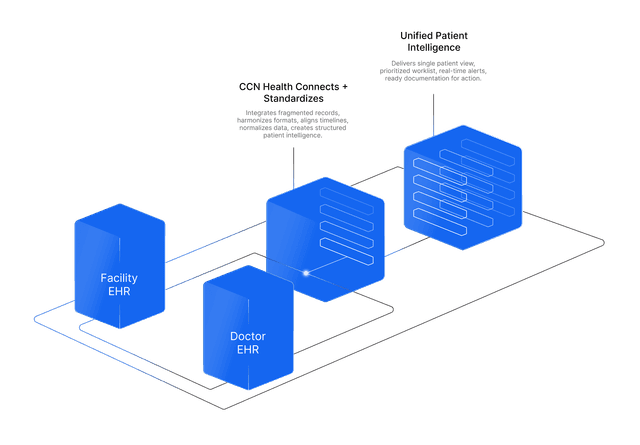
In assisted living environments where the community uses one EHR and the attending physician uses another, CCN Health bridges both systems. Overnight monitoring data flows simultaneously to the facility EHR (PointClickCare, ALIS, MatrixCare, August Health) for resident charting and to the physician EHR (athenahealth, Epic) for clinical review and billing documentation. No manual data entry or duplicate charting is required.
Billing Automation
CCN Health's platform tracks reading days, documents clinical review time, and generates billing-ready documentation for the physician practice. Because the XK 300 transmits data continuously, the 16-day threshold under CPT 99454 is met automatically for every enrolled resident every month. Combined with clinical time tracking for CPT 99457 and 99458, the full RPM billing cycle is handled without manual intervention from community staff.
Choosing the Right Solution for Your Community
There is no single correct answer for every assisted living community. The best choice depends on your resident population, clinical goals, budget, and operational capacity.
If your primary goal is bed-exit alerting on a budget, bed sensors may be sufficient — they are affordable, simple, and reliable for that specific use case.
If you need clinical-grade overnight data and Medicare billing, contactless radar is the strongest option. It delivers the physiologic measurements required for RPM billing, eliminates compliance variables, and provides the richest overnight clinical dataset.
If your residents are physically and cognitively capable, wearables can supplement contactless monitoring for residents who prefer a portable device — but should not be the sole overnight monitoring strategy for a community with any cognitively impaired population.
If you are considering cameras, weigh the regulatory, ethical, and family-acceptance implications carefully. Camera-based monitoring remains rare in assisted living bedrooms for good reason.
For communities that want the clinical depth, billing potential, and operational simplicity of contactless radar monitoring — with full EHR integration and managed clinical services — CCN Health's overnight monitoring program is purpose-built for assisted living.
Disclaimer: This article is for informational purposes only and does not constitute medical, legal, or billing advice. Device specifications, capabilities, and pricing are based on publicly available information and are subject to change. CPT code reimbursement amounts are estimates based on CMS published fee schedules and may vary by region, payer, and clinical circumstances. Fall statistics cited reflect general industry research and may not apply to every care setting. Always consult qualified healthcare, billing, and technology professionals for guidance specific to your community.
Let's figure this out together
We work closely with every client to find the right approach for their practice. Think of us as your partner, not just a platform.
Topics
Your Partner in Chronic Care
We love working closely with our clients to find the best solutions. Let us help guide you through the complicated stuff.
Why It Matters
Key Benefits
See how this approach drives measurable improvements across your organization.
Nighttime Fall Detection
Immediate alerts when residents exit the bed or fall during overnight hours — reducing response time from hours to seconds during the highest-risk period.
Continuous Vital Sign Trending
Heart rate and respiratory rate tracked throughout the night to detect developing respiratory distress, cardiac changes, and clinical deterioration.
Zero Resident Burden
Contactless sensors operate passively with no wearables, buttons, or actions required — monitoring works even for residents with cognitive impairment.
Night Staff Force Multiplier
Automated alerts and morning summary reports extend the reach of thin night-shift teams without adding headcount.
Privacy Preserving
Radar-based sensors capture no images, video, or audio — providing clinical monitoring without the dignity concerns of camera-based surveillance.
Medicare Revenue Generation
Overnight monitoring data qualifies for RPM billing under CPT 99454, generating $175+ per resident per month to offset program costs.
Continue Reading
Related Articles
Explore more insights on this topic.
CCN Health Launches Night Monitoring for Senior Living
CCN Health launches night monitoring for senior living, using contactless radar to track breathing patterns, sleep quality, and bed exits with automated alerts to night-shift staff.
CCN Health Partners with Xandar Kardian for Contactless RPM
CCN Health and Xandar Kardian partner to deliver contactless vital sign monitoring using 60GHz radar, enabling RPM for memory care and senior living residents.
Best Contactless & Sensorless Patient Monitoring in 2026
A comprehensive comparison of contactless and sensorless patient monitoring solutions in 2026 — covering radar-based technology, clinical applications, Medicare billing, and why CCN Health's Xandar Kardian integration leads for memory care and senior living.
Common Questions
Frequently Asked Questions
Get answers to the most common questions about this topic.
Contactless radar sensors are the best overnight monitoring technology for assisted living in 2026. They track heart rate, respiratory rate, sleep quality, and bed exits without requiring residents to wear or operate any device. CCN Health's Xandar Kardian XK300 integration is the leading solution, providing FDA-cleared 60GHz radar monitoring with automated alerts to night-shift staff, dual-EHR data flow, and Medicare RPM billing compliance.
Contactless overnight monitors use ultra-wideband radar to detect micro-movements of the chest wall caused by breathing and heartbeat. The sensor is mounted on a wall or placed on a bedside table and operates continuously through clothing and bedding. It captures heart rate, respiratory rate, sleep stages, bed presence, restlessness, and fall events — all without any physical contact with the resident or any action required on their part.
Yes. When overnight monitoring devices collect physiologic data (heart rate, respiratory rate) under a valid physician order for a resident with a qualifying chronic condition, the data counts toward the CPT 99454 16-day reading requirement. Because contactless sensors transmit data continuously, they meet this threshold automatically every month. The same clinical review requirements for CPT 99457 and 99458 apply.
Costs vary by technology type. Contactless radar sensors typically range from $300 to $800 per unit with monthly platform fees. Bed sensors cost $100 to $400 per unit. Wearable pendants range from $50 to $200 per unit. However, for qualifying Medicare beneficiaries, RPM billing can generate $175+ per resident per month — often exceeding total program costs within the first month of enrollment.
Yes. Overnight monitoring provides immediate alerting when a resident exits the bed or falls, reducing response time from the next scheduled round (which could be 1-2 hours) to minutes or seconds. Faster response times reduce the severity of fall-related injuries. Respiratory and heart rate trending can also detect early signs of clinical deterioration that contribute to fall risk, enabling proactive intervention.
Bed sensors use pressure-sensing pads placed under the mattress to detect weight changes and movement — they can tell when someone is in bed and when they leave, but they cannot measure vital signs. Contactless radar sensors use ultra-wideband radar to detect chest wall micro-movements, capturing actual heart rate and respiratory rate data in addition to bed presence and movement. Radar sensors also work when the resident is out of bed (detecting falls and room presence), while bed sensors only function when the resident is on the mattress.
Still have questions? We love helping practices figure this out — no pressure, just real answers.

Your Partner in Chronic Care
We're Here to Guide You Every Step of the Way
RPM, CCM, and chronic care management can get complicated. We work closely with every client to figure out the best solutions for their practice.